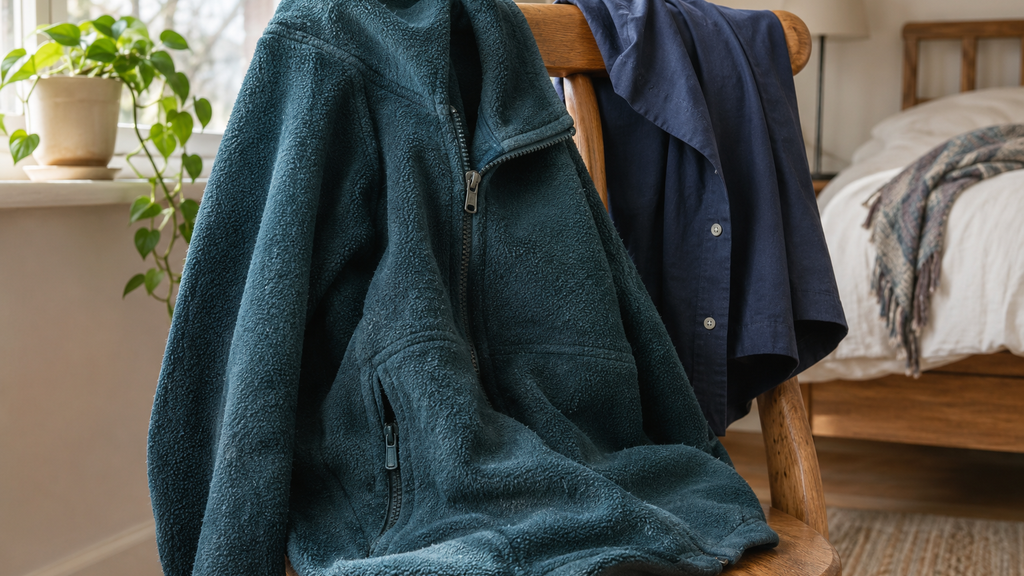
Clothes can shed fibres while you wear them, not only when they go through the wash. In a controlled experiment, volunteers wearing polyester garments released fibres that researchers collected as they settled around the room.[1] A separate laboratory experiment found that rubbing polyester fabric could also produce much finer fibre fragments.[2]
That gives us a reason to consider the fabric itself, rather than treating a washing-machine filter as the whole solution. It does not give us a personal inhaled dose, a diagnosis or a reason to throw out a useful fleece. The studies measured release and fabric damage, not whether changing clothes prevents illness.[1][2]
What did the wearing experiment actually collect?
Francesca De Falco and colleagues compared four commercial garments: a polyester blouse, T-shirt and dress, and a sweatshirt made from an equal blend of polyester and cotton. Four adult volunteers each tested all four garment types, giving 16 wearing trials. The garments were pre-washed before testing.[1]
Each volunteer performed a set sequence of movements for 20 minutes in a cleaned, closed room. Eight dishes lined with damp filter papers stood around the wearer to collect fibres settling out of the air. Researchers examined those fibres under a microscope and used infrared spectroscopy on subsamples to check their composition.[1]
This was a settling-fibre experiment, not a pump drawing a measured volume of air through a breathing-zone filter. The researchers counted fibres on the collectors, scaled the deposition to the room's floor area and normalised the result to garment mass. They did not measure the number entering a volunteer's mouth or nose.[1]
The compact woven polyester blouse shed fewer collected fibres than the other garments under these conditions. But the garments differed in several ways at once, including knit versus weave, yarn twist and whether the yarn contained short fibres or continuous filaments. This was not a clean experiment changing only one construction feature.[1]
There is also an easily missed material distinction. For the blended sweatshirt, just one of the 32 collected fibres checked by infrared spectroscopy was polyester; the others were cellulosic. Its total fibre count therefore cannot honestly be called a plastic-fibre count. Nor does checking that subsample chemically identify every fibre collected during every trial.[1]
The manuscript we read is the university-hosted accepted version, rather than the final typeset paper. Its methods support the finding that fibres can leave garments during wear, but its small selection of clothes cannot rank an entire wardrobe.[1]
How rubbing can split a polyester fibre
A different question is whether ordinary friction merely shakes loose existing fragments or creates new ones. Yaping Cai and colleagues investigated this using polyester fleece and interlock fabric swatches, pre-washed to remove much of the loose manufacturing debris.[2]
They used a Martindale abrasion tester, rubbing each fabric against the same type of fabric under controlled pressure for 5,000 rubs. Afterwards, they rinsed the apparatus and used a laboratory washing procedure with a surfactant solution to extract fragments still held in the textiles. Electron microscopy revealed both fibre-sized fragments and much thinner, tape-like pieces called fibrils.[2]
The images showed splitting at some fibre ends after abrasion, supporting a mechanism in which repeated rubbing can make finer fragments. The authors also distinguish this from mobilising fragments already embedded in the yarn. More extractable material after rubbing need not mean every piece was newly created by that rubbing.[2]
Crucially, these were fragments recovered from the apparatus and by subsequent liquid extraction, not a measured cloud of airborne fibres from someone wearing a fleece. The authors explicitly caution that the machine only partly simulates real use over time.[2] A count extracted after 5,000 rubs cannot be relabelled as the number you breathe during a walk.
A follow-up complicates the shopping advice
A later experiment by Tong Yang and colleagues extended the abrasion work to 12 polyester textiles. It shares senior investigator Bernd Nowack with the earlier abrasion paper, so it is a follow-up experiment, not independent-team replication.[2][3]
The follow-up found substantial variation between individual fabrics. However, grouping them as woven, knitted or surface-treated did not produce statistically significant differences in the paired group comparisons. One surface-treated fabric could not be included in the quantitative comparison because its overlapping debris could not be counted reliably.[3]
That does not cancel the lower shedding observed for one blouse in the volunteer study. It shows why the finding should not become a universal rule that woven clothes always shed less than knitted ones. The experiments used different fabrics, stresses and collection methods.[1][3]
The follow-up also changed how results were normalised: for its per-gram comparison it used the small rubbed specimen rather than combining that specimen with the larger opposing fabric. The authors identify this as a reason its reported per-gram figures were higher than the earlier work.[3] Those numbers are not interchangeable emission ratings, even though both papers used a similar abrasion machine.
Does a smaller fragment establish a health risk?
Finer fragments are worth investigating because their movement through air and possible inhalation may differ from those of larger fibres. But a physical width seen in an electron microscope is not, by itself, a measurement of aerodynamic behaviour or lung deposition. The abrasion paper specifically calls for further work on those questions.[2]
None of these experiments followed clothing wearers for clinical outcomes or tested whether replacing a fleece reduces disease. The volunteer study measured deposited fibres; the abrasion studies measured fragments recovered after controlled rubbing and extraction.[1][2][3] Laboratory or animal findings discussed in a paper's introduction do not turn its textile measurements into demonstrated human harm.
For the separate question of what room-air measurements can establish, see our guide to microplastics in indoor air. That distinction matters before comparing a settling collector with a suspended-air concentration.
What is reasonable to do with your clothes?
There is no validated low-shedding shopping rule in these studies, but they suggest better questions and some proportionate choices.
- Ask for evidence about the actual fabric. If a seller claims a garment is low-shedding, ask whether it was tested during abrasion, laundering or wear, and whether the result reports all fibres or plastic specifically. A broad material label cannot capture the differences these experiments found.[1][2][3]
- Do not replace a serviceable wardrobe on the strength of a particle headline. These experiments do not compare the full environmental costs of keeping clothes with buying replacements, and they establish no health benefit from a wardrobe clear-out.[1][2][3] Our recommendation is to keep useful clothing and consider durability when a replacement is genuinely needed.
- Follow the care label rather than trying to scrub away loose fibres. The abrasion experiments show why deliberately rough treatment is a poor basis for a microfibre remedy. They do not test a household treatment that makes polyester stop shedding.[2][3]
- Keep laundry measures in their proper place. A drain-water filter addresses material leaving the washer, not fibres released during wear.[1] Our guide to microfibres from washing clothes covers that separate stage and the limits of filter claims.
Choosing cotton instead would change the material, but would not mean choosing a fibre-free garment: the blended sweatshirt experiment recovered many cellulosic fibres.[1] The studies here do not establish a universal environmental winner between cotton and polyester.
The useful takeaway: wearing and rubbing clothes are part of the microfibre story. Fabric design deserves attention alongside washing, but a laboratory shedding result is not a personal exposure meter. Ask how a garment was tested before trusting a low-shedding label, and do not confuse smaller recovered fragments with proven harm from ordinary wear.[1][2][3]
Sources
- https://pearl.plymouth.ac.uk/cgi/viewcontent.cgi?article=1656&context=bms-research
- https://dora.lib4ri.ch/eawag/dload/eawag%3A22774/PDF/Cai-2021-Formation_of_fiber_fragments_during-(published_version).pdf
- https://dora.lib4ri.ch/empa/dload/empa%3A34226/PDF/Yang-2023-Formation_of_microplastic_fibers_and-(published_version).pdf