Airborne microplastics have been measured in homes, workplaces and cars. That does not tell you how many particles you personally inhale, whether they stay in your lungs, or whether cleaning your flat will prevent a specific illness.[1][2] The measurements are worth understanding, but the practical advice is modest: manage ordinary indoor dust and ventilation sensibly, without treating every fibre as a medical emergency.[3][4]
Air sampling is not the same as dust sampling
Researchers can pump a measured volume of room air through a filter and report particles per cubic metre.[1] That is active air sampling, a snapshot of particles suspended during the collection period.[1] They can also leave a collector exposed to particles settling out of the air, then report deposition per square metre per day.[1] That is passive sampling. Neither number is interchangeable with the other, and settled household dust collected from a floor is yet another sample type.[1]
A Birmingham study collected both active air and passive fallout samples in 30 homes and 30 workplaces.[1] It found plastic polymers in the samples, but the active and passive results used different units and captured different size distributions.[1] The homes in that study were all carpeted, while some workplaces were not.[1] That association is a clue about possible indoor sources, not proof that removing your carpet will lower your exposure by a predictable amount.[1]
The size limit matters as much as the headline count. The Birmingham team's airborne results were dominated by particles in the 10 to 25 micrometre range; larger particles were more prominent in the settling samples.[1] A later study in France deliberately targeted much smaller suspended particles, roughly 1 to 10 micrometres, using Raman spectroscopy.[2] It collected seven residential samples from three apartments and five car samples from two cars.[2] With those different size windows and small, different samples, comparing the two studies' particle counts as if they were rival readings of a standard home would be misleading.[1][2]
How does a lab know a speck is plastic?
A microscope can locate a candidate fibre or fragment, but appearance alone is not a reliable polymer identification.[2] The French researchers collected air on filters, analysed candidates with Raman spectra and matched them against reference spectra.[2] They also used blank filters to check whether handling and laboratory materials had contributed particles.[2] They analysed only a small part of each filter and extrapolated to the whole filter area, a necessary but consequential assumption in that method.[2]
Those controls are not academic fussiness. In the French study, particles found in blank samples required a correction; its results also depended on recovery testing and extrapolation.[2] A reader seeing a daily inhalation estimate should ask what sizes the equipment could detect, what volume of air was sampled, whether polymers were chemically identified, and how contamination was handled. A particle count is conditional on those choices, not a universal exposure score.[1][2]
The studies also cannot tell you which item in your room shed each identified particle. Synthetic furnishings and carpets are plausible contributors, but outdoor air and other activities can add particles indoors too.[1][3] A plastic particle found on a filter is evidence of presence in that sampled environment. It is not a tracing result for a particular chair, jumper or rug.
What about health?
Small particles may be inhaled deeper than larger settled fibres, which is one reason researchers are trying to measure them better.[2][3] But detection in air is not a demonstrated human disease outcome. Neither of these two indoor sampling studies followed residents for clinical outcomes or tested whether a household intervention reduced microplastic-related illness.[1][2] Laboratory and animal findings can suggest mechanisms worth investigating; they cannot by themselves establish the size of any health risk from ordinary home exposure. A measurement of air is not a medical test for the people breathing it.
There is a separate, better-established reason to care about indoor air: particulate matter contains many substances besides plastic. The US Environmental Protection Agency advises reducing indoor particle sources, cleaning settled dust and using suitable filtration, while noting that outdoor pollution can also come in through windows.[3][4] Do not transfer known health findings for the whole particulate-matter mixture to microplastics alone.
What is reasonable to do now?
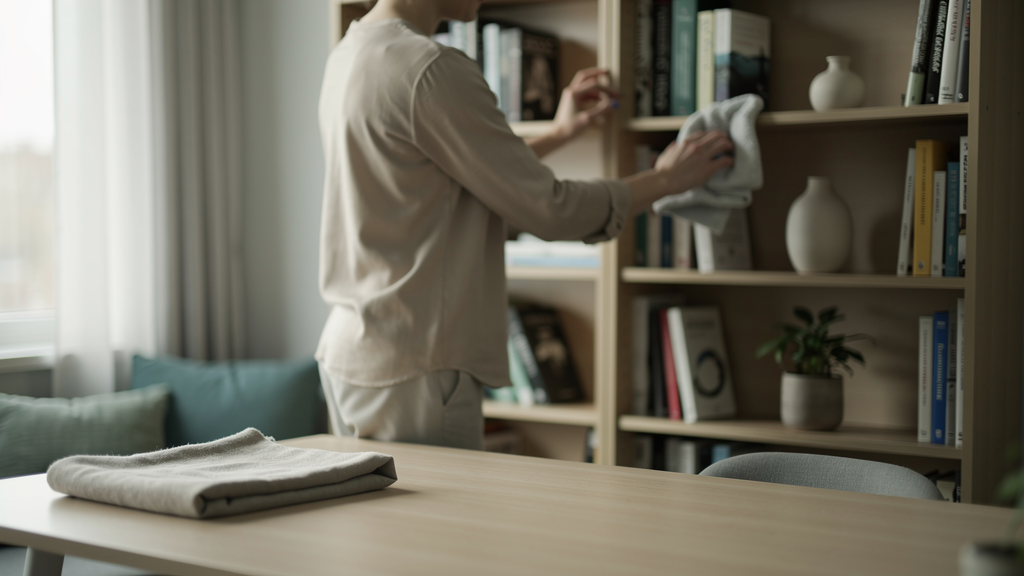
- Clean without throwing dust back into the air. Use a damp cloth for settled dust and vacuum carpets and furniture regularly. EPA suggests considering a HEPA-filter vacuum, which can help keep some captured dust from escaping again. This is general dust-control advice, not a measured microplastic health treatment.[3]
- Ventilate when the air outside is suitable. Fresh outdoor air can dilute indoor pollutants, but opening windows beside heavy traffic, smoke or another local pollution source can bring particles in. Adapt to current outdoor conditions rather than following a blanket rule to leave windows open.[3]
- Treat filters as supplements, not guarantees. A portable air cleaner should have a particle clean-air delivery rate appropriate for the room; HVAC filtration must suit the system, and filters need replacing. EPA says these devices can reduce indoor pollution but cannot remove every pollutant. The guidance does not establish that a particular purifier lowers your personal microplastic burden or prevents illness.[4]
- Do not buy a number without a method. If a test kit or product promises to make your home "microplastic-free", ask for the detection size, polymer-identification method, blank controls and independent before-and-after results in real rooms. An ordinary PM monitor does not chemically identify microplastics.[1][2]
For the wider exposure picture, read our overview of food and air pathways. If you are considering a personal test, see the limitations of human microplastic diagnostics. Those are different questions from measuring a room's air.
Bottom line: Indoor air can contain identified plastic particles, but published counts change dramatically with the sampling method and minimum particle size.[1][2] Damp dusting, appropriate vacuuming and sensible ventilation are worthwhile indoor-air habits. No study cited here shows that they prevent a microplastic-specific disease.[1][2][3]