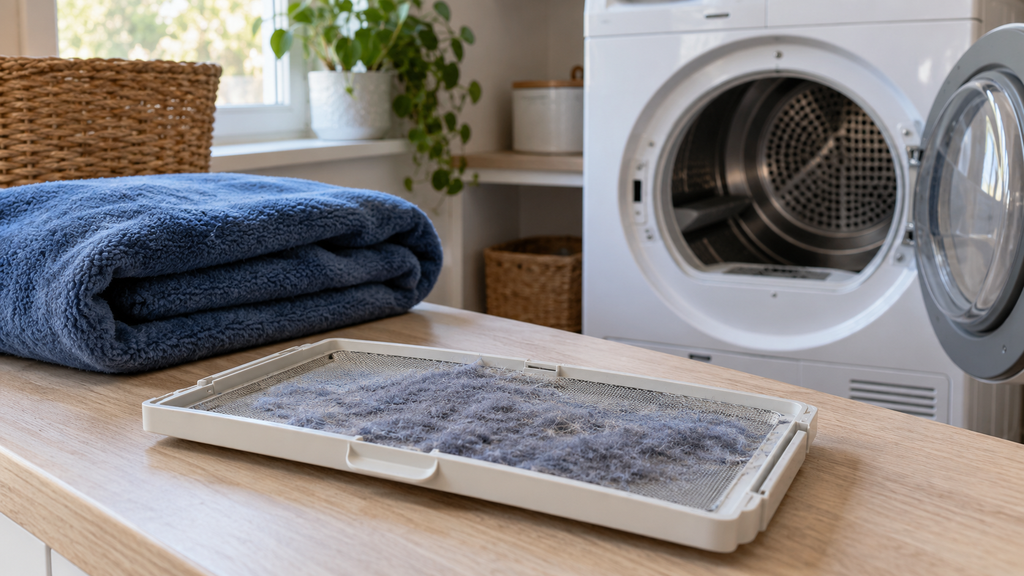
Tumble dryers can shed fibres from clothes, catch some in the lint filter and send others along a different route: through an exhaust vent, onto internal components or into collected water.[1][2][3] For synthetic textiles such as polyester, those shed fibres can be microplastics; a mixed load also releases non-plastic fibres, including cotton.[1][3]
The most useful household action is to deal carefully with the lint you can already collect. Where your appliance instructions allow dry cleaning, remove it into household rubbish rather than rinsing the whole layer down the sink.[3] Keep the filter and ventilation system properly maintained. Trying to catch more fibres must not mean restricting the dryer's airflow.[4]
The lint filter is a collection point, not the whole result
In a study of selected synthetic textiles, Niina Kärkkäinen and Markus Sillanpää ran five successive washing and tumble-drying cycles, collecting dryer fibres from the lint filter and weighing them.[1] Fleece fabrics generally lost more fibre mass during drying than the technical sports shirts tested.[1] Fabric construction mattered: the results were not a simple rule that every polyester garment sheds the same amount.[1]
The first drying produced between 10 and 1,700 milligrams of collected fibres per kilogram of textile across the tested materials.[1] That is a range of lint-filter measurements, not a measured quantity escaping into a room or river.[1] The researchers did not collect all airborne and waterborne outputs from the dryer, so those results cannot establish its complete environmental release.[1][3]
This distinction matters when a headline says drying releases more fibres than washing. In that study, comparing the two stages required converting washer fibre counts to estimated mass, while dryer lint was weighed directly; which stage was larger also depended on the textile.[1] A lint-filter total cannot simply be treated as pollution discharged outdoors, because the filter has retained that material. What happens when someone cleans it is another part of the story.[1][3]
For the washing stage, including bags and drain filters, see our guide to microfibres from washing clothes. This article follows the fibres after drying instead.
Vented dryers: fibres can leave through the exhaust
A vented dryer provides an air route out of the appliance. Kapp and Miller investigated two home-installed electric dryers in the United States, using bright pink polyester fleece blankets so that their fibres could be distinguished from background material.[2] They sampled fresh snow around the exterior vents and separately collected lint leaving the exhaust.[2]
Pink fibres matching the blankets were recovered from snow plots, including plots at the furthest sampled distance of 9.14 metres from the vents.[2] That establishes a local release and deposition pathway under those test conditions. It does not mean all dryer fibres travel that distance, or that this was their maximum possible travel distance.[2]
The experiment was deliberately narrow. It involved two installations, new fleece blankets and wintry outdoor conditions, not a representative survey of mixed household laundry in every climate.[2] Blankets were wetted by soaking rather than put through a normal washing-machine cycle first.[2] Identification relied on colour and morphology; the researchers did not chemically confirm the sampled fibres using FTIR or Raman spectroscopy.[2]
Those limits do not erase the observed release. They do mean the study should not be used to calculate the number of particles a person in a different home inhales. It measured exhaust and deposition, not individual breathing exposure or illness.[2]
Condenser dryers: look at the water as well as the air
Removing the outdoor exhaust route does not make fibre management disappear. A later study by Cummins and colleagues examined a condenser dryer at three collection points: its lint filter, condenser and condensed water.[3] It also tested a vented dryer, collecting material at its lint filter and exhaust.[3]
The experiments included repeated drying of new cotton and polyester T-shirts, plus separate mixed laundry loads supplied by UK households.[3] With the household loads, the condenser dryer's lint filter retained an average of 91.1% of the measured fibre mass, while the vented dryer's retained 86.1%.[3] These are results for the particular appliances, programmes and loads tested, not ratings for every condenser or vented dryer.[3]
The material passing the condenser dryer's lint filter was found on the condenser and in its water.[3] If collected lint is also rinsed into the sink, material that the filter successfully captured is deliberately moved into wastewater.[3] That is why dry removal of the loose lint can matter even when you have no choice about the appliance you use.
There are two further qualifications. The study measured textile microfibres, not plastic alone; cotton made up much of the counted material in its controlled cotton-and-polyester tests.[3] It also did not test heat-pump dryers. The authors discuss similar possible water pathways in those designs, but their measurements are not a head-to-head test of heat-pump machines.[3]
The paper discloses Procter & Gamble funding and three authors employed by the company, which sells fabric-care products.[3] The earlier snow-sampling paper also discloses that one author co-owned a washing-machine fibre-catching product.[2] These are relevant interests to keep in view, particularly when reading product recommendations. Neither paper is a reason to buy a specific additive or accessory.
Is line-drying a proven microplastic solution?
Choosing a rack or line avoids running the tumble-drying stage for that load. It does not establish that the clothes release no fibres, or quantify how much total environmental release changes.
The snow-sampling study explicitly did not compare alternative drying methods.[2] The synthetic-textile experiment measured fibres during machine washing and tumble drying, while the condenser study compared selected tumble-dryer designs; neither supplies a universal line-drying reduction percentage.[1][3]
Air-drying suitable items is a reasonable option where your space, garment care instructions and conditions permit. Treat it as a practical choice, not a promise to make your home microplastic-free. There is no basis in these experiments for replacing a working dryer solely to achieve a claimed personal health benefit.
A routine that keeps collection useful
- Remove loose lint as dry waste where permitted. Use the cleaning method allowed for your particular filter and put the collected material in household rubbish, subject to local disposal guidance. The condenser study recommends hand removal or vacuuming rather than flushing the collected fibres into the drain.[3]
- Keep necessary maintenance. If your manual requires washing a component, remove loose lint first where permitted, then follow the instructions. Do not skip cleaning to avoid releasing fibres. US Fire Administration guidance says to clean the lint filter before and after each cycle and keep venting undamaged and unrestricted.[4]
- Do not improvise a finer exhaust filter. Keep the manufacturer's filter in place and ask the manufacturer about approved options rather than fitting cloth, bags or extra mesh to the vent. Unrestricted venting is a fire-safety priority, not an optional environmental trade-off.[4]
- Be sceptical of a percentage without a collection point. Ask whether a product test measured lint caught inside the machine, fibres in exhaust or fibres in water, and whether it reported mass, count or plastic specifically. The studies above measured different outputs, so their results are not interchangeable.[1][2][3]
Household rubbish is a disposal route, not destruction of the fibres. The condenser study itself flags the need to consider their ultimate fate after collection.[3] The narrower aim here is to avoid needlessly sending captured lint into another environmental pathway.
Bottom line: Dryer lint, outdoor exhaust and condenser water are different destinations, and a useful comparison has to say which one was measured.[1][2][3] Collect the lint you can, follow the appliance's maintenance instructions and avoid obstructing airflow. These are environmental-release and appliance-care measures, not demonstrated treatments for microplastic-related disease. None of these dryer experiments measured a reduction in human illness.[1][2][3]
For the separate question of what room measurements tell us about exposure, read microplastics in indoor air.