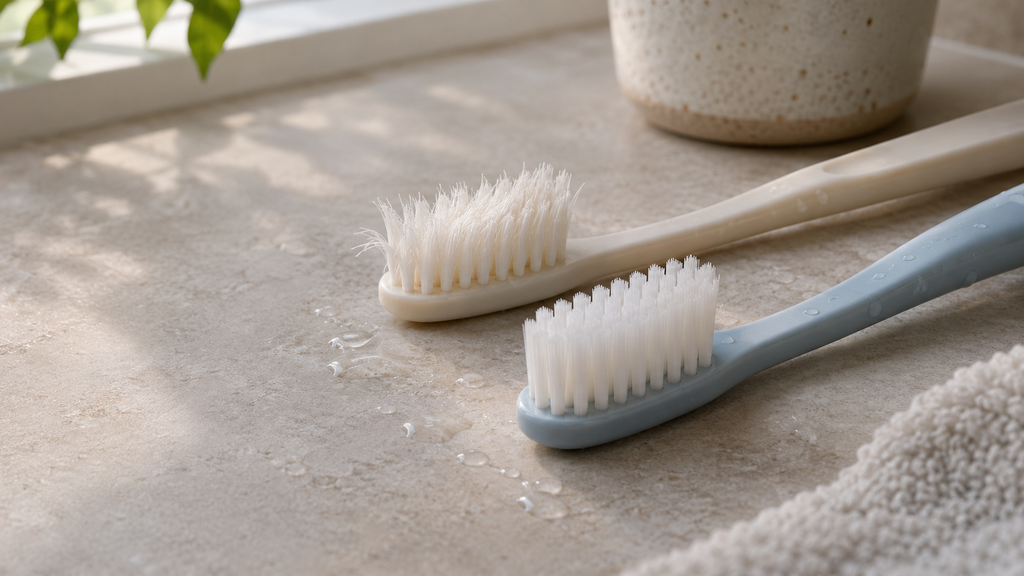
Toothbrush bristles can shed microplastics in laboratory brushing tests. Two small original studies identified plastic material released from brushes, but neither measured a person's swallowed dose or showed that brushing causes disease.[1][2]
That distinction matters because the wrong response would be to brush less. The American Dental Association's patient guidance on microplastics explicitly advises against cutting back on brushing and interdental cleaning while research continues.[4] Our recommendation is to keep normal dental care, check your brush's condition and question any promise of a microplastic-free alternative that lacks relevant testing.
What happens when bristles wear?
A toothbrush's bristles bend and rub against surfaces during use. Researchers have examined worn bristle surfaces and recovered detached material, using spectroscopy to distinguish plastic from other debris.[1][2] This is a question about wear of an object, not simply whether a toothpaste intentionally contains plastic particles.
Material identification is important. A microscope can reveal a fragment, but its appearance alone does not establish that it is plastic. In the toothbrush studies, infrared or Raman spectroscopy provided chemical information alongside images.[1][2] These methods also have limits: the size of the scanned area, the selection of particles and interference from other ingredients affect what a result can tell us.[1][2]
The seven-day simulated-brushing study
In a 2025 paper, Çağla Öztürk Aytulun and colleagues tested medium-bristled toothbrushes from six brands sold in Türkiye.[1] They used a zirconia dental arch made from a digital scan, rather than brushing human teeth.[1] One trained operator brushed the model twice daily for two minutes over seven days, collecting filtered-water rinses for analysis.[1]
The team deliberately omitted toothpaste to avoid interference from toothpaste-derived particles.[1] This made it easier to investigate the brush, but also made the setup different from a mouth containing toothpaste and saliva. It was a short, small experiment, not a survey of ordinary brushing across ages, techniques and products.[1]
Microscopy screened the collected material. Infrared analysis characterised the brush components, while micro-Raman spectroscopy investigated recovered particles and found polymers matching bristle materials, including nylon and polybutylene terephthalate, or PBT.[1] The authors state that examining every particle spectroscopically was impractical.[1] A total seen under the microscope must therefore not be treated as a total in which every item was independently confirmed as plastic.
The researchers reported release from all six tested brands, with substantial differences between products.[1] They also described possible overcounting from material already adhering to brushes, carry-over between trials and airborne contamination, and excluded contamination identified in blanks from their final results.[1] Controls reduce those problems; they do not make a selected set of products representative of every toothbrush on sale.
This experiment supports a specific finding: the tested brushes released identifiable plastic material under these simulated conditions. It does not establish a daily dose for someone using a different brush at home.[1]
Why another paper produced much larger estimates
A 2023 study by Cheng Fang and colleagues focused on Raman imaging and the difficulties of identifying plastic within mixed material.[2] Its main used-brush examples came from two volunteers, one supplying a manual brush and the other an electric brush, with new brushes of the same brands as controls.[2] This was far too small a sample for a manual-versus-electric ranking.
The researchers cleaned the used brushes with laboratory solvents and water. To collect detached material, they brushed glass slides for about three minutes without toothpaste or water.[2] They explain that attempts to identify brush particles in mouth-cleaning waste were frustrated by toothpaste and saliva debris.[2] The simplified glass-slide collection was therefore not a measurement of what either volunteer swallowed.
The large release estimate came from counting particles in a small image area, scaling to a whole slide under an assumed uniform distribution, then applying an estimated polyamide fraction from selected Raman analyses.[2] The authors acknowledge that the distribution might not be uniform, that the plastic fraction could vary and that more samples were needed.[2]
Raman imaging also distinguished polyamide from titanium oxide used as a pigment.[2] A pigment signal is not, by itself, identification of a plastic particle. The paper's discussion of very fine structures also warns about interference, signal variation and imaging resolution.[2] We would not use it to assign a precise nanoplastic dose to your morning routine.
The two studies consequently cannot be compared as if they measured the same thing with interchangeable counters. A filtered-water collection from a model arch and a dry glass-slide experiment differ in surfaces, preparation and analysis.[1][2] Both support release; their totals do not define a universal brushing exposure.
Our tea-bag evidence review explores another case where counting and chemical identification need to be kept separate. The chewing-gum article examines a different oral-contact activity, including the distinction between particles collected in saliva and material actually swallowed.
Did these experiments demonstrate a health risk?
Neither study followed people for gum disease, measured absorption into their tissues or tested whether replacing a brush improved health.[1][2] Their direct evidence concerns material release and identification, not a demonstrated human outcome.
The 2025 paper also calculated a polymer hazard index and discussed inflammation research.[1] That index is not a clinical prediction of your chance of illness. Biological possibilities discussed using other research do not become health effects observed in the brushing experiment.
The ADA's 2026 patient guidance says that the extent of release from oral-care products, how much enters the body and the implications for health still need research.[4] Uncertainty does not prove that every released particle is harmless. It also does not justify abandoning established dental care or buying a product on the promise that it prevents microplastic-related disease.
What to do with your toothbrush
Keep brushing normally. The ADA recommends two minutes twice a day with fluoride toothpaste, a soft-bristled brush and gentle pressure.[3] Its microplastics guidance does not advise reducing brushing or flossing.[4] Soft bristles and gentle technique are dental-care recommendations, not a proven percentage reduction in plastic release.
Use the established replacement advice. Replace a brush approximately every three to four months, or sooner if the bristles become matted or frayed, unless your dentist advises otherwise.[3] The 2023 paper suggests frequent replacement, but did not test a schedule that minimises exposure.[2] The 2025 experiment often found a higher initial release followed by a decline, which likewise does not establish an optimal replacement interval.[1] Neither finding justifies replacing a brush after every use or keeping a visibly worn one indefinitely.
Clean and store it normally. The ADA recommends thoroughly rinsing the toothbrush after use, storing it upright and allowing it to air-dry.[3] Do not copy the solvents used for laboratory sample preparation. That procedure was part of an analytical method, not validated home toothbrush care.[2]
Ask about bristles as well as handles. A wooden or bamboo handle does not answer the separate question of what the bristles contain. Request a material specification and relevant finished-product testing before accepting a zero-release claim. Natural bristles are not automatically the better dental choice: the ADA notes that some, such as boar hair, may be too stiff and that some natural materials dry more slowly.[4]
If a seller claims unusually low shedding, ask which product was tested, under what brushing conditions, across what particle-size range, with what chemical identification and contamination controls. A photograph of an intact head or a handle-material label cannot answer those questions.
For now, the useful conclusion is modest. Toothbrush wear deserves better product testing, but the available experiments do not supply your personal dose, identify a universally best material or overturn normal brushing advice.[1][2][4] Keep your teeth clean and judge the evidence behind the product claim.
Sources
- https://avesis.medipol.edu.tr/yayin/556f459c-0015-41c3-b373-a21510d802b5/preliminary-results-on-microplastic-release-from-commercial-toothbrushes-during-simulated-brushing/document.pdf
- https://www.sciencedirect.com/science/article/pii/S0269749123015129
- https://www.ada.org/resources/ada-library/oral-health-topics/toothbrushes
- https://jada.ada.org/article/S0002-8177(26)00185-6/pdf