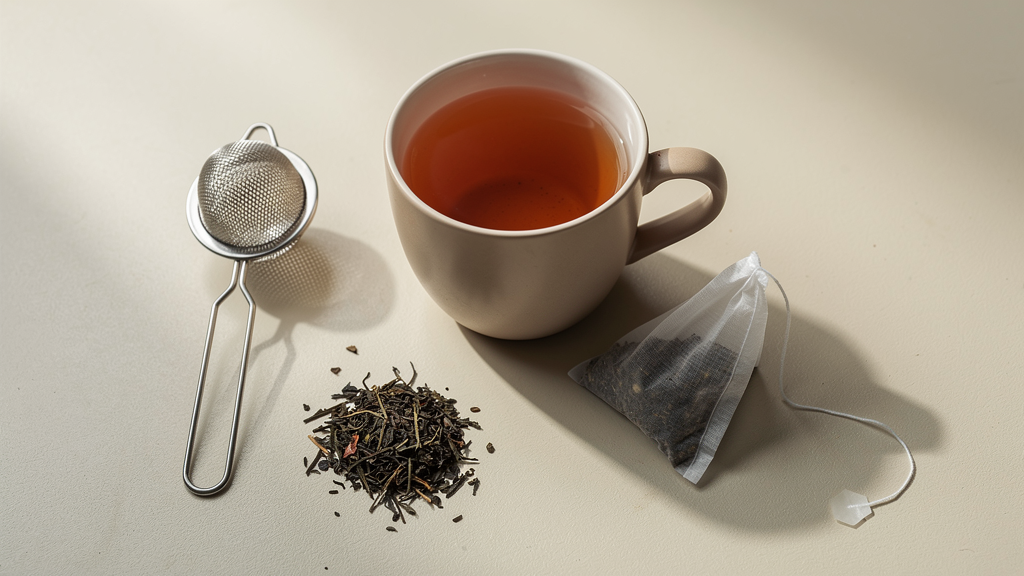
If your tea comes in a silky, mesh pyramid bag, the bag may be made from plastic. Laboratory researchers have found plastic particles in hot-water extracts from some such bags.[2][9] That is a reason to ask what the bag is made of, not a reason to assume every cup contains billions of confirmed plastic particles. The best-known estimate has been challenged by scientists who measured very different numbers and questioned what had actually been counted.[2][4][5]
An easy choice, if you want to avoid steeping a plastic mesh bag, is loose-leaf tea in a reusable metal infuser. It removes that particular bag from the cup. It has not been shown to prevent a disease, and it cannot make the rest of your diet or environment free of microplastics.[6]
Where did the "billions per cup" headline come from?
A 2019 study tested nylon and polyethylene terephthalate (PET) tea bags in hot water. The researchers reported roughly 11.6 billion microplastic particles and 3.1 billion nanoplastic particles released per bag at 95°C.[9] They used microscopy to count particles and analysed the material collected from the liquid with techniques that found chemical signatures matching the bags.[9][4] They also exposed water fleas to the collected particles and reported behavioural and developmental effects. Water fleas are not people, and this experiment was not a test of human tea drinkers.[9]
There is a detail the headline misses. The team emptied and rinsed the bags, then steeped three empty bags in a small volume of water before estimating a figure per bag.[4][5] That controlled extraction helped them study the packaging, but it was not a survey of ordinary cups brewed with tea leaves, different brands and household water.[4][5] The result belongs to those materials and conditions, not every tea bag on a supermarket shelf.
Why other scientists objected
A 2020 published comment by a different research team challenged the way the original particles were identified.[2] Microscopy can show a particle without establishing its chemical identity. The original study identified polymer signatures in bulk dried material, but that does not prove that each particle counted was plastic.[2] The critics suggested that soluble short-chain plastic compounds, called oligomers, might crystallise when an extract dries and be counted as particles.[2]
The critics ran their own test with a nylon bag and identified individual particles above one micrometre using micro-Raman spectroscopy. They reported 5,800 to 20,400 plastic particles per bag in that size range, compared with the original team's estimate of 2.3 million above one micrometre.[2][5] Those numbers are not a neat head-to-head replication. The bags, water volumes, filtering steps and counting methods differed.[2][4] The critics also found plastic particles, so their result is not "tea bags release nothing".[2]
The original authors replied in the same journal.[4] They said they had also counted particles in liquid without drying it, using nanoparticle tracking analysis, and obtained a similar order of magnitude for the smaller particles. That rebuts a simple explanation in which all small particles appear only when a sample dries.[4] They argued that filtering in the critics' method could lose particles, and that different bags and volumes prevent a direct comparison.[4] Their bulk chemical analysis, however, still does not identify every counted particle individually.[2][4]
The German Federal Institute for Risk Assessment (BfR), whose researchers participated in the critique, reviewed the dispute in 2025. It continues to judge the original headline count too high and the drying method unsuitable for identifying individual microplastics.[5] That is the institute's assessment, not a universally settled number. The fair reading is narrower: plastic particles have been detected, but the size of the release and the source of each counted particle remain contested.[2][4][5]
Are all bags the same?
No. "Tea bag" describes a package, not a single material. The 2019 experiment concerned plastic nylon and PET bags; the later studies did not establish an amount for all brands or for plain paper bags.[5][9] A mesh bag can look like fabric without telling you whether it is nylon, PET or another material. If the packaging does not specify the bag material, appearance alone is a poor test.
A separate 2024 study tested three plastic-based filter bags and used Raman imaging for larger particles and pyrolysis-based chemical analysis for smaller material.[12] It reported a range of 80 to 1,288 micron-sized particles per bag under its methods, while measuring the submicron fraction by mass, not as a comparable number of particles.[12] It found that the woven nylon bag in its sample released less than the nonwoven bags.[12] That does not settle the 2019 dispute: different bags, size thresholds and methods produce numbers that cannot simply be stacked on one scale.[2][4][12]
For another kitchen example, our guide to reheating food in plastic containers separates measured particle release from health claims. The wider exposure overview puts food-contact questions alongside other routes.
What should a tea drinker do?
- If avoiding plastic contact is your goal, brew loose leaves with an existing metal infuser. That avoids using a plastic mesh bag without making a medical claim.
- If you prefer bags, check the manufacturer's stated bag material rather than relying on the words "silky", "plant-based" or "biodegradable". Those words alone do not identify the polymer or prove zero particle release. A paper-looking bag can have other components, so ask the maker if the packaging matters to you.
- Do not treat the 11.6-billion figure as your personal dose. It came from one experimental approach and has a published methodological challenge and response.[2][4][9]
- Do not throw away ordinary food safety judgement to chase a particle count. A cup of tea is not a clinical exposure test.
The US Food and Drug Administration says current evidence does not demonstrate that the levels of microplastics or nanoplastics detected in food pose a human health risk, while noting major gaps in measurement and health-effect data.[6] That is neither proof of harm nor a guarantee of harmlessness. A metal infuser is a modest, low-fuss choice if this particular exposure worries you; the science does not justify a health-risk number for your cup.[2][5][6]
Sources
- https://pubs.acs.org/doi/full/10.1021/acs.est.0c03182
- https://pubs.acs.org/doi/10.1021/acs.est.0c06422
- https://www.bfr.bund.de/en/notification/bfr-assesses-study-on-tea-bags-and-microplastic-particles
- https://www.fda.gov/food/environmental-contaminants-food/microplastics-and-nanoplastics-foods
- https://pubs.acs.org/doi/10.1021/acs.est.9b02540
- https://doi.org/10.1016/j.foodchem.2024.138740