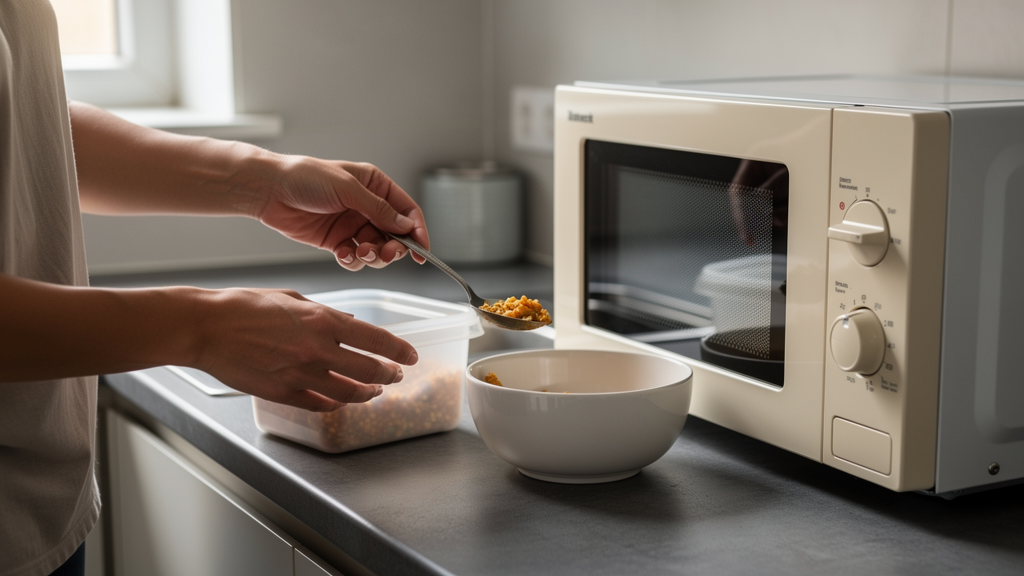
If you have a choice, move food from a plastic storage tub to a microwave-safe glass or ceramic dish before reheating it.[1][8] This is a simple way to avoid heating the plastic alongside the meal. It is a precaution, not a proven way to prevent illness: scientists have measured particles released by some heated containers, but have not established that the amounts people encounter from reheated food cause a particular human disease.[1][9]
The microwave itself is not the villain. A published follow-up found similar orders of particle release when polypropylene containers were heated in a microwave and in a water bath at comparable heating rates.[3][7] Heat and the container matter more than a blanket claim that microwave radiation has a special effect.[3][7]
What was actually tested?
In a 2023 laboratory study, researchers bought two polypropylene baby-food containers and one reusable polyethylene pouch.[1] They filled them with purified water or dilute acetic acid, used as stand-ins for watery and acidic foods.[1] The containers went through storage and heating conditions; the pouch was not microwaved because it was unsuitable for that use.[1] The microwave test ran for three minutes at 1,000 watts.[1]
The researchers measured particles in the liquid after each test and used Raman spectroscopy to identify polypropylene in samples from the containers.[1] Under their test conditions, microwaving the containers produced more counted particles than the storage conditions they compared it with.[1] The two containers did not behave identically.[1] That is an important reason not to transfer a headline particle count to every takeaway tub or every meal.[1]
Water and dilute acid are controlled food simulants, not a lasagne, soup or infant meal.[1] The work shows release under particular laboratory conditions.[1] It does not measure the number of particles a particular person swallows over a year, nor does it establish a safe or harmful dose.[1][9] Even the paper's infant and toddler intake figures are modelled estimates built from its measured samples and assumed consumption patterns, not measurements in children.[1]
A useful correction to the microwave headline
A 2024 correspondence tested three other polypropylene baby-food containers with microwave and water-bath heating at comparable rates.[3] Its authors reported particle releases in the same order of magnitude across the two methods.[3] Their point was not that the original experiment was false, but that its comparison of a hot microwave condition with cooler storage cannot separate the effects of heating method from temperature.[3]
The original researchers replied that the comparison clarified their result: rising temperature is a major driver, and hot plastic containers can still release particles whichever method heats them.[7] That is the sensible reading of the exchange.[3][7] It does not prove that every microwave-safe plastic container releases the same amount, or that conventional heating in plastic solves the problem.[3][7]
Particle measurement is difficult, particularly at the smallest sizes.[9] The US Food and Drug Administration says the field still lacks standardised, validated methods and that current evidence does not demonstrate that the levels of microplastics and nanoplastics detected in food pose a human health risk.[9] That is not a declaration that exposure is harmless; it is a statement about the evidence available to assess risk.[9]
The 2023 team also placed particles recovered from a heated container onto cultured human kidney cells.[1] At its highest laboratory concentration, cell viability fell sharply.[1] A dish of cells exposed directly to a concentrated preparation is not a clinical study of someone eating reheated dinner.[1] The authors themselves said the concentration used was substantially higher than the concentration released.[1] It would be misleading to convert the cell result into a risk percentage for families.[1][9]
If you want more on the limits of finding particles in human samples, read our guide to microplastic diagnostics. For the wider exposure picture, our overview of what the science actually says covers other routes without turning this one kitchen choice into a medical test.
What to do in the kitchen
- Reheat in a microwave-safe glass or ceramic dish if one is already to hand.[8] Transfer the food before heating; you need not replace every storage container overnight. This avoids heating a plastic container, but no study cited here shows a measured reduction in human disease from the switch.[1][9]
- If you do use plastic, follow its microwave-use instructions.[8] A label for microwave use means the product is intended for that use; it does not promise zero particle release.[1][8] Do not microwave disposable takeaway tubs, margarine-style tubs or other one-time containers that are not meant for heating.[8] US Department of Agriculture guidance warns that they can warp or melt and allow chemicals to migrate.[8]
- Keep ordinary food safety in view.[8] Stir or rotate the meal to reduce cold spots and follow appropriate reheating guidance.[8] A particle precaution is not a reason to leave food inadequately heated.[8]
The practical rule is modest: use the right dish and respect the label if using plastic.[8] A striking laboratory particle count has not told us your personal health risk.[1][9]