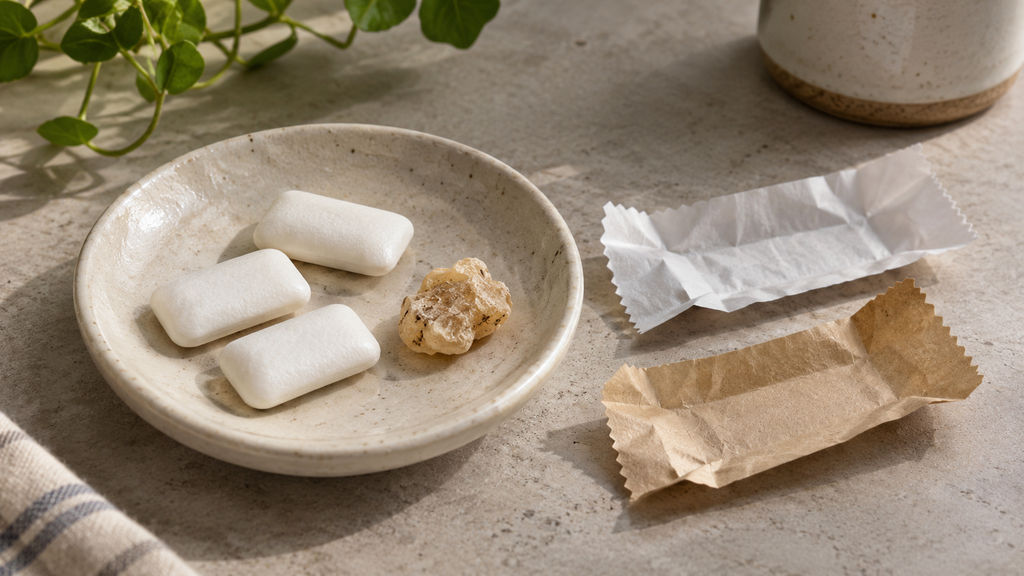
A "natural" chewing gum is not a reliable guarantee that no microplastics will enter your saliva. In a small study comparing five natural and five synthetic gum products, researchers detected particles from both groups and identified synthetic polymers in a subset of the collected samples.[2] That does not establish that every natural gum behaves like every conventional gum, or that chewing either causes illness.[2][6]
Our recommendation is to avoid paying a premium solely for an unverified promise of zero microplastic release. Ask what the gum base contains and what testing supports the claim. If you would rather avoid this particular possible source, choosing not to chew gum removes that activity; these studies do not measure the resulting change in anyone's total exposure or health.[2][5]
What was actually collected during chewing?
Lisa Lowe, Jamie Leonard and Sanjay Mohanty investigated ten commercially available US gum products, selected for popularity and availability.[2] One person chewed seven pieces of each product in separate tests, collecting saliva during four minutes of chewing and adding a mouth rinse afterwards.[2] The American Chemical Society's report explains that using the same person was intended to reduce variation in chewing patterns and saliva.[3]
That is a useful controlled comparison, but it is not a survey of how different people chew. Repeated pieces from one chewer do not tell us how a child's chewing, another person's saliva or a different formulation would change the result.[2] The researchers used background rinses and processing blanks to account for contamination introduced outside the gum-chewing step.[2] Those controls matter, without making the selected products representative of every gum sold today.
The endpoint was material recovered in saliva and rinse water.[2] It was not a measurement of how many particles the participant swallowed, absorbed into tissues or retained in the body.[2] Although the journal article's title refers to ingestion, its annual ingestion estimate is an extrapolation using assumed gum consumption, not an observed personal dose.[2]
A screened particle count is not the same as chemical confirmation
The researchers used two stages of analysis. Fluorescent Nile Red staining and smartphone imaging screened and counted candidate particles, while infrared spectroscopy, called FTIR, investigated polymer identity in a subset of composite samples, one per brand.[2] The screening method could detect particles down to about ten micrometres, whereas the FTIR identification described in the paper concerned particles larger than twenty micrometres.[2]
The paper's often-repeated average of roughly 100 particles per gram comes from that screening approach.[1][2] It should not be described as a count in which every particle was individually confirmed as plastic by FTIR. The spectroscopy did identify synthetic polymers in samples from both product categories, including polyolefins and PET, but the paper does not supply a chemically confirmed fraction for every trial's screened count.[2]
This distinction is a reason to interpret the number carefully, not to pretend the polymer findings do not exist. The tea-bag evidence review explores a separate example of why impressive counts need an identification method attached.
Why natural gum did not settle the question
In the selected products, the screened particle counts did not differ significantly between the natural and synthetic groups.[2] A non-significant difference does not prove that the categories are equivalent. It also cannot rank brands that were never tested or certify a packet on a UAE supermarket shelf.
A plant-derived gum base and freedom from synthetic particles are different claims. The authors proposed manufacturing or packaging as possible explanations for synthetic polymers found in the natural-gum samples, but did not trace the particles to a particular source.[2] We therefore cannot conclude that natural plant material itself was responsible, that a wrapper caused the result, or that a named brand has misrepresented its ingredients.
For shopping purposes, a material description needs to be kept separate from a test of the finished product. Our guide to biodegradable and compostable labels makes a related distinction for disposal claims: a label answers only the question its evidence actually covers.
A separate experiment supports release, not a brand ranking
An independent team led by Udit Pant used Raman spectroscopy and a surface-enhanced Raman technique to investigate material released while one volunteer chewed a piece of gum for an hour.[5] This was a separate original experiment, not another report about the Lowe study. It found gum-related plastic particles in collected saliva and reported qualitative evidence of nanoscale gum-base material.[5]
Its larger headline total was extrapolated from particles identified in small scanned areas to the sample volumes.[5] It was not a direct count of every particle in an entire hour's saliva. Different chewing durations, products, detection methods and extrapolations mean that the two studies cannot be read as a simple increase from one universal release rate to another.[2][5]
The Pant experiment did not compare natural and synthetic product groups.[5] It therefore supports the possibility of release during chewing, not independent replication of the natural-versus-synthetic comparison. Both experiments remain small, and neither followed participants for a health outcome.[2][5]
Why we are not recommending a chewing-time trick
You may encounter advice to keep chewing the same piece for longer rather than start another. The Lowe paper's abstract reports 94% of release within eight minutes, while its results text says 92%; the earlier thesis results text says 52%, despite its abstract also giving 94%.[1][2] We found these conflicting statements when checking the sources and cannot resolve them from the text alone.
That is too uncertain a basis for a precise eight-minute rule. More broadly, an observed release pattern in selected gums does not establish a medically safe chewing duration or demonstrate a benefit from changing how long you chew.[2]
A 2026 narrative review by Babatunde Solomon Ojelade and Olatunde Samod Durowoju also treats the quantitative release estimates as tentative and warns against claims of gum-specific health damage without realistic exposure and dose-response evidence.[6] That review is supporting appraisal, not another chewing experiment. Detection in saliva, possible ingestion and demonstrated human harm remain separate questions.[2][5][6]
What to do with a packet in your hand
- Ask a specific material question. Request the gum-base ingredients rather than treating "natural" as a particle test. The study's authors could not establish the source of the synthetic particles found in their natural-gum samples.[2]
- Ask for the test behind a zero-release claim. We would want the tested product and batch, chewing conditions, particle-size range, polymer-identification method and blank results. A result that excludes smaller particles cannot establish that none of those particles exist.[2]
- Keep any change proportionate. If avoiding gum is easy for you, it is a simple way not to carry out this particular particle-releasing activity. Do not attach a percentage reduction in total exposure or a promised health benefit to that choice; neither experiment measured one.[2][5]
- Dispose of used gum in a bin. Keep it off pavements and out of the environment. This is practical litter prevention, not a claim that a particular natural gum will or will not fully biodegrade outdoors.[6]
For now, the evidence supports scepticism about a blanket "natural means no microplastics" promise. It does not justify a universal brand league table, a personal annual dose or a prediction of disease.[2][5][6] Choose on the basis of a disclosed material and relevant testing, not a comforting word on the wrapper.
Sources
- https://escholarship.org/content/qt7654j0k4/qt7654j0k4.pdf
- https://www.sciencedirect.com/science/article/pii/S2666911025000243
- https://www.acs.org/pressroom/presspacs/2025/march/chewing-gum-can-shed-microplastics-into-saliva-pilot-study-finds.html
- https://www.sciencedirect.com/science/article/pii/S0304389424035593
- https://www.mdpi.com/2227-9717/14/14/2354