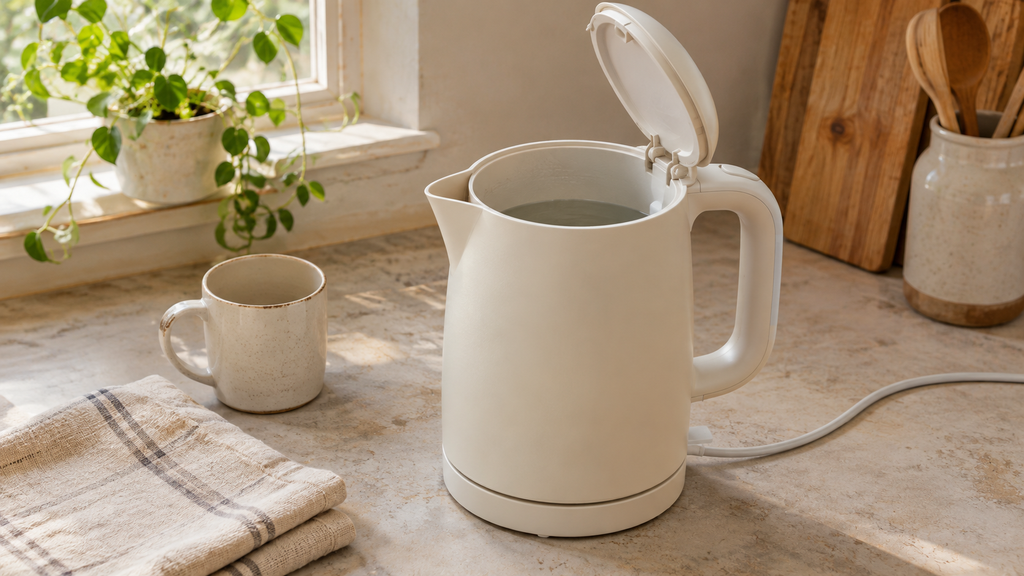
A plastic kettle can be a source of particles in the water it heats. A 2025 laboratory study detected polypropylene in both microplastic and nanoplastic fractions released from selected kettles during boiling.[1] That finding does not tell you how much plastic is in your own cup, or establish that using a particular kettle causes illness.
It also does not contradict research showing that boiling hard water can trap particles in mineral deposits.[4] One question concerns particles coming from the appliance; the other concerns particles being captured from the water. For a household choosing a kettle, the useful details are its water-contact materials, the water used and the way the experiment identified plastic.
What the kettle experiment actually tested
Shi and colleagues bought eight new polypropylene kettles from two supermarket chains in Brisbane. Six kettles, three from each brand, underwent repeated boiling with highly purified laboratory water. Two additional kettles from one brand were used for the tap-water comparison.[1] These are different sample groups, not eight independent brands.
The main experiment used 1.1 litres per boil. Researchers rinsed the kettles before testing, let them cool between cycles and collected water after selected cumulative boil numbers, extending to 150 boils.[1] The study therefore followed repeated use of a small selection of new products. It was not a survey of water collected from hundreds of household kitchens, and it did not test decades-old kettles.
The researchers divided the collected material around a one-micrometre filter boundary. They used the larger retained fraction for microplastic analysis and concentrated the smaller fraction for nanoplastic analysis.[1] These were operational laboratory fractions: aggregation and the preparation steps can affect where material ends up.[1]
Importantly, they did more than photograph specks. Pyrolysis-based chemical analysis measured polypropylene mass. For the smaller particles, a separation method sorted material into size-related fractions, which were then chemically analysed to check for polypropylene.[1] This supports the conclusion that the kettle water contained nanoplastic material, rather than simply assuming that every tiny object seen was plastic.
A particle count is not a count of confirmed plastic particles
The same study used optical instruments to estimate nanoparticle numbers and sizes. Those methods produced substantially different particle counts, and the authors explicitly state that these counted nanoparticles were not individually chemically confirmed as plastics.[1] A chemical signal in a collected fraction and an optical count of all particles in that liquid answer related, but different, questions.
That distinction is why we are not giving a headline number of particles per cup. Nor should a mass result be converted into a particle count without assumptions about particle size, shape and composition.
There is a broader identification problem too. A separate 2022 experiment by Li and colleagues showed that small particles of plastic additives can resemble polymers in Raman spectra and be misidentified as microplastics.[3] Its authors included several researchers from the earlier kettle water-chemistry study discussed below.[2][3] It is a methodological follow-up from overlapping investigators, not an independent replication of either kettle experiment.
The additive study tested pellets, bottle caps and food containers, rather than establishing a corrected count for every kettle.[3] Its alcohol-treatment step was a laboratory procedure for analysing captured material, not advice to rinse an appliance with solvents. The lesson for readers is to ask how plastic was identified before treating a large particle number as settled. Our tea-bag evidence guide examines another hot-water example where that distinction matters.
Repeated use and water chemistry change the result
In the 2025 kettle experiment, measured polypropylene release was higher early in use and declined with repeated boiling, although both microplastic and nanoplastic material remained detectable after 150 cycles.[1] Loosely attached material left from manufacture is one explanation proposed by the authors; the experiment did not demonstrate that every kettle becomes particle-free once it has been used enough.[1]
An earlier, independently conducted kettle experiment published in the Journal of Hazardous Materials explored a different question: what happens when dissolved constituents in water form deposits on the kettle surface?[2] It used five identical new kettles for each water condition, comparing several prepared water mixtures with deionised water over a 100-day programme.[2]
There is an easily missed detail in its methods. The kettles were used with their assigned water, but release measurements were collected through additional boils with deionised water.[2] That helped researchers examine the conditioned surface without the same interference from water constituents. The resulting count is not simply an analysis of a household's finished drink.
The researchers found that certain dissolved ions formed mineral or metal-oxide films on the plastic and reduced reported particle release. Adding already formed iron-oxide particles did not create the same continuous film.[2] They also examined a small number of used kettles and found surface deposits consistent with naturally occurring water chemistry.[2]
The newer study found lower nanoplastic release with its tested hard tap water than with ultrapure water, but its tap-water microplastic results did not show a clear trend across boils.[1] Water chemistry matters; these experiments do not establish one reduction percentage for every tap, kettle or particle size. Their different methods and release patterns also make a universal rule about kettle age unreliable.[1][2]
How can boiling remove particles and a kettle release them?
The processes can coexist. Yu and colleagues reported that selected plastics could become incorporated into calcium carbonate deposits when water was boiled.[4] That is a mechanism for moving particles out of the freely suspended water, not proof that heating destroys plastic.
The kettle-release studies ask whether plastic in the appliance contributes material during use.[1][2] Putting those findings beside the removal experiment does not reveal the net result in your kitchen: you would need measurements of the actual incoming water, appliance contribution and water ultimately poured and consumed.
Our guide to boiling water and microplastics covers hardness, separation and the published scientific debate around removal claims. A kettle's automatic shut-off alone is not evidence that your cup has undergone a verified microplastic-removal treatment.
What to do when buying or using a kettle
These are practical recommendations for making a material choice, not a proven disease-prevention routine:
- If you are buying anyway, check the wet interior. Ask the manufacturer which materials contact the water and steam, including the body, lid, spout filter and level indicator. A stainless-steel-looking exterior does not answer that question. If your aim is to avoid a polypropylene vessel, choose a suitable design with less plastic in those contact surfaces. Neither kettle study establishes a particle-free alternative or a universal ranking of glass, steel and plastic appliances.[1][2]
- Follow the first-use instructions. Where the manufacturer calls for initial boils to be discarded, do that. The newer experiment supports taking early-use release seriously, but does not justify performing 150 conditioning boils or inventing a home flushing programme.[1]
- Keep to the specified cleaning and descaling routine. Do not deliberately grow a thick scale layer, add iron or copper salts to drinking water, or use laboratory solvents. The water-mixture experiments explain a mechanism; they are not household treatment recipes.[2][3]
- Do not trade established water safety for an uncertain particle reduction. Keep following local water notices and any preparation instructions relevant to your use. This article does not recommend colder preparation or abandoning required boiling.
There is no evidence here that an otherwise serviceable kettle must be thrown out immediately. If you want to change materials when replacement is due, that is a reasonable preference. It should not come with a promise that a purchase will prevent illness.
Detection is not a diagnosis
Neither kettle experiment followed people to measure disease caused by kettle-derived particles.[1][2] Exposure potential, a swallowed dose, uptake into the body and a demonstrated health effect are separate steps.
The FDA's public summary says current evidence does not demonstrate that the levels of microplastics or nanoplastics detected in foods pose a human health risk, while stressing major gaps in measurement and health-effect evidence.[5] That is not proof of zero risk or an appliance-specific safety guarantee.
The useful conclusion is narrower: selected polypropylene kettles have released chemically detected plastic material under laboratory conditions, with results affected by use and water chemistry.[1][2] Check the surfaces your water touches, follow the appliance instructions and be sceptical of any universal particles-per-cup claim.
Evidence access: we read the full publisher methods and results of both kettle studies and the full open additive-identification paper. The weekly plan had recorded abstract-only access to the older kettle study; its full text was accessible for this article. For the separate boiling-removal paper, we used its accessible abstract only for the mineral-capture mechanism, not a detailed protocol or a removal percentage. The FDA page is a regulatory summary, not another kettle experiment.
Sources
- https://www.nature.com/articles/s44454-025-00018-w
- https://www.sciencedirect.com/science/article/pii/S0304389421029666
- https://pmc.ncbi.nlm.nih.gov/articles/PMC9454250
- https://pubs.acs.org/doi/10.1021/acs.estlett.4c00081
- https://www.fda.gov/food/environmental-contaminants-food/microplastics-and-nanoplastics-foods