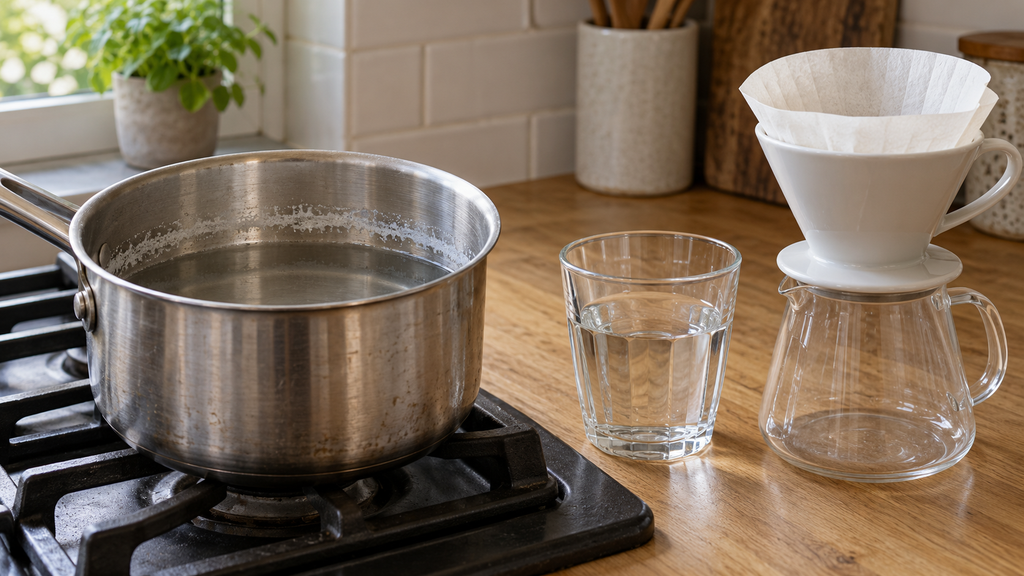
Boiling can help some plastic particles settle out of hard water by trapping them in calcium carbonate deposits.[1][2] It does not make the plastic disappear, and a laboratory removal percentage is not a promise about your kettle or a demonstrated health benefit.[1][2]
The useful question is whether your water and the way you handle it resemble the experiment. Water hardness, the particles present and separation of the deposits all matter.[2][5] A published scientific exchange, followed by a 2026 Perspective, explains why the familiar "boiling removes 90%" claim needs those conditions attached.[3][4][5]
What the experiment actually measured
Yu and colleagues investigated whether heating water could draw plastic particles into calcium carbonate deposits, often called limescale.[1] Their study covered polystyrene, polyethylene and polypropylene, using selected particles rather than every type of plastic that might occur in a household supply.[1][2]
The freely available Supporting Information makes the small-scale setup clear. In the microplastic experiments, the team added polystyrene spheres, polyethylene fragments and polypropylene fibres to 40 millilitres of tap water with a hardness of 180 milligrams per litre expressed as calcium carbonate.[2] They heated or boiled the samples for five minutes, allowed them to cool for ten minutes, then sampled the upper liquid.[2] Each experiment was repeated three times.[2]
The polyethylene fragments came from a plastic bag and the polypropylene fibres from a mask, both aged in sunlight before fragmentation.[2] Recovered microplastics in the upper liquid were identified and counted with Raman spectroscopy.[2] For the smaller fluorescent polystyrene particles, the researchers used flow cytometry, an instrument that counts particles through their optical signals, with controls and background correction.[2]
These details matter because the endpoint was the number of selected particles remaining in sampled water.[2] The experiment was not a trial in which people drank the water and experienced a measured improvement in health.[1][2]
The plastic moves into a deposit
As calcium carbonate formed, it encapsulated and aggregated the tested particles.[1] Deposits then settled, leaving fewer free-floating particles in the upper water.[2] This is a separation mechanism, not evidence that boiling destroys the polymers.[1][2]
If the particle-containing deposit is mixed back into the water and swallowed, the result cannot be assumed to match an analysis of the clearer upper liquid.[2] The later Perspective identifies the stability of these particle–mineral complexes during storage and consumption as an unresolved question.[5]
The separation mechanism explains the interest in filtering out deposits after cooling.[1][2] It does not establish that an ordinary coffee filter directly catches loose nanoplastics.[2] The original microplastic analysis used a laboratory membrane before Raman counting; that analytical step is not a validation of every kitchen filter.[2]
Why the percentage changes with hardness
The study's supplementary hardness experiment reported polystyrene nanoplastic precipitation efficiency of 90% at 300 milligrams per litre as calcium carbonate, compared with 25% at zero hardness.[2] Those are results for the tested conditions, not two guaranteed outcomes for all hard and soft water.[2]
Hardness provides part of the chemistry needed for the calcium carbonate deposits to form.[1][2] It is therefore a mistake to treat a country's average hardness, or the fact that a water source is called "tap water", as a measurement of your own supply. Hale and Albert's published Comment stresses that hardness varies regionally and locally, and that a household softener can reduce the applicability of the method.[3]
In their response, read here in a publisher-page snapshot archived on 18 February 2025, Yu, Li and Zeng agreed that removal may be ineffective in areas supplied with soft water or homes using softeners or water purifiers.[4] That response clarifies the limits; it does not turn the laboratory result into a universal household guarantee.[4]
For readers in the UAE, this article makes no assumption about the hardness at a particular building's drinking-water tap. Check the relevant supply or treatment information rather than borrowing a percentage from an overseas experiment.
The chemical question remains open
Hale and Albert raised another concern: heating can accelerate the release of additives associated with plastic particles.[3] Their Comment is a scientific critique, not a new experiment showing that a particular household kettle makes water more harmful.[3]
The original authors acknowledged the possibility.[4] They also proposed that calcium carbonate deposits might trap additives or other pollutants, but said this needed specifically designed experiments.[4] Neither side established the overall chemical benefit or harm of boiling every real-world mixture of particles and contaminants.[3][4]
The 2026 paper by Qadeer and colleagues is a Perspective, not an independent replication of the boiling experiment.[5] Its accessible abstract and introduction call for more evidence on particle types, water chemistry, associated contaminants and what happens after boiling.[5] They also describe possible oligomer and monomer release as unresolved, not as a proven consequence in ordinary homes.[5]
The reasonable reading is that mineral-assisted particle separation has experimental support, while its reliability and wider health relevance under household conditions still need work.[1][2][5] An animal or cell study of plastic toxicity, even if relevant to hazard research, would not by itself show that this water-treatment habit prevents disease in people.
What to do at home
- Keep established water-safety advice first. Follow local notices and your supplier's instructions. EPA guidance explains that boiling can kill disease-causing microorganisms but does not destroy heavy metals, salts and most other chemicals. A microplastics article is not a substitute for a drinking-water safety notice.[6]
- Do not start adding minerals or laboratory reagents to drinking water. The experiment's chemical conditions are information for interpreting it, not a home treatment recipe. If you want to assess whether the mechanism could apply, first obtain information about the hardness of the water you actually drink.[2][3]
- Do not assume a kettle's automatic shut-off reproduces the study. The reported microplastic protocol used five minutes of heating or boiling followed by ten minutes of cooling. This article does not recommend prolonging boiling solely to chase an unverified personal reduction percentage.[2]
- If you already boil drinking water, handle it hygienically afterwards. Let it cool safely and use clean, covered storage. Do not treat clear appearance or a limescale ring as proof of a measured microplastic-removal rate.[2][6]
If you are comparing treatment options, our guide to judging home-water-filter microplastics claims explains what to ask about particle sizes and testing. For the separate choice of water source, read tap versus bottled water.
Bottom line
Boiling hard water can move selected plastic particles into mineral deposits under laboratory conditions.[1][2] The deposits must be kept separate from the water consumed, and the result depends on the chemistry and handling.[2][5] The evidence does not justify promising that every kettle removes 90% of microplastics or that the habit delivers a known reduction in human disease.[2][4][5]
Evidence access: we read the original paper's publisher abstract and its complete 30-page Supporting Information, not the subscription-only main text. We read the full published Comment, the full authors' response in the 18 February 2025 archived publisher page, and the 2026 Perspective's accessible abstract and introduction, not its complete restricted text. The Perspective and correspondence are interpretation, not additional independent experiments.
Sources
- https://pubs.acs.org/doi/10.1021/acs.estlett.4c00081
- https://ndownloader.figshare.com/files/44725463
- https://pubs.acs.org/doi/10.1021/acs.estlett.4c00265
- https://web.archive.org/web/20250218164614/https://pubs.acs.org/doi/10.1021/acs.estlett.4c00475
- https://www.sciencedirect.com/science/article/pii/S1385894726050588
- https://www.epa.gov/ground-water-and-drinking-water/emergency-disinfection-drinking-water