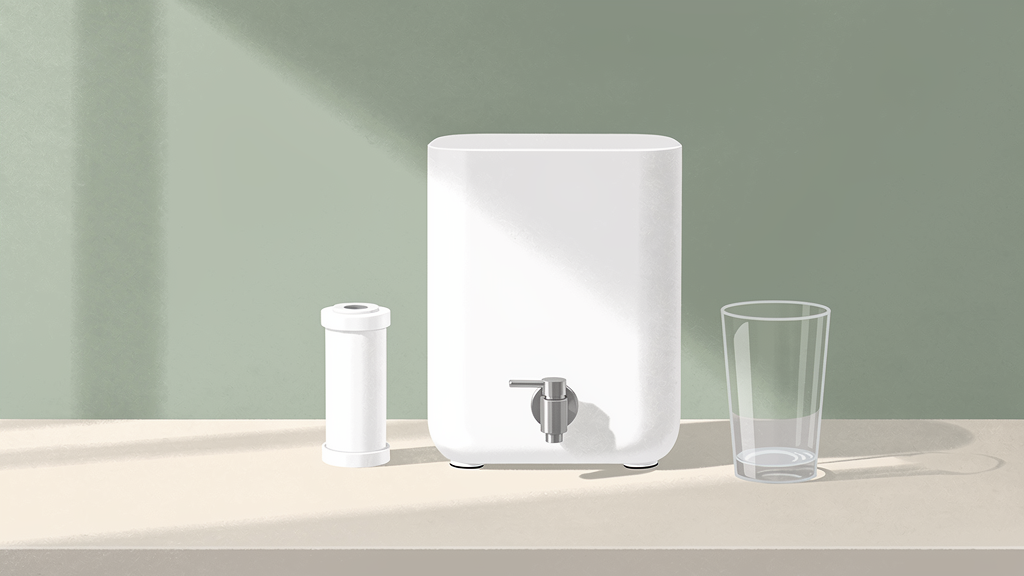
Some home water filters reduce microplastics, but the result depends on the device, the particles tested and how the filter is used.[7][8] A claim about large fragments is not evidence about every smaller particle, and a certification for better taste does not establish microplastic removal.[4][7]
Our recommendation is to check the exact cartridge's tested reduction claim before buying, then choose a system you can maintain. A pore-size number or a large percentage on its own is not enough to judge the water leaving a complete device.[6][7]
This guide is about filter evidence. For the separate question of which drinking-water source to use, read our tap-versus-bottled-water comparison.
What a household filter experiment actually found
A University of Toronto study published in 2023 compared three pour-through devices: one using granular activated carbon and ion-exchange resin, and two adding different membrane barriers.[7] Researchers added known plastic fragments and nylon fibres to water, then sampled the filtered water at successive stages of the manufacturers' rated treatment capacities.[7]
The membrane-equipped devices performed better overall on the fragments.[7] The detailed results reported PVC removal ranging from 46% to 78% for one device and 90% to 100% for the other; the corresponding PET ranges were 54% to 86% and 55% to 94%.[7] These are results across that experiment, not promised percentages for an entire filter category.
The carbon-and-resin device sometimes had more of the tested fragments in its output than in its input.[7] The authors suggested that previously trapped particles might have accumulated and then been released.[7] That does not prove all carbon filters add plastic: it describes one device configuration and a proposed explanation, not a finding about every carbon block or cartridge.[7]
The study is useful because it tested whole devices rather than simply assuming that a small pore must catch everything. It also has clear limits. The researchers used deliberately prepared, coloured plastics that could be counted by microscopy; the particle sizes represented in the abstract ranged from 30 to 1,000 micrometres.[7] The work therefore does not establish nanoplastic removal, and it did not test a household reverse-osmosis system.[7]
Why longer testing can change the answer
A different study published in 2025 followed four commercial point-of-use ultrafiltration membranes for a year under simulated household use.[8] Its overall median removal efficiencies ranged from 50.0% to 71.5%, and some early samples contained more particles after filtration than before it.[8] The authors also identified polymers in filtered samples that suggested contributions from the membranes or associated equipment.[8]
This was a different experiment, using different membranes and measurement methods, so its percentages should not be lined up against the 2023 results as a product league table.[7][8] Its routine fluorescence method had a detection limit of 10 micrometres; polymer identification by micro-FTIR was carried out at selected points.[8] The authors acknowledged that the fluorescence approach could overcount compared with polymer-specific analysis.[8]
The 2025 researchers proposed that a developing layer of retained material could help trap particles and protect the membrane surface.[8] That is a suggested mechanism, not permission to keep an old cartridge indefinitely. Their own paper discusses the trade-off between particle removal and declining membrane performance.[8]
There is a published debate about the study's statistical interpretation. Yoshiyasu Takefuji criticised reliance on SHAP, a method used to explain machine-learning predictions, as evidence of which operating factors truly drive the results.[16] The original authors published a reply, but the accessible publisher extract provided its title and authorship rather than the response's argument.[19] We cannot resolve that exchange from the available text. We therefore treat the proposed operating mechanisms cautiously and do not use the modelling to recommend extending filter life.
Read the certification claim, not just the badge
NSF explicitly warns that certification to a standard does not mean a system reduces every possible contaminant.[4] Its standards guide describes NSF/ANSI 42 as covering aesthetic impurities such as chlorine and taste or odour, while NSF/ANSI 58 concerns reverse-osmosis systems.[4] Neither description should be read as a blanket guarantee of plastic-free water.
For a microplastics claim, ask for the exact model and replacement-cartridge identifiers, the certifier's listing and the performance data sheet. Look for an explicit particle-reduction claim, its size range, the tested reduction and rated capacity. This is our suggested buying checklist, based on NSF's claim-specific approach and the limits of the device experiments.[4][7]
Apply the same scrutiny to reverse osmosis. NSF describes a semi-permeable membrane, usually with additional filters before or after it.[4] The 2023 researchers called for further work on household reverse osmosis and other device types.[7] This evidence does not justify promising that every system sold as 'RO' removes every micro- and nanoplastic particle.
A seller who supplies only a broad percentage, with no particle sizes or test conditions, has not given you enough information for a useful comparison.
A micron rating needs context
CDC distinguishes an absolute pore size from a nominal or mean pore size.[6] In its explanation, an absolute rating describes pores at or below the stated size; a nominal or mean rating can include larger openings.[6] Ask which type of rating a product uses rather than treating the word 'micron' as a performance guarantee.
Even that specification is only part of the evidence. The membrane devices in the 2023 study still had detectable particles in their output despite small stated pore sizes.[7] Checking a complete system's measured output is more informative than inferring perfect removal from its membrane specification alone.
What to do before buying or replacing a filter
Start with known water-safety needs. CDC recommends selecting a filter for the harmful germs or chemicals you need to address and notes that water without those problems may not require filtration.[6] Do not let a microplastics sales pitch displace a known drinking-water problem.
If you decide to filter drinking and cooking water, consider whether a point-of-use device meets that need rather than automatically treating every tap.[6] CDC notes that whole-home systems that remove disinfectant can allow more germs to grow in plumbing.[6]
Before paying, check replacement-cartridge availability, rated capacity and the maintenance instructions. Keep the manual and record when the cartridge was installed. Follow the manufacturer's replacement schedule: CDC says maintenance is necessary both for proper performance and to prevent germ growth.[6]
Finally, keep removal and health benefit separate. These filter experiments measured particles, not improved health in people.[7][8] FDA's drinking-water discussion says current evidence does not demonstrate that the detected levels of microplastics or nanoplastics pose a human health risk.[5] That is not proof of harmlessness, but it does mean a reduction percentage cannot be translated into a claimed reduction in disease risk.
For more on why detecting plastic is not the same as diagnosing harm, read our guide to human microplastic diagnostics.
Choose a filter on specific, checkable evidence, with particle-size limits stated clearly. Maintain it as instructed. Neither a generic badge nor a large headline number establishes that your drinking water is plastic-free.
Sources
- https://www.nsf.org/consumer-resources/articles/standards-water-treatment-systems
- https://www.fda.gov/food/environmental-contaminants-food/microplastics-and-nanoplastics-foods
- https://www.cdc.gov/drinking-water/prevention/about-choosing-home-water-filters.html
- https://www.mdpi.com/2073-4360/15/6/1331
- https://www.sciencedirect.com/science/article/abs/pii/S0043135425009613
- https://web.sfc.keio.ac.jp/~takefuji/publications/pdf/watershap.pdf
- https://www.sciencedirect.com/science/article/abs/pii/S0043135425018111