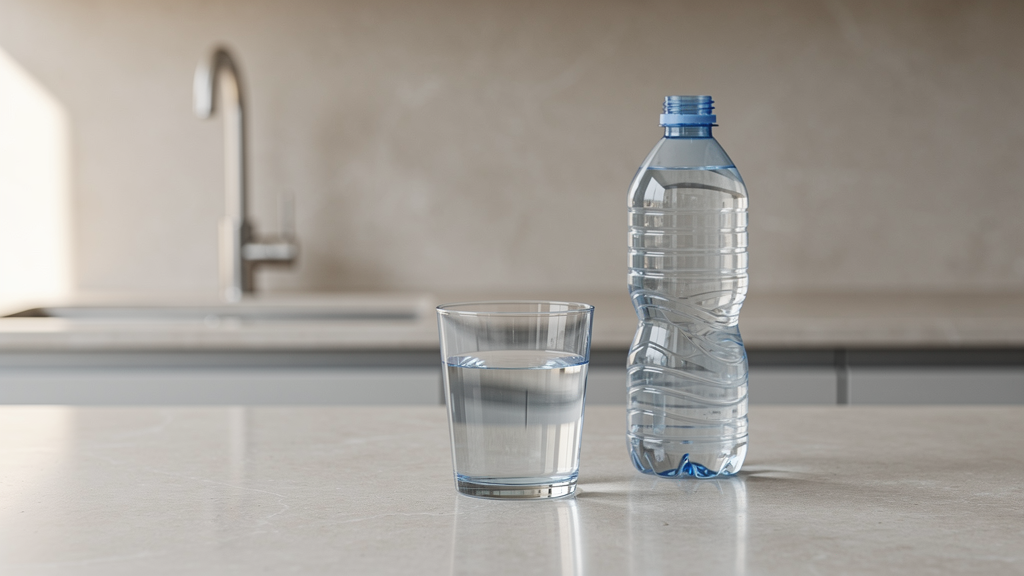
If you are choosing between tap and bottled water because of microplastics, the evidence is less tidy than the headlines.[1][6] Researchers have detected plastic particles in both.[6] Some studies report more in bottled water, but differences in particle size, sampling and laboratory methods make a universal ranking unreliable.[1][6]
The practical answer is to choose water known to be safe to drink locally, then consider whether you can avoid disposable plastic bottles without sacrificing that safety.[1] Microplastics are a reason to ask better questions, not a reason to ignore microbial or chemical contamination.[1]
What has actually been measured?
A 2024 review of drinking-water research found microplastics in bottled water, tap water and water at treatment plants across multiple regions.[6] Its findings varied widely, partly because studies used different sample volumes, filters and lower size limits.[6] If one team counts only particles above 25 micrometres and another can see far smaller ones, their counts cannot be compared as though they measured the same thing.[6]
The World Health Organization's 2019 assessment noted limited reliable evidence for direct tap-versus-bottle comparisons.[1] WHO said drinking-water treatment that removes pathogens and particles can also reduce microplastics.[1] Its judgement on human health risk was cautious: based on the evidence then available, microplastics in drinking water did not appear to pose a risk at current levels, but major gaps remained for the smallest particles.[1]
That is a dated assessment, not a certificate that all microplastics are harmless.[1] The most honest reading is that detection is not the same as demonstrated harm, and the quality of exposure measurement still matters.[1][6]
What about the '240,000 particles per bottle' headline?
The widely shared figure is an estimated average of about 240,000 micro- and nanoplastic particles per litre, not per bottle.[2][3] A 2024 study used stimulated Raman scattering microscopy on three bottled-water brands and estimated that around 90% of the detected plastic particles were below one micrometre.[2][3] It was a method-development study with a small bottled-water sample, not a market-wide survey and not a comparison with tap water using the same method.[2][3]
The number is also disputed.[4][5] A published critique argued that contamination in the study's procedural water blanks made its quantitative estimate unreliable.[4] The original researchers replied that the ultrapure water used for that comparison was itself contaminated and defended the blank they chose.[5] The scientific disagreement is about measurement controls and the reliability of the count; neither paper measures your own bottle or establishes a health-risk threshold.[4][5]
One more detail gets lost in the headline: NIH reported that the method classified seven kinds of plastic, while millions of other detected particles did not match those categories.[2] They should not all be casually labelled nanoplastics.[2]
Is bottled water safer than tap water?
Not as a blanket rule.[1][6] Bottled water may add particles from packaging or processing, and tap water can acquire particles at source, treatment or distribution.[6] But particle counts from different studies are not a controlled head-to-head test of the water available in your home.[6] Nor do counts tell us which water has lower overall health risk.[1][6]
If your local drinking water is subject to an advisory, or your building's storage and plumbing are suspect, resolve that known safety issue first.[1] Conversely, if your tap water is confirmed potable, switching to disposable bottles solely because of microplastics has no clear evidence-based health benefit.[1] Reusing a clean glass or stainless-steel vessel can reduce disposable packaging without claiming that it makes the water 'microplastic-free'.[1]
A useful decision checklist
- Check potability first. Follow your water supplier's current advice, any boil-water notice and relevant building-level guidance. A plastic-particle headline cannot substitute for a drinking-water safety notice.[1]
- Ask what a claim measured. Was it tap or bottled water? How many samples and brands? Which particle sizes and polymers were identified? Were contamination blanks used? The answers often matter more than the biggest number in the headline.[3][4][6]
- Avoid paying for certainty nobody has shown. An expensive water product or filter needs independent testing for the particle sizes and other contaminants it claims to address. General statements about 'removing microplastics' are not evidence about the water leaving your particular tap.[1][6]
- Cut avoidable single-use packaging when it is practical and safe. This reduces plastic waste; it is not a proven medical intervention. If you depend on bottled water for potable supply, keep using safe water while you investigate suitable alternatives.[1]
For a broader explanation of how exposure pathways fit together, see our overview of microplastics in food and air. If you are considering a personal measurement service, read what human microplastic diagnostics can and cannot establish.
Bottom line: Both sources can contain particles. The published numbers depend heavily on how researchers look for them, and there is no sound universal 'tap versus bottled' health ranking. Choose demonstrably safe water first, then reduce disposable plastic where you reasonably can.[1][6]
Sources
- https://www.who.int/news/item/22-08-2019-who-calls-for-more-research-into-microplastics-and-a-crackdown-on-plastic-pollution
- https://www.nih.gov/news-events/nih-research-matters/plastic-particles-bottled-water
- https://pubmed.ncbi.nlm.nih.gov/38190543
- https://pmc.ncbi.nlm.nih.gov/articles/PMC11621622
- https://www.pnas.org/doi/10.1073/pnas.2415874121
- https://pubmed.ncbi.nlm.nih.gov/38537794