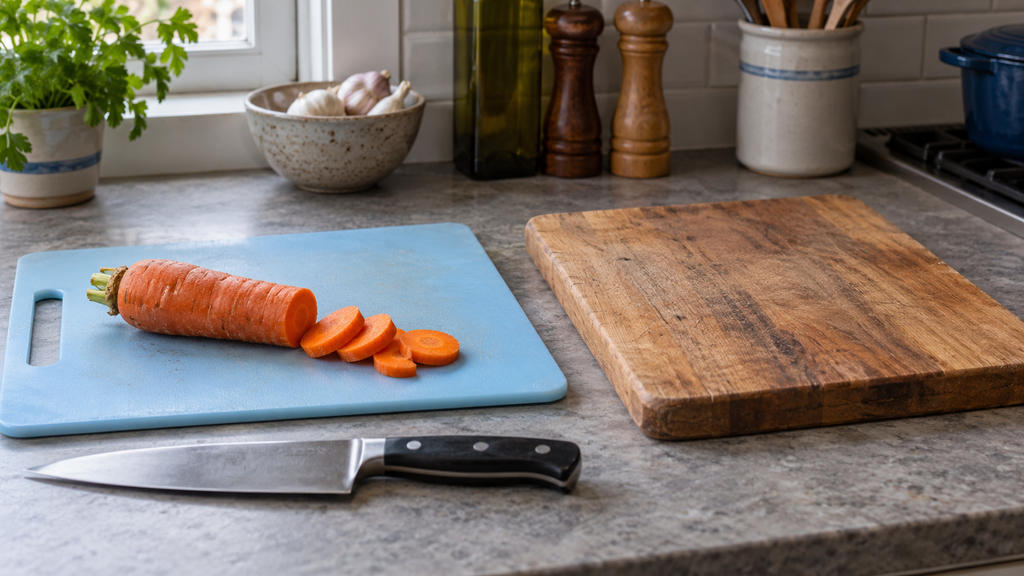
Plastic chopping boards can shed particles when a knife repeatedly strikes their surface. Laboratory studies have measured that release, including experiments with food.[1][2][3] That makes board choice a reasonable place to take a precaution. It does not give us a disease-risk figure for someone preparing dinner.[2][3][5]
If you already have a sound wooden board that you can clean properly, using it avoids cutting directly into a plastic board. You do not need to throw out every kitchen item today. The more immediate rule applies to both materials: replace a board when it becomes excessively worn or develops grooves that are hard to clean, and keep raw meat preparation separate from ready-to-eat food.[4]
What the knife experiments actually measured
A 2023 study compared polyethylene and polypropylene boards, two common plastic materials, with a wooden control.[1] Five people took part in the chopping-style experiment; other comparisons used the same person to reduce variation.[1] A cycle meant 500 knife strikes, with six consecutive cycles on each surface.[1] Some tests involved bare boards; another used carrots on a polyethylene board.[1]
After a cycle, the researchers rinsed the board and knife and collected particles from the rinse.[1] They used imaging to count particles and infrared spectroscopy to check the material of a selected subset against the original board.[1] Their counting and image-processing approach had a practical lower size limit of about 20 micrometres.[1] It was not a count of every smaller particle or nanoplastic.[1]
Release varied with use and between people.[1] The paper reported greater polypropylene release in several comparisons, but the detailed results say that some differences between the two plastics were not statistically significant because the measurements varied widely.[1] That is a poor basis for declaring one polymer the universally safe shopping choice.
The distinction between release and ingestion matters. Material recovered by rinsing a board and knife is evidence that the board shed particles. It is not a measurement of how much remained on a meal, survived preparation and was swallowed by a particular person.
Why annual particle totals are not your personal dose
The 2023 researchers extrapolated from chopping experiments to annual exposure, assuming that their fitted relationships continued over repeated use.[1] Those estimates depend on chopping frequency, technique and how well a short experiment represents a board's longer life.[1] They are estimates, not a year of measurements in people's meals.
A newer paper by Wang and colleagues adds detail about much smaller material.[2] We read its accepted, unedited manuscript, which the publisher currently labels an Article in Press.[2] The team tested seven commercial boards, six polypropylene and one polyethylene, using a controlled dry-chopping protocol of 600 strikes per cycle.[2]
The researchers combined microscopy and particle tracking with chemical analyses and an ethanol separation step.[2] Their results suggest that some nanoscale material consists of aggregates of short polymer chains, called oligomers, rather than only tiny fragments of a long-chain plastic surface.[2] That distinction helps explain why a nanoparticle count alone cannot describe the material's composition.
The study also combined release measurements with cooking-behaviour data to model possible exposure.[2] Its authors explicitly describe the outputs as comparative scenarios, not direct measurements of human intake or internal dose.[2] They note that real foods, washing, particle retention, digestion and knife condition can change the relationship between a laboratory release and what someone consumes.[2]
The sample was too unbalanced to support a general polypropylene-versus-polyethylene conclusion.[2] Accelerated light-ageing was examined in detail on just one representative board.[2] Neither a headline count nor a large ageing effect therefore supplies a replacement interval for every board in a household kitchen.
Do the health experiments establish harm in people?
No. They raise questions worth investigating, but they did not study disease in human chopping-board users.[1][2][3]
There is an easily missed detail in the 2023 paper. Its preliminary mouse-cell test used filtered liquid that had been exposed to the collected material, rather than the plastic particles themselves.[1] The researchers did not find a significant reduction in cell viability in that test.[1] This narrow result is not proof that eating board particles is harmless, nor does it test every possible effect of long-term exposure.
A separate 2025 study prepared mouse feed on polypropylene, polyethylene and willow-wood boards.[3] Researchers chopped feed paste with 700 strikes per batch, characterised released material and fed the prepared diets to mice for four or twelve weeks.[3] The experiment used 36 female mice initially, with six animals per group assessed at each endpoint.[3]
Compared with the wooden-board group, the polypropylene group showed higher levels of several inflammatory markers and changes in markers related to intestinal barrier function.[3] The polyethylene group did not show the same inflammatory pattern, but did show differences in gut microbes and metabolites after twelve weeks.[3] The authors acknowledge relatively high exposure concentrations and say that relevance to human populations needs further assessment.[3]
These findings do not contradict the earlier cell result. A filtered-liquid test on one cell type and a repeated feeding experiment in whole mice ask different questions. Neither provides a clinical diagnosis or a risk percentage for a home cook.
The 2026 study also tested an extracted polypropylene oligomer fraction in zebrafish embryos and reported developmental and cardiac effects.[2] This was an animal hazard-screening experiment, not a study of people eating chopped vegetables.[2] Its authors distinguish those test concentrations from a specific human internal dose.[2]
A published perspective cautions against a simple shopping prescription
Castillo, Korfmacher and Tyler discussed the mouse study in an invited perspective in the same journal.[6] This is expert commentary, not another independent experiment. They welcomed studying particles generated from real products, but questioned how the authors' advice to minimise plastic-board use should account for uncertain human health implications, alternative materials, food safety and affordability.[6]
Their point is useful: finding an effect in a particular animal experiment does not automatically tell every household what to buy. The mouse-study authors recommend reducing use, while also acknowledging the need to test longer exposure at lower doses.[3] We treat their recommendation as a precautionary interpretation of animal evidence, not proof that a wooden board prevents illness.
The US Food and Drug Administration's current position is that evidence does not demonstrate that levels of microplastics or nanoplastics detected in food pose a human health risk.[5] It also highlights substantial gaps in methods and health-effect data.[5] That is an assessment of what can presently be concluded, not a guarantee that all exposure is harmless.
Choosing and caring for a board
Our practical recommendation is to make a manageable change without sacrificing hygiene:
- If you want to avoid this particular source, use a suitable wooden board for the jobs it can safely do. The 2023 wooden controls also shed wood microparticles, so "not plastic" does not mean "no particles".[1] We are not claiming that wood eliminates all food contamination or improves a clinical outcome.
- Check the surface of whichever board you use. USDA food-safety guidance says to discard plastic or wooden boards that are excessively worn or have hard-to-clean grooves.[4] That is a hygiene rule, not a validated microplastic threshold. The studies here do not establish a universal three-month or one-year replacement schedule.
- Use one board for fresh produce and bread and a separate board for raw meat, poultry and seafood, as USDA advises.[4] Changing material does not replace separation.
- Wash boards with hot, soapy water after each use, rinse and dry them.[4] Follow the product's care instructions. The evidence reviewed here does not establish that a household rinse makes a scratched plastic board particle-free.
For a different kitchen decision, our guide to reheating food in plastic containers examines heat rather than knife abrasion. Our tea-bag article explains why material identification and particle counts need to be read together.
A sound wooden board is a reasonable option if avoiding direct plastic abrasion matters to you. For either material, cleanliness and surface condition still matter. The research supports taking board wear seriously; it does not support a personal health-risk calculator or a promise that switching boards prevents disease.[2][3][5]
Sources
- https://doi.org/10.1021/acs.est.3c00924
- https://www.nature.com/articles/s43246-026-01290-y_reference.pdf
- https://pmc.ncbi.nlm.nih.gov/articles/PMC11980920
- https://fsis.usda.gov/food-safety/safe-food-handling-and-preparation/food-safety-basics/cutting-boards
- https://www.fda.gov/food/environmental-contaminants-food/microplastics-and-nanoplastics-foods
- https://wastedfood.american.edu/wp-content/uploads/2025/07/castillo-et-al-invited-perspective-should-you-scrap-your-plastic-cutting-board.pdf