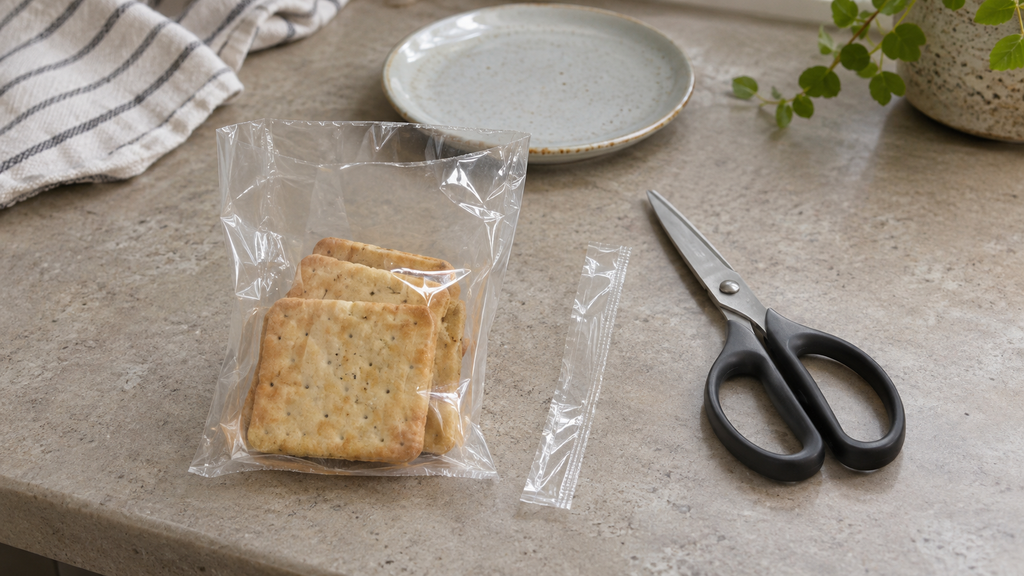
Opening a plastic wrapper can create small plastic fragments.[1] A laboratory study found particle generation when researchers tore, cut or used scissors on selected plastic materials, including food packaging.[1]
That is a narrower finding than saying that opening a snack delivers a known dose of microplastics into your mouth. The experiment collected material beneath the opening point and examined damaged plastic; it did not measure what a person swallowed with the food.[1]
Our practical recommendation is modest: use the opening provided, avoid repeatedly shredding the edge, and keep detached strips away from food. These are precautions rather than a tested way to reduce your exposure by a particular amount. The evidence does not justify throwing away packaged food or buying a special pair of supposedly microplastic-proof scissors.
What happens at the edge of a wrapper
The relevant process is mechanical damage: when a flexible film is pulled apart or sliced, stress concentrates near the moving tear or cutting edge.[1] The 2020 study by Zahra Sobhani and colleagues investigated whether that damage could produce small fragments and fibres.[1]
The researchers used plastic products bought in Australian shops.[1] Their broader tests included bags, packaging film and other plastic items; a food-packaging example involved tearing chocolate bags.[1]
This was an original laboratory experiment, not a survey of meals or a clinical study.[1] Before testing, most plastic targets were washed with laboratory detergent and water and dried.[1] Tools were cleaned, and control periods included operating scissors in the air without cutting plastic.[1] Those steps helped distinguish material generated during handling from some background contamination. They also mean the setup was not simply a shopper opening an untouched packet at the kitchen table.
For the flexible-plastic comparisons, the researchers repeated short cuts or tears to reach a cumulative length of about three metres.[1] The collection instrument stayed beneath the advancing opening point.[1] That repeated laboratory handling should not be described as the result of opening one ordinary snack wrapper.
Three kinds of evidence, with different jobs
The team combined a sensitive mass measurement with microscopy and chemical analysis.[1] Each contributed something different:
- A quartz crystal microbalance detected changes consistent with material landing on its surface. It was positioned beneath the cutting or tearing point and collected only part of the material released.[1] It did not weigh every fragment generated throughout the room.
- Electron microscopy showed damaged edges and the shapes of selected fragments and fibres. Some fine structures remained attached to the parent plastic in the images.[1] Seeing a structure at a torn edge is not the same as measuring its transfer into food.
- Raman and infrared spectroscopy helped identify plastic composition in selected examples. These methods provided chemical evidence alongside the images and mass readings.[1] They did not turn every change in the balance reading into a separately identified particle.
Together, these results support the conclusion that opening selected plastic products can generate microplastics.[1] They do not provide a complete count of every released particle at every size, or a measurement of what ended up inside a particular chocolate bag.
Why the headline particle count needs care
The paper gives estimated particle numbers per length of plastic opened.[1] Those numbers were not obtained by finding, counting and chemically identifying every particle released.[1]
The calculation depended on assumptions about the size and mass of an individual particle and the fraction collected by the instrument.[1] The authors estimated that collection fraction using a simplified spatial-distribution assumption, while acknowledging that larger pieces would tend to fall rather than behave like particles distributed uniformly around the opening point.[1]
Changing the assumed particle dimensions changes the inferred number.[1] The authors also describe variation with material properties, thickness and opening conditions.[1] That makes a single count a poor label for all wrappers, let alone a personal intake estimate.
There are several steps between generating a fragment and demonstrating a health effect. Material must reach the food, remain there until eating and be swallowed; a health assessment then needs evidence about the relevant exposure and biological response. This experiment did not measure that chain.[1]
Our guide to plastic chopping boards and knife wear examines a different kitchen abrasion problem. Results from repeatedly chopping a board cannot be substituted for measurements of opening a thin film.
Are scissors better than tearing?
The study does not establish a universally best way to open every package. In a controlled comparison on a polyethylene bag, knife cutting produced a greater mass response than scissors or tearing, which had similar slopes in the instrument readings.[1]
That comparison is informative about the tested material and setup. It is not a product standard for every crisp packet, sealed pouch or multilayer wrapper. The paper describes factors such as stiffness, thickness and direction-dependent material behaviour that can affect fragmentation.[1]
Nor did new, apparently sharp scissors eliminate particle generation in the experiments.[1] Buying sharper scissors therefore cannot be presented as a proven zero-particle solution. Conversely, the findings do not mean you should tear a package that its instructions say to cut, or use a knife unsafely to avoid touching a plastic edge.
For closure-related contamination, our article on microplastics in glass bottles and their caps addresses a separate mechanism. A cap's coating and a flexible wrapper's torn edge are different sources, even though both show why the whole package matters.
Does this show that packaged food is unsafe?
No. The opening study investigated particle generation, not illness in people, and did not establish a dietary exposure or a health-risk threshold.[1]
The US Food and Drug Administration's current public assessment says that scientific evidence does not demonstrate that levels of microplastics or nanoplastics detected in foods pose a human health risk.[2] It also highlights gaps in measurement methods and health-effect evidence.[2]
The FDA additionally says there is insufficient scientific evidence to show migration of microplastics and nanoplastics from plastic food packaging into foods and beverages.[2] That broader regulatory assessment and this laboratory finding address different questions: showing fragments during controlled cutting is not the same as establishing their migration into food under normal use.
We read the FDA page as a statement about the limits of present evidence, not a guarantee that every packaging exposure is harmless. Equally, the laboratory paper's warning about particle generation does not establish that opening a packet causes disease. Neither source supplies a personal risk percentage.[1][2]
A sensible routine for opening packages
Our precautionary advice is to keep the task simple:
- Use the intended tear notch, peel seal or opening instructions rather than making repeated cuts along the same edge. This is a handling recommendation, not an experimentally validated exposure reduction.
- Keep the detached strip or corner together with the wrapper, and discard it appropriately rather than leaving it beside ready-to-eat food. Do not deliberately crumble or shred the packaging.
- If the package needs scissors, use clean tools suitable for food preparation. The experiment does not demonstrate that a special blade makes opening particle-free.
- Do not copy the researchers' laboratory cleaning procedure. Washing food packaging with laboratory detergent or solvents is not consumer advice, and this study did not test it as a household intervention.[1]
There is no need to inspect every cracker for invisible particles or discard a sound packet because it has been opened. If avoiding disposable packaging is practical for you, refill or unpackaged options may suit that preference, but this study does not demonstrate a health benefit from switching.
The useful finding is specific: the act of opening a flexible plastic package can generate fragments under tested conditions.[1] Handle the opening without unnecessary damage, keep loose packaging out of food, and be sceptical of any headline that converts the experiment into a precise dose per snack.