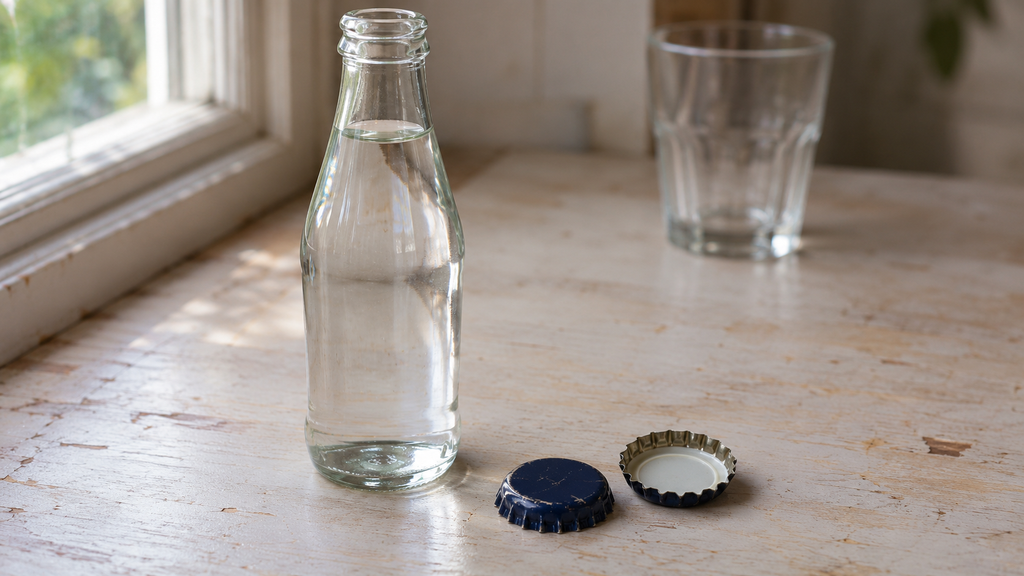
A glass drinks bottle can contain microplastics even though its body is not made of plastic. In a French study, researchers traced a contamination route to the polymer-based paint on metal bottle caps.[1]
That finding is useful if you buy glass to avoid plastic contact. It is also easy to misread. The study did not establish that every glass bottle contains more microplastics than every plastic bottle, or that switching packaging changes your risk of illness.[1][2][3]
Our recommendation is to judge the whole package, including its closure, rather than treat the bottle material as a guarantee. For manufacturers, the research points to a specific opportunity: examine cap coatings, storage and cleaning before sealing. For shoppers, it does not justify a complicated cap-washing routine.
What the French researchers tested
Iseline Chaïb and colleagues at ANSES and their university collaborators examined selected waters, soft drinks, beers and wines sold in France.[1] Their paper appeared in the Journal of Food Composition and Analysis in 2025.[1]
This was an exploratory product survey, not a census of the French market.[1] Products were chosen partly because the researchers could find a beverage in several packaging formats, and six samples from the same production batch were examined for each selected reference.[1] That helps investigate variation within a batch; it does not capture every batch, producer or country.
The team filtered the drinks, examined recovered particles under a microscope and used infrared spectroscopy to identify selected particles.[1] Chemical analysis was guided by groups of particles with similar shape and colour, rather than separate chemical confirmation of every counted item.[1]
Their reported size window was 30–500 micrometres.[1] Smaller particles were difficult to identify with their method, and no particles larger than 500 micrometres were observed.[1] These results therefore do not count nanoplastics or establish the total number of plastic particles at every size.
The researchers used air and water controls, subtracted matching contamination found in those controls, and checked recovery using known particles.[1] Those precautions matter, but they do not remove the limits of the product selection or identification method.
How paint on the outside of a cap can reach the drink
For several beverage categories, the sampled glass bottles had higher reported particle concentrations than the other packaging examined.[1] Water and wine generally had lower levels than several of the other drinks.[1][2] That pattern prompted a closer look at the closures rather than the glass itself.[1]
Many particles recovered from the glass bottles matched the colour and polyester composition of the paint on their metal caps.[1] Microscopic examination also found scratches on the outside of unused caps and paint material on their inner faces.[1]
The proposed route is that caps rub against one another during storage, releasing coating fragments that can end up on the side facing the drink.[1][2] The matching material and cap examination support that explanation. The exact contribution from storage friction across different factories remains less certain than the finding that these tested caps could contaminate water.
A metal cap is therefore not necessarily a plastic-free component. In this experiment, the relevant material was the polymer-containing coating, not the metal becoming plastic.[1]
There is a related lesson in our guide to plastic-lined paper cups: the material you see on the outside does not tell you everything about the components involved. The cup-lining experiments and cap-paint experiment investigate different release routes, so their particle counts should not be added together.
The cap-cleaning experiment is more informative than a packaging league table
The team went beyond comparing drinks from shops. They cleaned glass bottles, filled them with filtered water and fitted new yellow caps under controlled conditions.[1]
They compared caps used without pre-treatment, caps blown with air, and caps blown with air then rinsed with filtered water, ethanol and water.[1] After sealing, the bottles were inverted to recover potential particles from beneath the caps, and yellow particles in the water were counted.[1]
Pre-cleaning reduced the reported yellow-particle levels, while the cap-rinsing liquid itself contained yellow particles.[1] Together with the material matching, this supports the cap coating as a contamination source in that setup. It is stronger evidence for that particular route than the simple observation that two shop-bought packages had different counts.
ANSES suggests that manufacturers investigate cap storage, paint composition and cleaning before sealing.[2] Its public explanation describes the same research; it is not an independent replication of the experiment.
This was a production-stage test using controlled water and cleaning procedures. It did not show that wiping a closed bottle at home removes particles already inside, or validate alcohol rinsing as a household food-safety routine.[1] Do not add cleaning alcohol to a drink or try to reproduce the laboratory procedure in your kitchen.
Why the glass-versus-plastic comparison was challenged
The broad packaging interpretation attracted a published comment from Jane Muncke and colleagues.[3] In the Food Packaging Forum's account of that comment, the authors raise two concerns: differences in package size and the focus on the final container rather than earlier processing contacts.[3]
The glass bottles in the study were generally smaller than their plastic counterparts.[1][3] The critics argue that reporting particles per litre can make comparatively small packages appear more contaminated, and call for consideration of the relevant contact surface area.[3]
Particles per litre still describes a concentration in the sampled drink. Our reading is that it cannot, by itself, isolate the effect of bottle material when volume, closure and production conditions also vary. A fair material comparison needs those differences addressed, not simply a different label on the same chart.
The critics also point to plastic equipment used before bottling, including filling lines and storage containers, as potential contributors that a final-package comparison needs to consider.[3] Finding particles in a glass bottle does not establish that every one originated in its cap.
We read the original research in full. The comment discussion here is based on the Food Packaging Forum's accessible account, an organisation whose researchers co-authored the comment, rather than a full-text reading of the journal letter.[3] It is a methodological criticism, not another experiment showing that the cap finding disappeared.
The narrower conclusion holds up better than a universal ranking: the tested cap coatings provided a plausible, experimentally supported contamination route. The retail survey does not settle which packaging material always produces the lowest exposure.[1][3]
What to do with this information
For everyday purchases, we recommend:
- Do not pay for a guarantee based on glass alone. Ask what a claim covers: the bottle body, the closure, or testing of the finished drink. A glass body is not a test result.
- Keep packaging and health claims separate. You can prefer glass for reuse or other practical reasons without claiming that it makes a drink microplastic-free. This study did not measure a health benefit from switching containers.[1][2]
- Skip improvised decontamination. Follow the product's normal handling instructions. The cap-cleaning experiment concerns pre-sealing controls, not a proven consumer treatment.[1]
For a drinks producer or buyer specifying packaging, the more useful questions are whether caps arrive with coating debris, how they are stored, and whether a validated pre-sealing process reduces contamination without compromising food safety. ANSES identifies storage conditions and coating composition as avenues for investigation.[2] Ask for evidence from the finished product rather than assuming that a material specification proves performance.
If your immediate decision is what water to drink, our tap-versus-bottled-water guide addresses that separate question. This cap study is not a reason to disregard local drinking-water safety guidance.
Detection is not a health-risk threshold
The French work measured contamination and investigated a source; it did not follow drinkers for disease or test whether changing caps improves human health.[1] ANSES explicitly says that, without toxicological reference data, it cannot determine whether the levels found pose a health risk.[2]
That uncertainty is not a finding of harmlessness. It is a reason to avoid turning a particle count into a personal diagnosis or a promise about safer packaging.
The useful takeaway is specific: a glass bottle can still have a polymer-bearing closure, and cap handling can matter before the drink reaches the shop. The research gives producers something to investigate. It gives consumers a reason to question whole-package claims, not a reason to panic over a bottle of lemonade.[1][2][3]