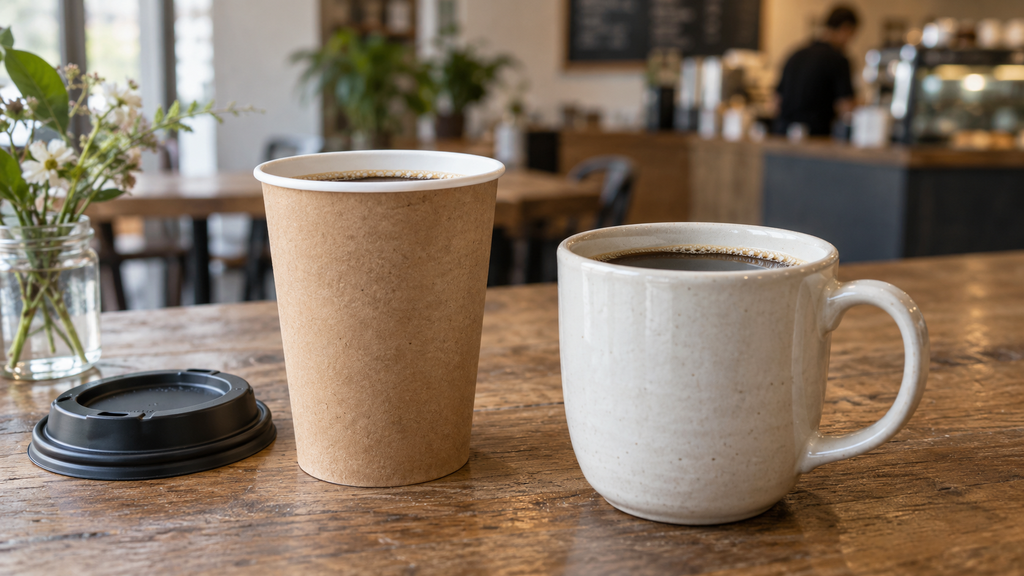
A paper takeaway cup can still put a plastic lining in contact with your drink. Studies of polyethylene-coated paper cups have detected particles released into test water, including particles much smaller than a standard microscope can resolve.[2][4] That supports a more useful question than whether the outside feels like paper: what is the cup's liquid-contact surface made of?
My practical recommendation is to ask for a ceramic mug when drinking in, or use a suitable reusable cup you already own. That avoids the disposable paper cup's lining as a contact surface. It is a precautionary choice, not a proven way to prevent disease. The studies below did not follow coffee drinkers or measure a health benefit from changing cups.[1][2][4]
Why a paper cup can contain plastic
In the paper cups examined in a 2023 Food Control study, the inner coating was high-density polyethylene, or HDPE.[2] A separate US study examined cups lined with low-density polyethylene, or LDPE.[4] Both are polyethylene plastics, but the products and manufacturing processes were different.[2][4] Neither study establishes the lining of every cup sold today.[2][4]
The coating is there to stop liquid passing through the paperboard.[4] A brown exterior, a paper sleeve or a recycling symbol is therefore not enough information to identify the surface touching the coffee. Ask the supplier for the lining material and its intended use rather than treating the word “paper” as a plastic-free guarantee.
These experiments concern specific plastic-coated cups. They do not establish a universal ranking of paper, compostable, reusable plastic, steel and ceramic cups. Our separate guide to biodegradable and compostable labels explains why a disposal claim also needs its own conditions checked.
What the cup experiments actually tested
The 2023 Food Control researchers bought five brands of plastic-coated paper cup in Shaanxi, China.[2] They rinsed the cups three times, added hot ultrapure water, and examined small samples of the water using micro-Raman spectroscopy.[2] A glass-beaker control went through the same procedure.[2]
Raman analysis matters because it helps identify a particle's material from its chemical spectrum, rather than simply counting everything that looks like a fragment.[2] The researchers identified polyethylene and polyamide, but also reported uncertain and unidentified particle categories.[2] They acknowledged that some uncertain material could include oligomers, shorter molecular chains that are difficult to distinguish from polymers in this analysis.[2] It would overstate the evidence to call every reported item an equally certain fragment of the cup's polyethylene lining.
The paper reports particles above 1 micrometre and describes a wide spread of results between brands.[2] This was a small laboratory product sample, not a survey of every café chain or a measurement of your own drink.[2] It also used water, not coffee with milk, sugar and the other substances that complicate particle analysis.[2]
A second original study, published in 2024, tested polypropylene, polystyrene, expanded polystyrene and polyethylene-coated paper cups purchased in Istanbul.[1] It used 50 mL of ultrapure water at 4°C, 50°C or 80°C, with contact periods up to 20 minutes.[1] The researchers took contamination precautions, including a HEPA-filtered workspace and a glass-beaker water control, in which they reported no contamination.[1]
There is an important identification limit: particles were counted visually under a microscope, with staining used to help distinguish natural material.[1] The infrared spectroscopy described in the methods examined the cup surfaces; it did not chemically identify every counted particle.[1] Those counts should not be presented as having the same identification certainty as individual Raman-confirmed particles.
Why “thousands” and “trillions” are not competing answers
The 2022 US study by Zangmeister and colleagues looked much further down the size scale.[4] It tested commercially available polyethylene-lined cups with ultrapure water, including water initially at 100°C that cooled naturally over a 20-minute contact period.[4] The water was not kept boiling in the cup for 20 minutes.[4]
The team sprayed the water into an aerosol, dried it, sorted particles by electrical mobility and counted them.[4] Microscopy, particle tracking and infrared spectroscopy provided additional characterisation.[4] This approach detected a population in the tens-of-nanometres range, much smaller than the micrometre-scale particles targeted by the other experiments.[4]
That difference helps explain the spectacular headline counts. Counting very small particles can produce a much larger number without implying a proportionally larger mass. The authors explicitly note that their high particle-number results accompanied lower mass concentrations than some earlier investigations.[4] A particle count without a size range, volume and method is a poor basis for comparing cups.
The US paper notes that dissolved material can precipitate during drying and increase the calculated particle number.[4] Its blank water also produced a background signal, and chemical identification of the material from the cups was more challenging than identification of the nylon material tested separately.[4] The experiment provides evidence of released nanoscale material, not a chemical identification of every counted nanoparticle.[4]
NIST's accompanying public explanation is a summary of that same experiment, not an independent second study.[3] It also makes clear that the work did not establish whether the detected particles caused harmful effects in people or animals.[3]
Does hotter water or longer contact always mean more particles?
Hotter test conditions were associated with greater release in the US study and in the 2024 cup experiment, but the relationship was not a simple rule that each additional degree caused another proportional increase.[1][4]
The 2024 paper's conclusion says that extending exposure increased release, yet its results section reports that the effect of exposure time was not statistically significant.[1] I would not use that paper to promise a particular reduction from finishing a coffee five minutes earlier. Nor is drinking a scalding beverage quickly a sensible response to a laboratory particle count.
Rinsing also needs context. Some experiments rinsed cups before testing, and the 2024 study investigated pre-washing.[1][2][4] That is not a validated household method for making a disposable cup particle-free. I would choose a purpose-made reusable vessel rather than wash and repeatedly reuse a cup designed for one use.
What this does, and does not, say about health
These are material-release experiments. They do not measure how much of a coffee drinker's total exposure comes from the cup, how much enters the body, or whether that exposure causes a particular disease.[1][2][4] Evidence from cell or animal experiments elsewhere cannot supply the missing human outcome for these cup tests.
The FDA takes a more cautious position on the broader evidence than some paper headlines suggest. Its current overview says there is insufficient scientific evidence to show migration of microplastics and nanoplastics from plastic food packaging into food and beverages; it also highlights the lack of standardised, validated measurement methods.[5] The laboratory papers report release under their test conditions, while the regulator judges the wider evidence insufficient.[2][4][5] Those are different assessments, and neither should be quietly omitted.
The FDA further states that current scientific evidence does not demonstrate that levels detected in foods pose a risk to human health.[5] That is not proof that every particle is harmless. It does mean that these cup counts cannot honestly be converted into a personal disease probability or a promised medical benefit from switching mugs.
A sensible coffee routine
For a regular takeaway habit, my recommendation is modest:
- When staying in the café, ask for a ceramic mug.
- For takeaway, use a clean, intact reusable cup designed for hot drinks, following its care instructions. If avoiding a plastic drink-contact surface is your aim, check the interior as well as the exterior, including any lid you use.
- Ask a supplier what a paper cup is lined with. Treat “plastic-free” as a claim requiring a clear material specification, not as something a brown cup proves.
- Do not rush a hot drink, start a complicated cup-rinsing routine, or buy an expensive product on the strength of an unsourced “particles avoided” claim.
These are practical preferences, not interventions with a measured percentage health benefit. For another source of particles in a hot drink, read our tea-bag evidence guide; cup and bag experiments answer different questions, so their headline counts should not simply be added together.
You do not need to treat an occasional takeaway coffee as a medical incident. For an everyday habit, choosing a durable vessel you like using is a reasonable way to stop relying on that disposable lining, while the science works towards more comparable measurements.
Sources
- https://pmc.ncbi.nlm.nih.gov/articles/PMC11121293
- https://www.sciencedirect.com/science/article/pii/S0956713523003018
- https://www.nist.gov/news-events/news/2022/04/nist-study-shows-everyday-plastic-products-release-trillions-microscopic
- https://pubs.acs.org/doi/10.1021/acs.est.1c06768
- https://www.fda.gov/food/environmental-contaminants-food/microplastics-and-nanoplastics-foods