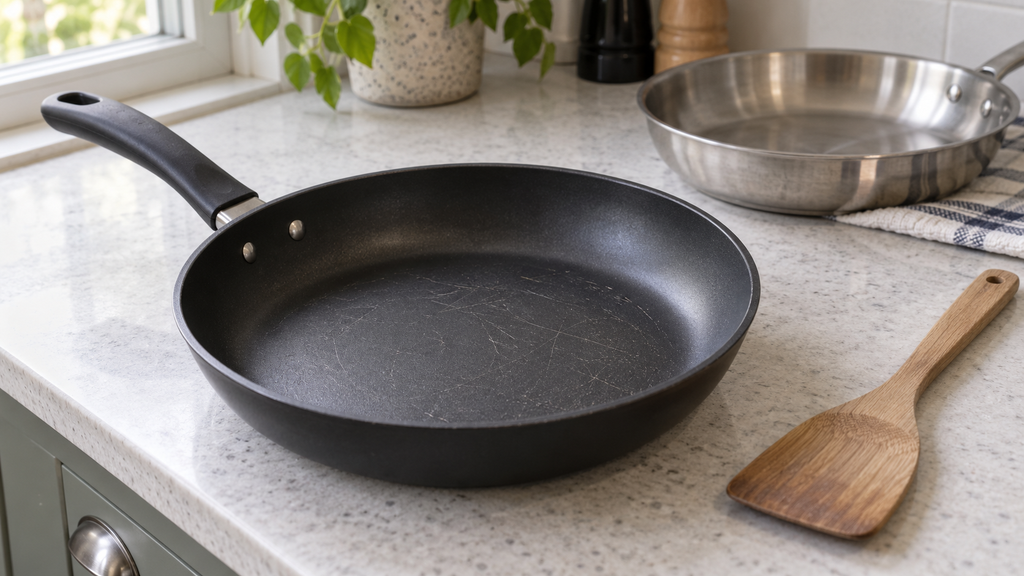
A scratched non-stick pan can shed pieces of its coating.[1] A laboratory study identified Teflon material on damaged cookware and utensils, including structures at very small sizes.[1] That finding deserves attention, but it is not a measurement of how many particles reach your dinner or a demonstration that using a scratched pan causes disease.[1]
For an existing pan, start with its care instructions and condition rather than a frightening particle headline. Avoid empty overheating and further damage to the coating.[1][2] The German Federal Institute for Risk Assessment, BfR, says that properly used PTFE cookware is not expected to harm consumers, and that accidentally swallowing tiny particles from a scratched coating is not expected to have an adverse health effect.[2] Replacing a badly deteriorated pan is a reasonable maintenance choice. Neither source supplies a validated scratch count that tells you your personal microplastic risk.[1][2]
What the coating is, and which question you are asking
Many non-stick coatings use polytetrafluoroethylene, abbreviated PTFE and commonly associated with the Teflon name.[1][2] PTFE is a synthetic polymer and belongs to the broad group of per- and polyfluoroalkyl substances, or PFAS.[2]
Three questions need separate answers. Can abrasion produce solid coating particles? Can excessive heat decompose the coating and release hazardous gases? Does normal use expose a person to enough material to cause harm? The laboratory paper addresses particle generation and identification, while BfR's guidance addresses consumer use and the overheating hazard.[1][2]
Calling PTFE a PFAS does not make every finding about another PFAS a finding about swallowed PTFE fragments.[2] BfR distinguishes the polymer from non-polymeric substances used during manufacture and assesses the expected releases from properly used cookware.[2] A paper identifying coating debris therefore should not be retold as proof of exposure to a particular manufacturing chemical.[1][2]
This article concerns PTFE-coated cookware. It does not rank every product sold as non-stick, ceramic, stone or granite. Check the actual coating specification rather than assuming that a product name describes its chemistry.
What the scratch experiment actually did
Luo and colleagues' 2022 study examined six non-stick cooking pots, four new and two old, and tested utensils including steel turners and a wooden turner.[1] Researchers cut the cookware into small sections and cleaned the samples before testing.[1]
They mimicked stirring and turning motions for about 30 seconds in a dry test at room temperature, without food or oil.[1] The authors explicitly say that cooking with food, oil or water could give different results and was outside the scope of the experiment.[1] It was not a test of particles recovered from a cooked meal.[1]
The researchers used Raman imaging, which provides information about a material's molecular composition, alongside scanning electron microscopy, which shows much finer surface structure.[1] Their work developed ways to extract weak PTFE signals from a complicated background.[1] Combining chemical identification with detailed images is more informative than assuming every speck seen under a microscope is plastic.
They identified PTFE debris on utensils and examined broken coating and scratches on the cookware.[1] Some very small structures remained attached to the coating or utensil, a point the paper itself makes in its conclusion.[1] Material present at a damaged surface is not automatically material transferred to food and swallowed.[1]
The study included a wooden turner for comparison with steel utensils.[1] The authors also comment that wood and plastic turners are softer and generate fewer scratches and less debris, but a plastic turner is not listed among the utensils tested.[1] We treat that comment as a reason to avoid unnecessary abrasion, not a quantified comparison of plastic, wood and steel or a universal percentage reduction for every pan.
Why the big particle numbers are not a dose per meal
The study estimated about 2.3 million microplastic and nanoplastic structures in one broken area, and about 9,100 associated with a crack or fracture.[1] These are estimates from image analysis of particular damaged areas, not a serving of food, a whole household's cookware or a person's measured intake.[1]
The authors describe several limitations. The test lacked heating, food and oil; cookware quality and age vary; the force and direction of utensil movement matter; and counting depends on the image-processing threshold.[1] Their counting process could not effectively distinguish fine wire-like structures from nanoparticles.[1] The analysis combines Raman identification with finer SEM images; it does not chemically identify every nanoscale structure individually.[1]
Neither figure means that each scratch releases that number into dinner.[1] A particle count alone does not say what the total mass is, how much is swallowed, how the body handles it or what health effect follows.[1][3] Those are further questions, not numbers supplied by this experiment.[1]
How the laboratory finding fits with health guidance
The study's authors call for further toxicity research and systematic risk assessment.[1] They did not run a human clinical study, an animal feeding experiment or a cell-toxicity assay in this cookware investigation.[1] Its strongest evidence concerns material identification and damage, not a demonstrated human outcome.[1]
BfR's July 2025 FAQ takes a reassuring position on normal consumer use. It says that tiny PTFE particles accidentally eaten from a scratched coating are not expected to harm health because PTFE is inert and the particles are excreted unchanged.[2] That is an official risk-assessment statement, not a second cookware abrasion experiment.
The sources are addressing different parts of the problem. Finding coating debris does not by itself contradict a judgement that accidental ingestion is not expected to cause harm. Equally, that judgement does not mean the coating cannot shed. We should report both without turning either into a guarantee about every particle size and every exposure condition.
The US Food and Drug Administration's broader assessment is that current evidence does not demonstrate a human health risk from the levels of microplastics and nanoplastics detected in foods.[3] It also describes major gaps in measurement methods, particularly for nanoplastics.[3] This is context for the uncertainty, not a pan-specific safety test or proof that all possible exposure is harmless.
Overheating is a separate, actionable hazard
BfR warns that PTFE can decompose at around 360°C and above, releasing hazardous substances into the air, potentially without visible smoke.[2] It advises never heating PTFE-coated cookware while empty and taking particular care with rapidly heating gas and induction hobs.[2]
That temperature is a warning about decomposition, not a recommended cooking setting. Follow the manufacturer's temperature limits rather than treating anything below the cited figure as automatically suitable. BfR also advises against PTFE cookware at the high temperatures that can occur directly over gas or charcoal grill flames.[2]
A scratch and an overheated coating are different mechanisms. Replacing a scratched pan does not remove the need to use the next pan correctly.
A practical decision for your kitchen
Our recommendation is to use condition and intended use as your guide:
- For a serviceable pan: follow its instructions, avoid heating it empty, and use utensils and cleaning tools that the manufacturer permits. The scratch experiment provides a reason to avoid hard abrasion, not a tested lifetime for every pan.[1][2]
- For a peeling or badly deteriorated coating: consider replacement rather than continuing to scrape it. This is a precaution and a maintenance judgement, not a diagnosis of poisoning or a promise of measurable health improvement.
- For the next purchase: if you want to avoid a PTFE coating, look for an explicitly uncoated cooking surface and verify the material specification. Choose something suited to how you cook and can maintain. Do not assume that an expensive pan, or a reassuring product name, certifies zero particle release.
- For claims about risk: ask whether the source measured debris on a surface, particles in food, a biological effect in a laboratory, or an outcome in people. Those are not interchangeable endpoints.
For another abrasion question, our plastic chopping-board guide examines knife contact and food-safety considerations. Our guide to microwaving food in plastic containers considers heating and explains why a laboratory release measurement is not a clinical risk estimate.
There is a useful middle position here: protect the coating, avoid empty overheating and replace cookware when its condition warrants it. The evidence does not justify a dose-per-scratch calculator, an emergency clear-out of every non-stick pan or a claim that changing cookware prevents disease.[1][2][3]