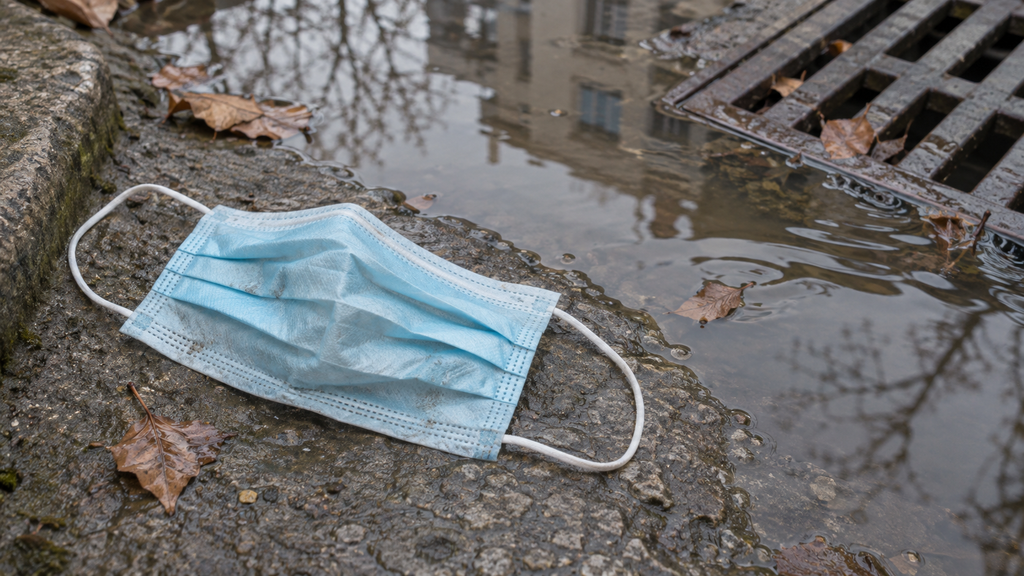
A discarded disposable mask is more than an untidy piece of fabric. Its nonwoven plastic layers can release smaller fibres and fragments into water, as two original laboratory studies have demonstrated.[1][2] That is the microplastics connection: an intact protective product can become a source of small plastic particles after it enters the wrong waste pathway.
The useful response is to keep used masks out of streets, drains and waterways, without compromising the protection for which they are worn. These water experiments did not measure what someone inhales while wearing a mask, nor did they demonstrate illness caused by normal mask use.[1][2]
Why a soft mask can be plastic litter
The masks examined in these studies were made from layered nonwoven materials, with polypropylene among the identified polymers.[1][2] A soft, cloth-like appearance does not mean the sheet is cotton or that it will simply dissolve in rainwater. In Bogush and Kourtchev's experiment, polypropylene was the main polymer identified in particles recovered from the water around the tested masks.[2]
There are two related possibilities: loose particles already associated with the product can detach, and the material can break into smaller pieces as it wears or weathers.[1][2] Finding particles after soaking alone does not establish how much new fragmentation occurred during that soak. The distinction matters when headlines describe a mask as having “broken down”: release of some small particles is not disappearance of the whole item.[2]
Our wet-wipe disposal guide explores a similar material-versus-disposal question. Here, however, the evidence concerns protective masks immersed in water, not wipes moving through sewers or a test of flushability.
What the used-versus-new mask experiment tested
Chen and colleagues compared new disposable masks with masks worn normally for one day by students and staff at their institute.[1] They obtained products from 18 brands, covering several mask categories, and used three replicates for each brand and treatment.[1]
Each whole mask was placed in a glass flask containing deionised water, then shaken at 120 revolutions per minute for 24 hours.[1] The researchers rinsed the mask afterwards and filtered both the flask water and the rinse water to collect released material.[1] This was a controlled agitation test, not a mask left undisturbed in a roadside puddle.
After correcting for particles found in laboratory blanks, the team reported more particles from the previously worn masks than from the new ones.[1] Fibres were the predominant shape.[1] That supports a release pathway, but it needs two qualifications.
First, the counts relied on visual assessment of shape, colour and size under a microscope.[1] The team used Raman spectroscopy to identify selected typical particles, rather than chemically confirming every object counted.[1] The paper therefore should not be read as a complete chemical inventory of everything released.
Second, a used mask can carry material captured from the surrounding air as well as material from its own layers.[1] The authors explicitly discuss that possibility, alongside wear during handling and use.[1] The difference between new and worn masks cannot all be assigned to newly broken mask fibres with certainty.
The study did not test breathing through masks, collect a wearer's inhaled dose or follow participants for health outcomes.[1] Its water-release result should not be converted into a claim about particles entering someone's lungs.
A second experiment found release without shaking
Bogush and Kourtchev investigated whether unused masks could release microplastics into water without added mechanical agitation.[2] They tested selected surgical/medical masks and filtering facepieces purchased from UK pharmacies.[2]
Whole new masks were placed in glass beakers containing high-purity water and left at room temperature for 24 hours.[2] The experiments were performed in triplicate, with procedural blanks to account for contamination.[2] The mask-soaking stage did not include shaking.[2]
The researchers filtered the water and used infrared microscopy to identify particles and their polymers.[2] Their analysis required a spectral-library match above a stated confidence threshold, a different approach from visually counting particles and checking selected examples.[2]
All tested mask types released identified microplastics under those static conditions.[2] The authors suggest that particles associated with manufacturing may already have been present on new masks.[2] That is an interpretation of the release result, not direct observation of the factory process.
The paper reports an analytical lower limit of about 10 micrometres for identified particles.[2] Its much smaller filter-pore size did not mean that every particle retained by the filter could be identified.[2] Nor was this a measurement of nanoplastics. A collection membrane and an identification instrument have different limits.
Why the studies cannot give one universal count per discarded mask
The two experiments agree on the basic possibility of release into water.[1][2] They do not use an interchangeable particle-counting method or reproduce an identical environmental journey. One shook new and previously worn masks; the other soaked selected new masks without agitation, using a different identification method.[1][2]
They also do not establish a consistent ranking of mask categories. Chen and colleagues found no significant release difference among the types they tested, whereas Bogush and Kourtchev reported higher counts per mask for the filtering facepieces in their experiment.[1][2] Different products, product weights, preparation and analytical methods complicate that comparison.[2] Neither result is a reliable shopping league table for every brand now on sale.
A real discarded mask may encounter sunlight, grit, moving water or long dry periods. These two day-long laboratory tests do not establish a universal outdoor release rate or how much material from a particular street reaches the sea.[1][2] Multiplying their counts by an estimate of global mask use would be an extrapolation, not a worldwide measurement.
The second paper also analysed selected chemical additives separately.[2] Dissolved chemicals and solid plastic particles are different measurements; an additive finding should not be folded into a microplastic particle count. Neither study establishes a person's dose from drinking water or a clinical outcome attributable to discarded masks.[1][2]
Dispose of the waste without weakening protection
The practical priority is containment after use, rather than changing a protective product on the basis of a water-soaking experiment. Follow current local health advice, workplace requirements and the instructions for your mask. Do not wash, shake out or extend the use of a single-use mask as a supposed microplastics remedy.
WHO's October 2023 mask Q&A advises removing a medical mask by its straps without touching the front, discarding it immediately, preferably into a closed bin, and cleaning hands afterwards.[3] The page is now retained for reference and is no longer being updated; we use it for those basic handling instructions, not as a statement of current UAE masking requirements.[3]
Our recommended disposal routine is:
- Use the designated bin promptly. At home or in a public setting, follow local waste instructions and keep the item contained. In healthcare or occupational settings, use the required waste stream rather than assuming household rules apply.
- Keep it away from water. Do not flush it, rinse it down a drain or leave it beside a bin where it could become litter. Avoiding those routes addresses the water-contact pathway examined in the studies.[1][2]
- Check any specialist collection claim. Do not put used masks into ordinary mixed recycling merely because their fibres are plastic. Use a separate programme only when it explicitly accepts that item and gives handling instructions.
- Make the bin convenient. For a workplace or venue, our suggestion is a clearly identified, appropriately managed disposal point where people remove masks. This is a practical source-control recommendation, not a measured reduction in human microplastic exposure.
Our contact-lens disposal article makes the same useful distinction between a product's job and its waste route: maintain appropriate care first, then dispose of the used item deliberately.
The evidence supports taking mask litter seriously without treating needed protection as the problem to avoid. Smaller plastic fibres and fragments can leave masks in water; how many are detected depends on the product and test.[1][2] Keep the used mask contained, follow the relevant disposal rules, and do not turn an environmental release experiment into a diagnosis of the person who wore it.