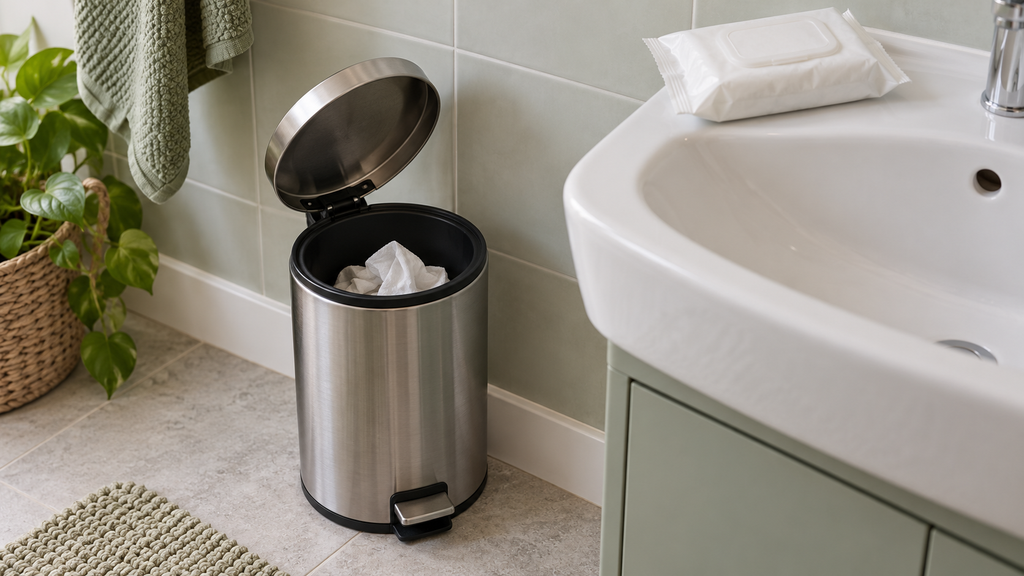
A wet wipe can feel like cloth and still contain plastic.[1] In a Toronto river study, researchers identified polypropylene and polyester in discarded wipes, then showed that selected wipe products could shed smaller fibres under experimental weathering.[1] The useful household response is simple: put used wipes in a bin, including those labelled "flushable". That is also the UK Government's public disposal advice.[3]
Choosing a clearly described plastic-free wipe can address the material in the sheet. It does not settle what happens when that sheet enters a sewer or river. A separate field experiment in Wales found that selected cellulose-based wipes weakened at different rates, with some material persisting after weeks in flowing water.[2] Material choice and disposal deserve separate decisions.
Which part of a wet wipe can be plastic?
The sheet itself matters, not just its wrapper. Hansra, Haney and Rochman examined wipes collected from Toronto's Don River and used infrared spectroscopy to identify their material.[1] Of 734 collected wipes, 206 were analysed by that method; the authors reported that 99% of the analysed subset was plastic, predominantly polypropylene and polyester.[1] That percentage describes a selected sample of river litter, not all wipes sold in Canada, and certainly not the UAE market.[1]
The same team surveyed product packaging at five Toronto store chains and an online retailer.[1] After removing duplicates, they recorded 72 products across 42 brands.[1] Only seven products gave composition information, while 48 carried disposal information.[1] The online part relied on merchant photographs rather than physical inspection of every package, another reason to keep the finding local and bounded.[1]
Our buying recommendation is to look for an explicit statement about the wipe's fibres, rather than infer composition from a white sheet, green packaging or the liquid-ingredient list. Polypropylene and polyester are relevant plastic names in this study; regenerated cellulose was a different material tested alongside them.[1] If the sheet composition is not disclosed, ask the manufacturer rather than treating the omission as proof either way.
How can a whole wipe become microfibres?
The Toronto work combined three kinds of evidence: river litter sampling, a packaging survey and a controlled weathering experiment.[1] They should not be collapsed into one claim that researchers followed an individual flushed wipe all the way into a fish or a glass of drinking water. They did not.
The river survey sampled four sites in 2022.[1] Wipes were especially abundant at a site associated with a combined sewer overflow and at a downstream site; the authors interpreted untreated sewage releases as a likely pathway.[1] A combined sewer overflow can divert sewage into receiving waters during storm events.[1] That explains the proposed route in this study system, not how every country's drainage network operates.
For the weathering experiment, the researchers cut selected polypropylene, polyester and regenerated-cellulose wipes into four-centimetre squares.[1] They exposed them to combinations of wet or dry conditions, sunlight or shade, and mixing in the wet treatments, collecting samples after two and six weeks.[1] They included blank jars to estimate procedural contamination and corrected the fibre results against those controls.[1]
The tested polypropylene wipe shed more fibres than the polyester wipe, while the regenerated-cellulose wipe shed more fibres than either plastic product.[1] Microfibre is a description of shape, not automatically a synonym for microplastic. A cellulose fibre should not be relabelled as polypropylene simply because it is small.[1][2]
The team identified the original wipe materials spectroscopically, then counted released fibres under a microscope, using subsampling and mass-based extrapolation for dense fibre clumps.[1] That is not chemical confirmation of every released fibre, nor a measurement of nanoplastics.[1]
The experiment supports the possibility of plastic sheets becoming smaller plastic fibres.[1] It does not establish a release rate for every brand: only one selected product represented each material, and the authors note that wipe construction and intended use may also explain differences.[1] Turning its jar counts into "particles released every time you use a wipe" would answer a question the experiment did not test.
Why a biodegradable wipe is not a licence to flush
Allison and colleagues tested two commercial cellulose-based wipe brands marketed as biodegradable at ten urban river and stream sites in Cardiff.[2] They deployed whole wipes and cut strips in mesh bags, anchored them in the water and retrieved samples over five weeks.[2] This was a second, independent original experiment, not another news story about the Toronto work.[2]
The key measurement was tensile strength loss: how much weaker a strip became when pulled until it failed.[2] That is useful evidence of lost mechanical integrity. The paper explicitly cautions that it cannot distinguish physical disintegration from microbial or chemical breakdown.[2] A weaker sheet is not proof that all of its material has been biologically converted.[2]
The two brands behaved differently. By week five, one showed substantial deterioration at several sites, while the other often retained its structure.[2] The study also had field constraints, including samples washed away at two sites; anchored mesh bags do not reproduce every journey of a loose wipe.[2] Its results cannot rank every plastic-free product or certify that a particular wipe is safe for a toilet.
This does not contradict the Toronto observation that cellulose shed fibres readily.[1] A product can lose fibres while parts of the sheet remain, and the two experiments used different products, conditions and endpoints.[1][2] Neither provides a universal disappearance time. Our guide to biodegradable and compostable labels explains why a claim for one disposal environment should not be transferred to another.
What to do at home
Put a small, accessible bin where wipes are used. Our recommendation is to make correct disposal easier than flushing, rather than rely on remembering an instruction hidden on the packet. The UK Government advises binning wet wipes even when they are labelled flushable, and notes that plastic-free wipes can still contribute to blockages when flushed.[3] This is cited as disposal guidance, not as a statement about UAE legislation.
When buying, separate two questions: what is the sheet made from, and where will you dispose of it? If your aim is to avoid a plastic sheet, choose a product that clearly discloses its fibre composition. Keep the used wipe out of the toilet regardless of that choice.[1][3] Do not assume a biodegradability claim means your local compost or recycling collection accepts it; check that exact route before using it.
Where a reusable cloth suits the task, it is an option for reducing disposable-wipe use. That is our practical suggestion, not a finding that every cloth has a lower total environmental footprint. Keep appropriate cleaning and infection-control requirements first; this article is not a reason to reuse a disposable medical or disinfecting wipe against its instructions.
For the next stage downstream, our wastewater microplastic removal guide explains why capture in a treatment plant is different from destruction. Keeping a wipe out of the drain is a source-control decision. The studies here measure litter, material identification, fibre shedding and deterioration, not a household's absorbed dose or a demonstrated reduction in human disease.[1][2]
The strongest practical conclusion does not require a frightening particle total: read the sheet composition if you want to avoid plastic wipes, and bin used wipes rather than flushing them.[1][3]
Sources
- https://uofttrashteam.ca/wp-content/uploads/2026/02/lifecycle-of-a-wipe-determining-the-contamination-fate-and-transformation-of-wet-wipe-pollution-in-the-environment.pdf
- https://orca.cardiff.ac.uk/id/eprint/182406/1/Degradation%20of%20cellulose-based%20wet%20wipes%20marketed%20as%20%27biodegradable%27.pdf
- https://www.gov.uk/government/news/new-law-bans-plastic-wet-wipes-to-protect-rivers-and-seas