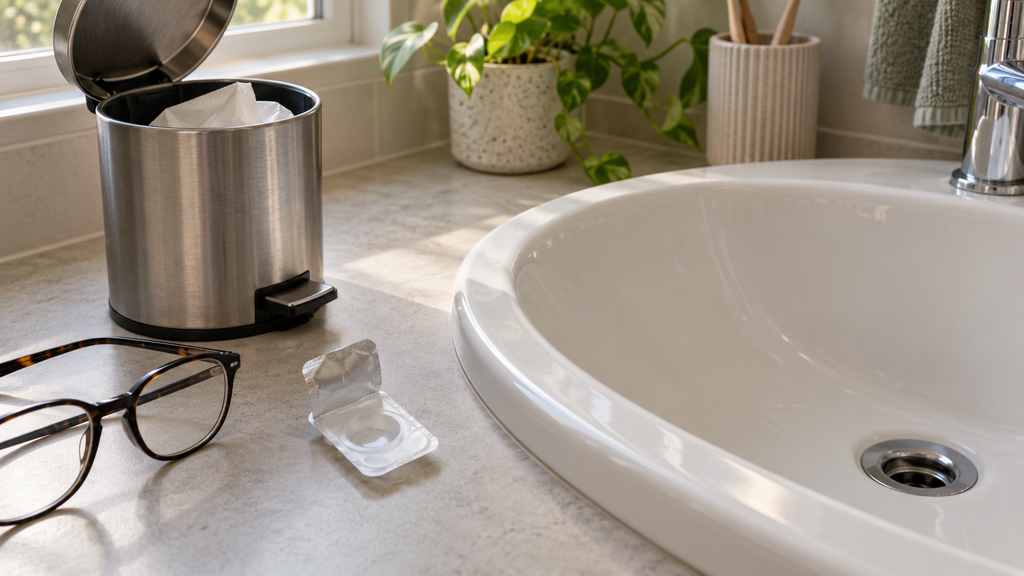
A soft contact lens feels more like a drop of water than a piece of packaging. But the lens itself is a polymer material: the silicone hydrogel lenses examined in disposal research are plastic, and used lenses can become fragments in sewage sludge.[1][3]
The practical choice is to keep discarded lenses out of the sink and toilet.[3] Use a specialist collection service only if it explicitly accepts your lenses; otherwise contain them in ordinary household rubbish, following local waste instructions.[3] Keep your prescribed replacement schedule.[4] Reducing waste is not a reason to stretch the life of a daily lens or change its cleaning routine.[4]
Why a soft lens belongs in a microplastics discussion
The connection is fragmentation, not simply the presence of plastic packaging. In their Environmental Science & Technology study, Charles Rolsky, Varun Kelkar and Rolf Halden investigated lens disposal through a US user survey, laboratory work and field experiments at a conventional sewage treatment plant.[1] Their published abstract reports limited polymer changes during biological treatment and the accumulation of lens fragments in sewage sludge.[1]
That supports a specific environmental concern: putting a lens down a drain can introduce persistent polymer material into wastewater treatment, where it need not disappear simply because it no longer resembles an intact lens.[1] It does not establish how much of that material reaches a particular river, tap or person.[1]
We could read the publisher's abstract and recover the original supporting information from ACS's Figshare repository, but not the main paper's full methods.[1][2] We therefore do not repeat its national tonnage estimates, assign a universal treatment-removal rate or offer a precise particle count for each discarded lens.
The supporting information provides a useful caution about handling. Wet lenses fragmented during repeated transfer and manipulation with tweezers and contact with microscope slides; dried lenses broke into smaller pieces during a separate shaking test.[2] Those are laboratory handling observations.[2] They are not measurements of particle release while a lens is worn on an eye, nor a release rate for an ordinary bathroom drain.[2]
A treatment plant is not a disappearance guarantee
The US research distinguishes the fate of the polymer from the route of the water: lens fragments were reported in sludge, the solids associated with treatment.[1] Its national estimates use a mass-balance model, including assumptions about disposal behaviour and the destinations of US sewage sludge.[2]
An estimate built from those inputs is not a nationwide collection of every discarded lens.[2] Nor can it be transferred directly to UAE sewer systems, disposal habits or sludge management. We have not measured those local pathways.
Even the survey needs its question attached. The supporting information separates how respondents dispose of used lenses from whether they have ever flushed one; those are different behaviours, with different response totals.[2] A headline percentage stripped of that distinction can mislead. We do not use the survey to tell an individual reader what their neighbours do.
Our guide to wastewater microplastic removal explains the broader distinction between capture and destruction. For lenses, the household decision comes earlier: keep the discarded item out of wastewater rather than rely on treatment to make it vanish.
The lens, blister and foil need separate decisions
A second original study, by Sarah Smith and colleagues, examined the waste from selected daily-disposable and monthly-replacement soft lens systems.[3] The researchers separated packaging and care-product components, identified their materials, weighed them and modelled annual waste under stated wearing and replacement assumptions.[3] This was a product-waste audit, not another experiment tracking lens fragments through a sewage plant.[3]
The products in that audit included silicone hydrogel lenses, polypropylene blister trays and sealing foils made from layers of aluminium and plastic.[3] The shiny seal was therefore not simply a piece of household aluminium foil.[3]
For a wearer, that means checking each item rather than treating the entire pack as one recyclable object. Our recommended routine is:
- Put a discarded lens somewhere it cannot be washed into the basin. A small piece of tissue placed in household rubbish is a practical option when an accepting specialist service is unavailable.
- Check whether a local optician or collection service explicitly accepts used lenses, blister trays and their seals. Ask about each component, not just "contact-lens recycling".
- Sort outer cardboard and empty care-product bottles according to your actual local collection rules. Do not assume the small blister follows the same route as the bottle.
- Keep any collected used lenses separate from clean lenses, cases and supplies. Follow the collection service's preparation instructions without changing your own lens-care routine.
The audit assessed disposal options available in Greater Manchester at the time, including a specialist collection scheme.[3] Its recycling percentages describe those products and those assumed routes, not what every current collection service will accept or actually recover.[3] The paper also includes authors affiliated with CooperVision, and we read its full text from a manufacturer-hosted copy.[3] It is useful evidence about the examined waste components, not an independent certification of every recycling claim.
No particular UAE contact-lens collection service has been verified for this article. Check acceptance before collecting or posting used lenses; do not put them loose into mixed recycling on the assumption that a plastic material must be accepted.
Do not save plastic by compromising eye care
The CDC advises washing and thoroughly drying hands before handling lenses, keeping lenses away from water, using the recommended lens solution and following the replacement schedule advised by an eye-care professional.[4] It also advises removing lenses before swimming or showering.[4]
Those instructions take priority over an improvised waste-saving routine. Do not rinse lenses in tap water, reuse daily-disposable lenses or keep wearing a lens beyond its prescribed schedule to reduce the number discarded.[4] If you want to discuss another lens type or wearing pattern, make that a conversation with your eye-care professional, not a decision based on packaging weight alone.
The waste audit itself examined dry waste and disposal, not the full environmental footprint of lens manufacture, transport and use.[3] Its product comparison does not establish which prescription or wearing schedule is clinically appropriate for you.[3] Equally, the sewage study is evidence about environmental fate, not a demonstration that normal lens wear causes microplastic-related eye disease.[1]
For the wider distinction between finding plastic and establishing a health effect, see our overview of microplastic diagnostics in humans. This article does not calculate a personal exposure or promise a health benefit from a disposal change.
Keep using lenses as prescribed, then deal with the waste deliberately. The supported message is modest and useful: used lenses should not enter the sink or toilet, and any recycling route needs real local acceptance.[3]
Sources
- https://pubs.acs.org/doi/10.1021/acs.est.0c03121
- https://acs.figshare.com/articles/journal_contribution/Nationwide_Mass_Inventory_and_Degradation_Assessment_of_Plastic_Contact_Lenses_in_US_Wastewater/12950723
- https://coopervision.co.uk/sites/coopervision.co.uk/files/clae_2021_smith_investigation_disposal_and_recycling_options_for_dd_and_monthyl_frp_soft_cl_modality_in_press_march2021.pdf
- https://www.cdc.gov/contact-lenses/prevention/index.html