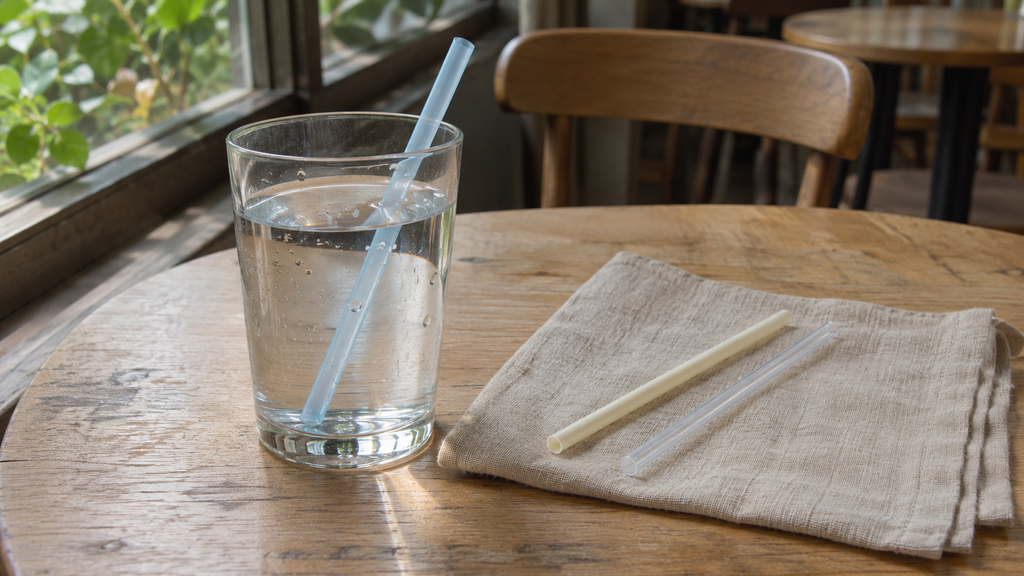
A drinking straw can be a source of microplastics in a beverage. A laboratory experiment found fragments from both conventional polypropylene (PP) straws and polylactic acid (PLA) alternatives during liquid circulation. PLA did not mean particle-free.[1]
That is a reason to look beyond a green label, not a reason to calculate your personal dose from a headline. The experiment repeatedly circulated drinks through a pump-and-straw system; it did not measure what customers swallowed in a café.[1]
Our recommendation is simple: if you do not need a straw, leave it out. If you do need one, choose for your drinking needs and the product's intended use rather than a promise of zero particles. The evidence below does not establish a universally safest straw material or a health benefit from switching.
What the disposable-straw experiment actually tested
In their 2025 study, Bangyuan Peng and Shengwang Yu tested commercially available PP and PLA straws with deionised water, cola and skimmed milk. A pump circulated liquid through the assembled straw system, with sampling over two hours. The main release comparison was at 25°C; separate temperature comparisons examined particle sizes at 25°C, 45°C and 65°C.[1]
Both materials released particles in the room-temperature experiment. PLA generally produced lower reported counts, but its result in cola was closer to PP than its result in water. The early sampling period showed a rapid initial release, followed by slower accumulation.[1]
The authors propose that loosely attached material from manufacturing and handling helps explain that early release. Their images show material on straw surfaces, but the proposed contribution of manufacturing debris should not be mistaken for a measured breakdown of every possible source.[1]
The immediate pathway is liquid contacting the straw's surface and carrying away detached material. This is a use-stage question, separate from a discarded straw weathering outdoors. It also differs from the lining-to-liquid pathway examined in our guide to paper cups and microplastics.[1]
Why we are not repeating a particles-per-drink figure
The filters used in the experiment had 3-micrometre pores, but the researchers restricted optical counting to visually identifiable particles larger than 20 micrometres. A filter's pore size is not the same as the study's counting limit. These results do not describe nanoplastics or all smaller microplastics.[1]
The team used micro-FTIR, an infrared technique, to check the polymer identity of recovered particles and presented PP- and PLA-matching spectra. Optical counting and chemical identification are nevertheless different steps. The paper does not provide a particle-by-particle confirmation rate for the entire counted population; it would overstate the methods to describe every optical count as separately polymer-confirmed.[1]
There are also limits to the control description. The methods describe a glass-straw blank in deionised water at 25°C. The results say background counts were subtracted in identical groups, without the methods clearly setting out the full beverage-specific control design. The published methods also do not clearly specify the total independent straw sample or the circulation flow rate.[1]
Those gaps matter if someone wants to compare brands or turn the results into a precise serving estimate. We use the study for the narrower finding that the tested PP and PLA products could shed under its laboratory conditions. We do not turn its two-hour circulation result into a standard drink, a daily intake or a percentage reduction from buying PLA.
Does the silicone-straw evidence contradict that finding?
A separate 2026 study by Dian Burhani and colleagues examined reusable bottles sold for young children. It included storage tests across three brands, but its sipping and simulated-biting experiments used only Brand 1. That distinction matters: three brands in the overall paper does not mean three brands independently tested for every action.[2]
For the sipping experiment, a glass syringe drew water through the straw and returned it to the bottle. The researchers compared sequences of one, ten and one hundred simulated sips. Their main chemical-imaging method, LDIR, searched an analytical size range of 20–500 micrometres.[2]
They did not detect the silicone polymer PDMS in the water within the methods' detection capability; Raman examination also found no PDMS in the scanned samples. Polypropylene particles were detected. This does not mean the silicone straw released nothing at every size, or that the particles in the water necessarily came from the mouth-contact straw.[2]
The product was a multi-material system. The detailed characterisation identifies a silicone outer straw and a PP inner straw in Brand 1, alongside other bottle components. Drawing with a syringe and opening and closing the bottle can also stress the assembly. The experiment does not isolate every PP particle's component of origin.[2]
The investigators saw surface damage after treatment, but an image of a crack or nearly detached flake is not a measurement of silicone swallowed. Their simulated biting used a metal clip with a force below the child bite forces discussed in the paper. Neither that model nor the non-detection establishes a lifetime performance guarantee for all silicone straws.[2]
The two papers therefore answer different questions. One reports release from disposable PP and PLA products during circulation; the other did not detect silicone polymer from one tested bottle-and-straw system under its particular procedures. Different materials, apparatus and detection limits can produce different findings without either result cancelling the other.[1][2]
What a PLA label can, and cannot, tell you
PLA is a plastic, even when described as a bioplastic. In the disposable-straw experiment, the tested PLA products released PLA-matching material; the label was not a guarantee against fragmentation during use.[1]
That does not settle whether a particular product meets an industrial composting specification or will be accepted by your local collector. Those are separate disposal questions. Our guide to biodegradable and compostable plastic labels explains the distinction. A result about shedding in a drink should not be repackaged as a complete environmental comparison between straw materials.
A sensible choice without a new shopping list
Our practical suggestions are:
- Skip an optional straw. This avoids that particular drink-contact item. We are not assigning it a measured reduction in total exposure.
- Keep a straw that meets an accessibility or drinking need. These papers do not justify removing a useful aid or assuming a rigid replacement suits everyone.
- Read the intended-use instructions. Choose a product suitable for the beverage and temperature, and follow its cleaning or replacement guidance. Do not invent a hot-rinsing treatment from a laboratory circulation experiment.
- Question absolute claims. Ask whether “plastic-free” describes the actual material and whether “microplastic-free” rests on a stated test, size range and detection limit. Neither appearance nor a compostability slogan supplies that evidence.
We would not buy an expensive replacement on the strength of these two papers alone. They do not compare every paper, metal, glass, silicone, PP and PLA straw under a common protocol.[1][2]
Particle release is not a demonstrated health outcome
Neither study followed people for disease or tested whether changing straws improved health. The bottle study included an exposure model, not a measurement of illness in children. Its discussion of cell and animal research does not supply a demonstrated human outcome for the drinking experiments.[1][2]
The FDA's broader assessment is more cautious than some laboratory-paper conclusions. It says current evidence does not demonstrate that the levels of microplastics or nanoplastics detected in foods pose a human-health risk. It also judges the evidence insufficient to show migration from plastic food packaging into food and drink, and highlights the lack of standardised, validated methods.[3]
That regulatory assessment and these laboratory release reports should both remain visible. They are not equivalent kinds of evidence: the papers report particular experiments, while the FDA assesses the wider evidence for regulatory interpretation. Neither establishes that every particle is harmless, or that a straw count can predict an individual's disease risk.[1][2][3]
The useful takeaway is narrower and practical: a PLA straw is not automatically particle-free, and a silicone non-detection is not a universal zero-release certificate. Choose a straw when it serves a purpose, use it as intended, and ask for better evidence before paying for a safety promise.