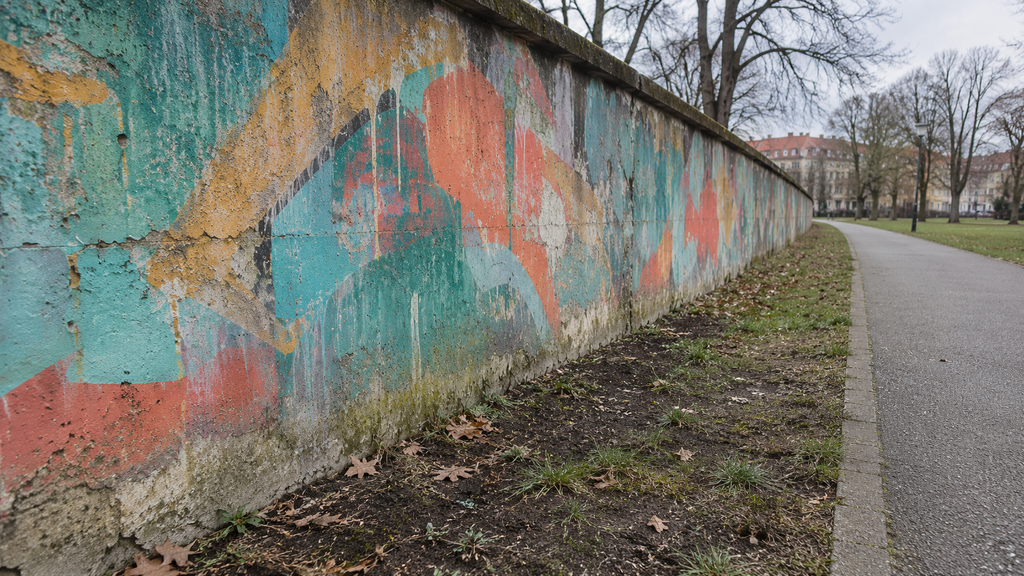
Spray paint can leave more than colour on a wall. A study beside a long-used graffiti wall in Berlin found small paint particles in the surrounding soil and confirmed polymer binders in material extracted from those samples.[1] Those binders are the connection to microplastics: a dried paint fragment can contain a plastic resin mixed with pigments and other ingredients, rather than being a piece of pure plastic.[2]
For an artist, venue manager or someone painting outdoors, the useful response is to plan where stray paint and removed coating will go. Protecting the ground and collecting waste are sensible precautions. The Berlin findings do not, however, tell a park visitor how much they inhale or establish that spending time beside a painted wall causes illness.[1]
Why paint belongs in a microplastics discussion
Paint is a mixture. Its binder helps form the coating, while pigments, fillers and other additives contribute colour and performance.[2] Andrew Turner's review of paint particles explains that small dried fragments containing polymer binders can fall within the microplastics category, even though their appearance and composition differ from familiar plastic packaging.[2]
That distinction matters when reading a count. The number of paint particles is not a measurement of pure polymer mass.[2] Nor is a coloured speck automatically plastic: identifying the material requires more than noticing its colour.[1][2]
Turner's paper is a review of existing research, mainly concerning the marine environment.[2] It supplies context about paint composition and analytical blind spots, not a second independent experiment at the Berlin wall.[2] Other coating questions need their own evidence: our guide to road marking microplastics examines traffic wear, whereas this article concerns material accumulating in urban soil beside an outdoor wall.
What the Berlin researchers sampled
Yaqi Xu, Matthias Rillig and Walter Waldman collected soil around the graffiti wall at Berlin's Mauerpark in September 2020.[1] Three sampling locations were two metres from the wall and another three were 7.1 metres away, avoiding a concrete footpath.[1] The team divided soil cores into five-centimetre layers; the analysed profiles reached depths of 20 to 30 centimetres.[1]
This was a case study at a place with a history of repeated spray painting, not a representative survey of parks, cities or every outdoor painting job.[1] The authors considered both spray droplets deposited nearby and fragments worn or peeled from the layered wall as likely inputs.[1] Their sampling did not follow each particle from a particular can or painting session into the ground.[1]
The researchers recovered small, often rounded coloured particles as well as larger fragments with several paint layers.[1] Particle abundance decreased with depth at the sampled locations.[1] A separate size analysis at the location with the highest reported concentration found a shift towards larger particles in deeper layers.[1] That last observation should not be described as a size-distribution test at every location.
Why a usual flotation test can miss paint
Separating small plastic pieces from soil is difficult because the sample also contains minerals and organic matter. A flotation method uses a liquid of known density: material less dense than the liquid can rise, allowing it to be separated from material that sinks.
Paint complicates that approach. Its pigments and fillers can make particles denser than many of the plastics commonly targeted in environmental surveys.[1][2] A method suited to lighter plastic fragments can therefore leave some paint particles behind.
The Berlin team used two separation steps. First, a sodium bromide solution removed lighter material, with that liquid fraction discarded.[1] The remaining material was then treated with a denser mixture of sodium bromide and zinc chloride to float the targeted paint particles for filtration and microscopy.[1]
The result was a paint-focused fraction, not a complete inventory of every kind of microplastic in the original soil. In particular, the method deliberately removed lighter material before examining the denser fraction.[1] Its laboratory salts and subsequent solvent analysis are also not a home soil-testing or cleaning recipe.
Chemical evidence is not the same as confirming every counted particle
The particle count came from microscope images. The researchers took ten randomly selected pictures for each soil layer, counted objects with the specified paint-like colour and shape characteristics, and scaled those observations to the filter area and soil mass.[1] They did not individually count every particle in a kilogram of ground.[1]
For chemical verification, they used xylene to extract paint binders from soil and analysed the film left after the solvent evaporated with Fourier transform infrared spectroscopy, or FTIR.[1] The resulting spectra indicated mainly alkyd and styrene-acrylic resins, with a smaller polyvinyl acetate contribution.[1]
That provides evidence for polymer-containing paint material in the samples. It does not mean every visually counted object received its own chemical identification.[1] Keeping those two parts of the method separate is more informative than saying simply that scientists "confirmed thousands of plastics".
The paper also acknowledges possible losses during separation, difficulty spotting particles against the background, and limited microscope detection below roughly four micrometres.[1] A filter's small pore size does not mean the microscope reliably identified everything that the filter could retain. This was not a nanoplastics measurement.[1]
There is a further reason to be cautious with the headline numbers: the abstract and the main results report concentrations on different numerical scales.[1] We have not verified a correction resolving that discrepancy, so we do not repeat a particles-per-kilogram figure or use it to rank this soil against other locations. The evidence for the presence of paint-derived material can be discussed without treating the abundance figures as settled.
What to do before painting outdoors
Our recommendation is to make containment and waste handling part of the job from the start, rather than leave the ground cleanup until the paint has dried. Official painting and stormwater guidance from the 78th Civil Engineer Group at Robins Air Force Base recommends drop cloths, drip pans and protecting nearby storm drains during outdoor painting.[3] This is pollution-prevention guidance, not a trial measuring a particular reduction in microplastic exposure.
For a mural venue, property manager or outdoor painting contractor, useful questions are:
- What will catch material outside the intended surface? Agree how the ground and nearby surfaces will be protected during preparation, mixing and painting. Drop cloths and drip pans are established practical measures.[3]
- How will removed coating and spills be collected? Ask for an appropriate collection method and a plan for containing the waste. The official guidance recommends having spill-cleanup materials ready and using suitable dry cleanup methods where possible.[3] Do not treat loose old paint as harmless material to scatter into the soil.
- Where will the waste go? Keep unused paint and cleaning residues out of storm drains.[3] Follow the product instructions and the receiving waste service's requirements; local rules and the paint's composition determine the appropriate route. The US guidance cited here is not a statement of UAE or other jurisdictions' disposal law.
An old or unknown coating warrants professional advice before disturbance, particularly where hazardous ingredients may be present. The cited guidance distinguishes ordinary dried paint waste from oil-based and lead-containing waste requiring different handling.[3] This article does not recommend scraping, sanding or solvent treatment as a DIY microplastic-removal method.
For large painted structures, our article on ship-hull paint and microplastics explains another reason to ask what a collection system actually captures. Having a hose, shroud or waste container is not, by itself, proof that nothing escapes.
A soil finding is not a visitor's health result
The Berlin study examined soil and recovered paint material. It did not measure visitors' inhaled or swallowed dose, test their health, or establish a safe distance from the wall.[1] It also did not experimentally demonstrate ecological harm at the sampled concentrations; the authors called for further work on effects in soil.[1]
For a visitor, these findings alone do not justify avoiding parks or buying a personal microplastic test. For the people responsible for painting and maintaining a site, they offer a more direct lesson: material that misses the wall, or later leaves its coating, deserves a collection plan. The practical priority is to prevent avoidable releases while keeping claims about quantities and health within what was actually measured.