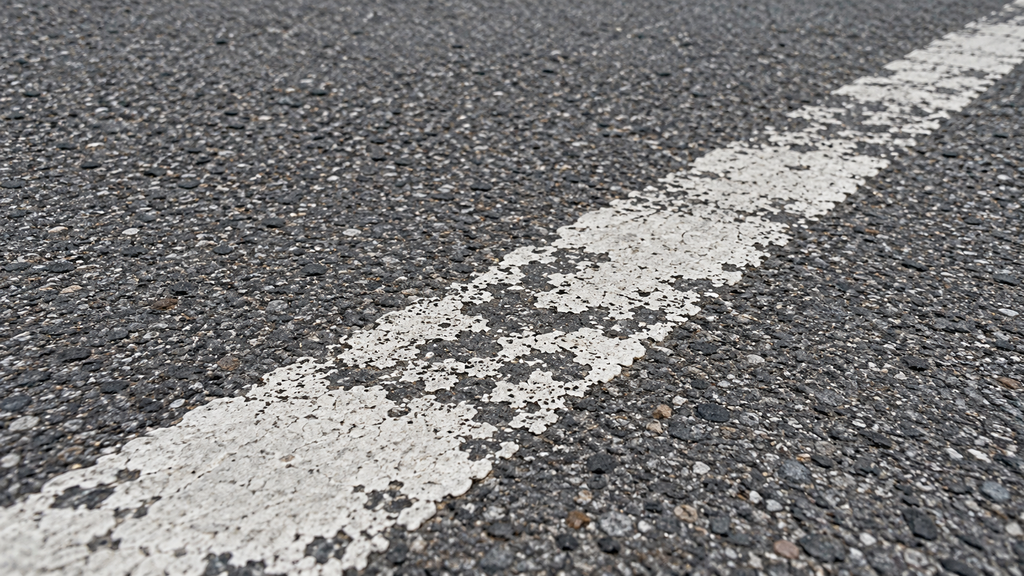
Road markings can release polymer-containing material as they wear, but a fading white stripe does not tell you how much plastic has entered the environment.[1][2] The answer depends on the marking material, its protective surface, the traffic it receives and when it is renewed.[1][2][3] For residents, the useful response is to report damaged markings safely. For road managers, it is to ask for evidence about material loss and maintenance, rather than treat every national estimate as a measured discharge.
There is a genuine disagreement in this research. A Swedish transport institute report describes potentially substantial emissions, while laboratory researchers argue that retaining surface glass beads can greatly limit abrasion of the polymer-bearing layer.[1][2] Both deserve a closer reading. Neither provides a personal exposure test or a calculation of your chance of illness.
The white material is a mixture
Road markings include different systems, such as paint, thermoplastic and cold plastic, with different compositions and application methods.[2] They can contain binders, pigments, fillers and glass beads; the mass of a worn fragment is therefore not automatically the mass of its polymer content.[2] Glass beads used for visibility are glass, not plastic. Counting every bead beside a road as a microplastic would confuse different materials.[1][2]
This makes the word "emissions" surprisingly easy to misread. A result might describe all material lost from a marking, only its estimated polymer fraction, or particles collected in a particular sample.[2] Those quantities need different labels. An estimate of polymer mass is not a count of chemically identified particles, and a missing patch of paint is not a measurement of what a pedestrian inhaled.
The separate question of rubber-derived material is covered in our guide to tyre wear and road runoff. A road-dust sample can contain several sources at once; identifying one does not establish the contribution of all the others.
What the laboratory experiment actually tested
Schulze and colleagues tested two commercially obtained thin-layer marking materials: a solventborne paint and a sprayed cold plastic.[1] Both were applied to concrete blocks and given the same type of surface glass beads mixed with anti-skid aggregate.[1] A wear machine then subjected them to aggressive rotating-tyre abrasion.[1]
The researchers periodically measured retroreflectivity, meaning the light returned towards a driver, photographed the surfaces and collected the worn material.[1] They used thermal analysis and elemental tracers to help distinguish marking-derived material from tyre-derived material, because the two adhered to one another and could not simply be separated.[1] This was not a visual count of every pale speck as plastic.
The two materials behaved very differently. The solventborne paint lost glass beads as abrasion progressed, while the sprayed cold plastic retained its beads much better and produced no meaningful identified microplastic emissions under the reported test conditions.[1] The result supports a protective role for the beads in these tested systems. It does not establish that every marking on every road releases negligible material.
The paper itself says more work is needed on other materials and conditions.[1] It also concludes that a decline in retroreflectivity is insufficient, on its own, as an emissions indicator.[1] A road stripe becoming less reflective is therefore not a calibrated plastic-pollution meter.
What the Swedish estimate adds, and leaves uncertain
VTI's 2024 report combined a literature review, a municipal survey, field observations, microscopic examination of road dust and calculations for Swedish conditions.[2] It is an original assessment with several components, not a nationwide collection and weighing of every particle worn from a road.
The survey recorded 223 employee responses, of which 210 were relevant responses representing 204 distinct municipalities.[2] The information needed to calculate material use was much thinner.[2] Only nine municipalities supplied applied-quantity information, and the authors judged the resulting municipal scaling too unreliable to carry into their emissions estimate.[2] They instead used other available application figures, road-network assumptions and assumed wear and polymer content.[2]
The report's conclusions give an estimated 43 to 570 tonnes of polymers released annually in Sweden, conditional on an assumed polymer content of 2 to 4 per cent.[2] That range is not a measured annual total. The authors explicitly say the figures are uncertain and need validation through controlled field studies.[2] They also explain that purchases do not directly equal wear: material can go onto new surfaces or renew existing markings before all the old material has disappeared.[2]
Winter maintenance, studded tyres and traffic loads were prominent in the Swedish findings.[2] Applying the resulting estimate to a UAE road without local material, traffic and maintenance data would be unjustified. The report did not measure a UAE network.
Why the disagreement cannot be settled with one headline
The dispute includes definitions as well as abrasion. In a published reply, Järlskog and colleagues challenge arguments about the absence of marking particles from environmental samples and call for reporting both total microplastic concentration and polymer content.[4] We read that reply's publisher-authorised abstract in the TRID record, not its full text.
Burghardt and Pashkevich's rebuttal argues that some rosin-derived binders are not necessarily polymeric and presents an analytical spectrum in support of that point.[5] For the rebuttal, we read the publisher's abstract and available section snippets, not the full correspondence. It would be unfair to present these limited readings as a resolution of every analytical disagreement.
Author context matters too. The laboratory paper and a related field study include an author affiliated with M. Swarovski GmbH; the rebuttal explicitly declares that employment as a potential competing interest.[1][3][5] That does not invalidate the results, but the laboratory and related field work should not be presented as wholly independent teams confirming one another.
The field study followed three Polish pedestrian crossings using repeated images over three years.[3] It inferred marking loss from the contrast between the light marking and exposed darker roadway, then calculated polymer release using assumed application mass and polymer content.[3] That is useful evidence about deterioration and material choice. It is not direct chemical measurement of every fragment leaving those crossings.
The sensible conclusion is narrower than either "road paint is harmless" or "all missing paint becomes a known plastic dose". Material, measurement method and maintenance change what a result means.[1][2][3] Our article on ship-hull paint particles explains a similar distinction between a coating fragment, polymer content and an environmental sample.
What residents and road managers can do
Our recommendation for residents is to report badly worn crossings or lane markings through the responsible road operator's normal reporting route. Photograph them only from a safe public position. Do not walk into traffic to collect dust, scrape paint or inspect beads.
For road or car-park managers, the evidence supports asking more specific procurement and maintenance questions:[1][2][3]
- Which material is suitable for the actual location and traffic, rather than simply cheapest per application?
- How will the contractor check adhesion, visibility and deterioration over time?
- Does an environmental claim refer to total marking loss, polymer mass or identified particles? Under which test conditions?
- What records distinguish new application, renewal and material actually worn away?
- How will removed material and collected road dust be managed under the operator's applicable procedures?
These are questions to put to qualified operators, not a DIY road-maintenance method. Neither the wear experiments nor the national estimate establishes a clinical benefit from an individual changing walking routes, buying a supplement or seeking a commercial microplastic test.
Road marking microplastics are worth investigating, but the practical starting point is better maintenance and better measurements. Keep road safety central, name what was measured, and leave a national estimate labelled as an estimate.
Sources
- https://publications.rwth-aachen.de/record/1026266/files/1026266.pdf
- https://vti.diva-portal.org/smash/get/diva2:1851997/FULLTEXT01.pdf
- https://swarco.com/sites/default/files/public/documents/2025_Field_study_of_pedestrian_crossings_deterioration_over.pdf
- https://trid.trb.org/View/2390262
- https://www.sciencedirect.com/science/article/abs/pii/S1361920924003018