Yes. Bursting bubbles can lift microplastics from water into the air in tiny spray droplets, as laboratory experiments have directly shown.[1] But that finding does not mean every particle in coastal air came from the sea, or that a walk along the shore has a known microplastic-related health risk.[2][3]
The useful distinction is between showing a transport mechanism and measuring how much material travels that way in the real world. The first is well demonstrated under controlled conditions; the global amount remains sensitive to particle sizes, ocean measurements and modelling assumptions.[1][3] For readers, this is a reason to question dramatic ocean-emission headlines, not a reason to avoid the beach.
How a bursting bubble carries a particle
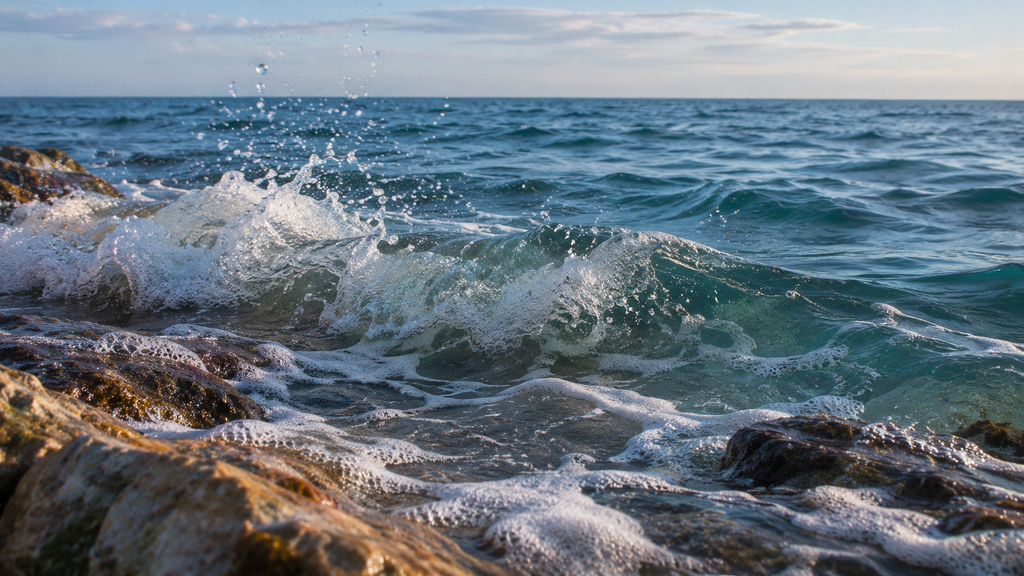
Breaking waves trap air below the water surface. As bubbles rise, they can collect particles; when they burst, some of the water becomes airborne droplets.[1]
Two parts of that burst matter. The thin cap at the surface can break into film droplets, while the underwater cavity collapses and pushes up a small jet that breaks into jet droplets.[1] Daniel Shaw and colleagues investigated the latter mechanism in their 2023 paper, Ocean emission of microplastic.[1] High-speed cameras recorded individual bubbles bursting and particles leaving the water inside jet droplets.[1]
The team also caught droplets above the surface, let them dry and counted the particles left behind under a microscope.[1] They varied bubble size, the distance bubbles rose, particle concentration and liquid properties, using several liquids including salt water.[1] This combination of direct images and collected droplets makes a stronger case for the mechanism than finding plastic near a coastline and assuming where it came from.
There is a limit to the comparison with an actual sea. The experiments used spherical particles, mainly polyethylene, rather than the full mixture of weathered fibres, flakes and fragments found outdoors.[1] The authors identified particle shape and biofouling as questions their experiment did not resolve.[1] A carefully controlled bubble test can explain a physical process without reproducing every condition in a breaking wave.
Leaving the water is not the same as travelling inland
The Shaw team combined its experimental results with estimates of sea-spray generation, wind and waves, and ocean microplastic concentrations to model global emissions.[1] The answer changed substantially with the concentration map and the assumed size distribution of particles available to be ejected.[1]
That distinction can disappear in a headline. A global annual estimate is a model output, not a mass of plastic collected from all the world's sea spray. In this study, limited information about ocean microplastic concentrations was a major source of uncertainty.[1]
There is another important boundary: the model described ejection from the ocean surface, not the amount subsequently carried into the upper atmosphere.[1] Some droplets fall back into the water, so an emitted amount cannot simply be treated as the amount travelling long distances or reaching people on land.[1] Nor can it be converted directly into a person's inhaled dose. That would require additional measurements of airborne sizes and concentrations where the person actually breathes, as well as an exposure model.
What scientists found in air over the Southern Ocean
A separate research team, led by Qiqing Chen and Guitao Shi, sampled air along an expedition route from East Asia towards Antarctica during the 2019–2020 season.[2] It used a high-volume air sampler aboard the research vessel and infrared spectroscopy to investigate particle composition.[2] This was field sampling, not a repeat of Shaw's bubble experiment.
The researchers detected particles they classified as microplastics along the route, with fibres showing a different geographical pattern from fragments.[2] Their interpretation favoured long-range atmospheric transport for most of the collected fibres, while leaving a possible contribution from ocean emissions unresolved.[2] Plastic detected over the ocean is not automatically plastic emitted by the ocean. Air can carry material from land across marine regions.[2][3]
Definitions and detection limits also matter. The analysis examined particles larger than 20 micrometres and included rayon, a manufactured cellulose fibre, in its reported microplastic categories.[2] That classification should not be read as saying every collected fibre was a conventional synthetic plastic. The paper separately identified non-plastic material, and used chemical identification rather than colour alone.[2] For some fibre-rich samples it initially analysed a subset of fibres, then checked that approach using archived filter material.[2]
Those methodological details help explain what the dataset covers. It is not a count of every smaller particle or nanoplastic in marine air, and it does not establish where each particle began its journey.[2]
Why newer global estimates change the story
A 2026 Nature paper by Ioanna Evangelou, Silvia Bucci and Andreas Stohl compared atmospheric modelling with a compilation of 2,782 measurements from 76 studies.[3] This was an original data-analysis and modelling study using existing measurements, not 76 new experiments or a new worldwide sampling campaign.[3]
The researchers aligned modelled and measured particle-size ranges and found that the unadjusted emission inventories substantially overpredicted measured atmospheric concentrations.[3] After scaling land and ocean emissions against the observations, their results indicated that land sources dominated the number of particles emitted, but not the emitted mass.[3] Those two statements can coexist because particle number and particle mass depend differently on the size distribution.[3]
The study does not overturn the observation that a bursting bubble can eject plastic. It challenges how confidently we can scale processes and sparse measurements into global totals.[1][3] Its own estimates retain substantial uncertainty: the authors used a simple global scaling approach because the available observations were too variable and geographically sparse for a robust regional inversion.[3] Conversions between particle mass and number were another major uncertainty.[3]
For an emission claim, ask whether it refers to numbers or mass, which particle sizes it includes, whether it counts ejection or longer-range transport, and how the estimate was checked against real air samples. Two large-looking figures may describe different things rather than contradict each other directly.[1][3]
What is sensible to do at the coast?
Our recommendation is to keep the response proportionate. These papers investigate transport and environmental occurrence; they do not follow beach visitors for clinical outcomes or test whether avoiding sea spray prevents disease.[1][2][3] They cannot provide a universal safe distance from the surf, a personal exposure score or a medical reason to stop visiting the shore.
Practical choices can focus on pollution prevention rather than trying to manage an unmeasured personal sea-spray dose:
- Keep belongings and litter contained. Secure lightweight packaging and take damaged plastic items home for appropriate disposal. This is our suggested coastal practice, not a quantified health intervention.
- Join an organised cleanup if you want to help. Follow its safety rules and leave sharp, hazardous or unidentified waste to the responsible team. Do not confuse the amount collected with a measurement of microscopic pollution.
- Ask better questions about testing claims. A useful report should explain the sampled air volume, particle-size window, chemical identification, contamination controls and uncertainty. The field and modelling studies show why those details change the interpretation.[2][3]
If your interest is local environmental monitoring, our beach microplastic sampling guide explains why a sediment sample needs a repeatable protocol. It answers a different question from sampling sea spray. For household exposure, our indoor-air guide separates suspended air particles from settled dust and discusses ordinary dust-control choices.
The takeaway is that the ocean can return some plastic to the air through bubble-driven spray, but the size of that contribution and its onward journey remain uncertain.[1][3] A demonstrated pathway deserves attention without being turned into a measured dose or a disease claim.