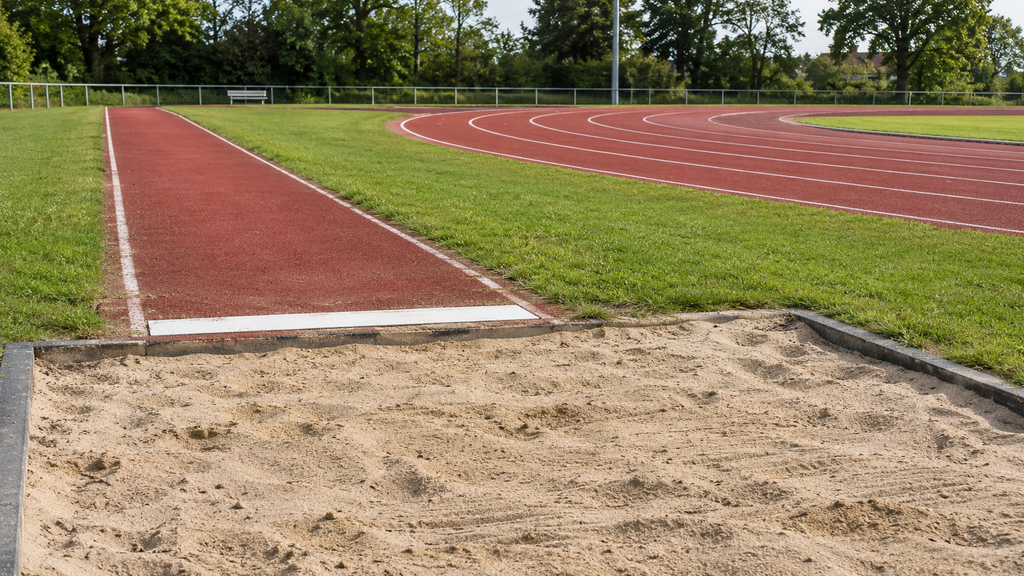
A long-jump pit can collect more than footprints. A Polish field study found coloured fragments in sand beside synthetic sports surfaces, with chemical analysis of selected particles identifying polymers used in those surfaces.[1]
That makes the sand a useful place to investigate running-track microplastics.[1] It does not make a scoop of sand a test of what an athlete has breathed in, swallowed or absorbed.[1] The practical opportunity is for facility managers: investigate where worn material goes, then review maintenance and waste handling before it spreads further.[1]
The takeaway: sand sampling can help flag local surface wear, but colour alone cannot identify every particle or its source. Use a repeatable monitoring method and chemical checks, not a photograph of black specks, to support a decision.[1]
Why look beside the runway?
The Polish researchers describe synthetic athletics surfaces containing polyurethane and rubber materials.[1] Mechanical wear and outdoor weathering can release fragments; neighbouring artificial-turf pitches and other surfaces can contribute material too.[1]
A long-jump pit provides an accessible collection medium close to those possible sources.[1] The question is whether particles accumulating there can reveal something useful about the surrounding facility, without having to catch a particular rainstorm.[1]
This differs from counting loose infill lost from a football pitch.[1] A bonded running surface can wear and fragment even though its normal use does not involve spreading loose performance granules.[1] Our artificial-turf infill guide follows that separate material and its escape routes.
The distinction matters for an inspection. Finding material beside a track should prompt questions about the actual surface, nearby pitches and cleaning practices, rather than an assumption that everything came from one red lane.[1]
What the Polish team actually sampled
The detailed methods describe nine long-jump pits across six elementary-school facilities and one university sports complex in Kielce, Poland.[1] Samples were collected on a single day in July 2025, with material taken from three positions in each pit.[1]
Researchers mixed the bulk samples and examined repeated 10-gram portions under a microscope.[1] They reported a range of 3 to 104 candidate particles per 10 grams of sand.[1] These were screening counts supported by chemical examination of selected fragments, not individual chemical identification of every item counted.[1]
Red fragments were the largest colour group.[1] The authors linked them mainly to long-jump runways and athletics tracks, while considering nearby pitches and shoe wear as other possible sources for different particles.[1]
The laboratory used Fourier-transform infrared spectroscopy, or FTIR, on selected particles grouped by colour and appearance.[1] It identified polyether urethane and ethylene propylene diene monomer rubber, usually shortened to EPDM.[1]
That supports the presence of synthetic material in the sand.[1] It does not prove that every visually similar fragment has the same composition, or that a particular manufacturer supplied it.[1] The authors themselves acknowledge the small subsample mass, visual identification and limited number of particles analysed by FTIR.[1]
Their microscope's stated detection range and the size measurements reported for a selected set of particles are also different descriptions.[1] Neither should be read as a complete inventory of smaller microplastics or nanoplastics in the pits.[1]
A red fragment is a clue, not a source fingerprint
A fragment's colour, porous texture and irregular shape can suggest that it came from a sports surface.[1] Chemical identification strengthens that interpretation, but a mixed-use site can contain several materials with overlapping appearances.[1]
The Polish paper notes uncertainty in assigning black particles to their source and discusses possible contributions from footwear.[1] It also found differences between locations within the university facility.[1]
For a manager, that argues for a site map and separate sample records. A sample beside a runway, one near a pitch and one taken after sand replacement answer different questions. Combining them without recording their origins would make any later comparison harder to interpret.
The pit is not necessarily a permanent trap either. The authors discuss onward movement by wind and rain, and the need to manage sand removed during maintenance.[1] Collecting fragments in one place is useful only if their next destination is considered too.
Rainwater reveals another part of the story
A separate study by Ye and colleagues investigated runoff from selected running tracks and artificial lawns in Chongqing, China.[3] We read its full methods in the publisher-hosted, unedited accepted manuscript linked below, rather than rely on the abstract-only view available on the ordinary article page.[3]
The researchers screened retained particles under a microscope and chemically checked a subset using micro-FTIR.[3] They reported polyurethane-related fragments in track runoff and predominantly polyethylene material in artificial-lawn samples.[3] Their chemical checks also rejected some visually selected items as cellulose or mineral material.[3]
This provides independent field evidence that runoff at sports facilities can carry plastic particles.[3] It does not establish that every recovered particle originated on the sampled surface: the authors acknowledge possible material arriving from surrounding areas.[3]
We use that study for the observed pathway, not a numerical comparison with Polish sand. Its sampling description gives a total that is not clearly reconciled with the stated numbers of locations, replicates and rainfall events.[3] The retrieved manuscript is also explicitly awaiting editing.[3]
Its city-wide annual emissions are a separate modelling exercise using mapped surface areas, published emission factors and adjustment coefficients.[3] They are not material collected and weighed across the city over a year, and the authors say those estimates need direct validation.[3] Applying them to a school in Poland or a UAE athletics club would go beyond the evidence.[3]
Sand and runoff therefore offer complementary views: material found near a possible source, and material found in water leaving a facility.[1][3] Neither alone gives the whole site's annual loss.[1][3]
What a facility manager can do now
Our recommendation is to begin with an inspection and a few specific questions, rather than order a generic “microplastic safety test”.
- Record visible wear. Note loose material, damaged edges, repairs and the relationship between the runway, pit, adjacent pitches and drains. Ask the surface supplier or maintenance contractor which repair and cleaning methods suit that installation.
- Follow collected waste. Ask where sweepings, vacuum contents, cleaning water and removed sand go. Request a contained handling plan rather than allow a cleanup to become a transfer to a verge or drain.
- Make monitoring repeatable. If commissioning sand tests, agree sampling locations, sample mass, timing, size range, contamination controls and the proportion receiving chemical identification before the first visit.
- Keep drainage safe. Have the responsible contractor assess any proposed interception device. Do not improvise fine screens that could obstruct water flow, and do not send volunteers into drains to collect samples.
These are precautionary management recommendations informed by the studies, not interventions those studies proved would cut emissions by a particular percentage.[1][3]
If a contractor presents a count, ask whether it means visually suspected particles, chemically confirmed particles or an estimate corrected from a tested subset. Ask how recent maintenance or replacement sand affects the comparison. Our guide to useful sand-sampling records explains the general measurement questions, although a beach protocol is not automatically suitable for an athletics facility.
What this means for athletes and parents
Neither study followed athletes to measure a clinical health outcome.[1][3] The Polish work examined sand; the Chongqing paper's human-exposure discussion used modelling assumptions rather than direct measurements of what individual players inhaled or swallowed.[1][3]
Those environmental findings cannot diagnose someone or establish that a particular track causes illness. They also cannot certify a facility as risk-free. A reasonable response is to report visible deterioration and ask the operator about maintenance and waste handling, not treat a particle count as a reason to abandon sport.
For operators, the useful finding is more specific: long-jump sand can help reveal where synthetic fragments accumulate. Combine that clue with chemical checks, local records and a plan for collected material. A count becomes more useful when it leads to a better-maintained site rather than an unsupported health headline.[1]