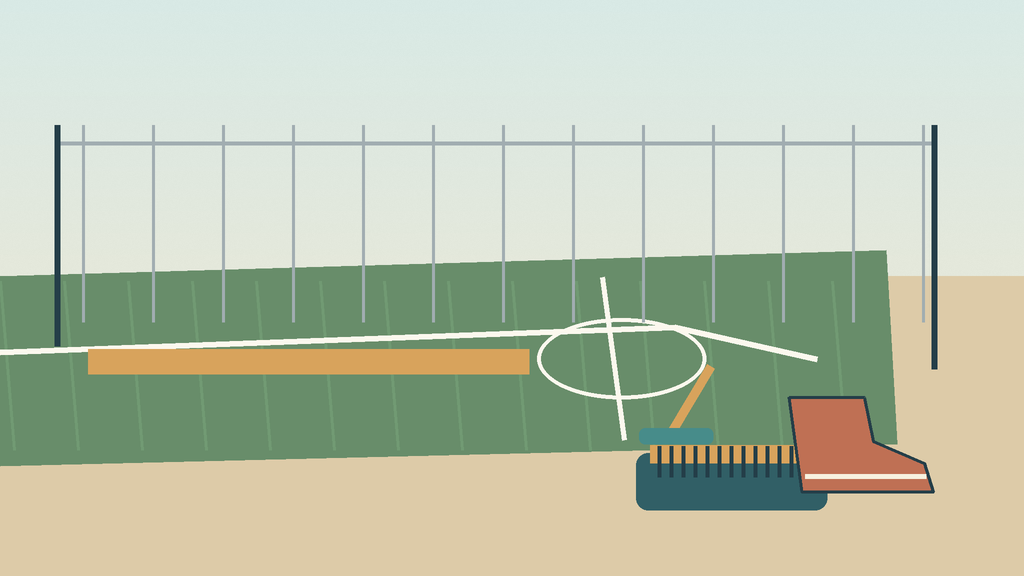
Rubber infill can leave an artificial-turf pitch through drainage, maintenance and material carried on footwear.[1] Those are facility-management questions, not measurements of a player's personal dose or proof of a clinical health effect. The EU restriction is also a specific placing-on-the-market rule for defined granular infill, not an immediate order to close every existing pitch.[2]
A Finnish study provides field evidence from two Helsinki football pitches, alongside hydrological modelling.[1] Its accessible accepted manuscript allows us to examine the methods rather than repeat a national model's headline loss estimate.[1] The legal discussion below uses the current consolidated REACH entry 78 and the Commission's timetable, checked in October 2026.[2][3]
Infill is separate from the grass fibres
Artificial turf includes several components; rubber performance infill is the loose material used within some systems, rather than the synthetic grass fibres themselves.[1] The Finnish researchers examined rubber granules at two selected pitches with different surroundings and maintenance arrangements.[1] A rule for that material should not casually become a rule for every part of every artificial surface.
The study focused on granules larger than one millimetre, mainly within the size range used as infill.[1] It did not measure all finer fragments or nanoplastics generated at the sites.[1] Its particle classification used visual features and the granules' elastic behaviour under pressure, rather than molecular identification of each recovered item.[1] Those limits belong beside the findings.
The source is marked as an accepted manuscript and article in press, so details can still change during final editing.[1] We use its accessible methods and broad findings with that caveat; we do not treat the document as a universal emissions factor for pitches elsewhere.
What the field sampling actually followed
The researchers established soil plots at different distances from the pitches and resampled them over several seasons.[1] They also collected material entering stormwater inlets, sampled receiving-ditch sediment and tested what adhered to footwear during running.[1] Additional observations covered snow and maintenance equipment.[1]
The sampling found granules outside the playing surface, with differences between the sites and between locations around the same pitch.[1] That is evidence of local movement. The soil-plot results should not be scaled into a national annual total without the additional sampling and assumptions such an estimate requires.
Stormwater collection units included overflow channels to reduce the risk of blockage.[1] They overflowed during the experiment, and the escaped material could not be quantified.[1] A device collecting granules is therefore not proof that it captured every granule entering the drain.
The footwear experiment also had a small participant group and specified running and cleaning procedures.[1] It demonstrates a possible transport route, not a measured annual loss for all players or a reason to prescribe one shoe type everywhere.[1] Weather and site conditions affected what the study observed.[1]
Measurements and model outputs answer different questions
Field collections show what researchers recovered at selected locations and times.[1] The hydrological modelling used site topography, drainage and rainfall information to explore movement in water.[1] That adds an explanation of transport conditions, but its predictions remain dependent on the model inputs and assumptions.[1]
The researchers acknowledge uncertainty in rainfall and flow information, limited site coverage and the difficulty of separating influences such as maintenance, usage and weather.[1] The snow-related pathways are relevant to these Finnish sites; the paper did not test whether they describe a UAE pitch.[1]
An operator's annual infill top-up is another distinct number. The paper cautions that replenishment need not equal environmental loss, because changes such as compaction also affect the amount added.[1] Do not label every kilogram bought as a kilogram discharged to a river, or every kilogram collected from a drain as a kilogram permanently destroyed.
What happens in October 2031?
REACH entry 78 restricts the placing on the market of defined synthetic polymer microparticles, with exclusions and derogations.[2] Paragraph 6(j) sets 17 October 2031 as the application date for granular infill for use on synthetic sports surfaces.[2] The Commission's table confirms that staged date.[3]
The provision is not phrased as an immediate ban on playing on an existing pitch.[2] It also is not a blanket restriction on every natural or mineral infill material: the definition and exclusions still matter.[2] Managers should ask suppliers about the exact material and documented classification, rather than assuming that every product sold as an alternative is outside scope or environmentally equivalent.
This is an EU restriction, not UAE law. Planning a replacement or replenishment strategy requires the rules applicable to the facility and its supply chain. Our reading of this entry should not be treated as a guarantee about every future stock transaction or a whole facility's legal compliance.
A useful site-management review
Our recommendation is to inspect the exit routes before buying a generic containment claim. Map gates, hard surfaces, drainage inlets and maintenance routes. Check where collected material is stored and how equipment is cleaned. The Finnish study shows why those routes deserve attention, but supplies no universal saving percentage for a particular barrier or brush.[1]
Ask whether any drain device has a safe overflow and a documented inspection routine. In the study, collectors required monitoring and still lost unquantified material during overflow events.[1] Flood protection cannot be sacrificed to an improvised fine screen.
Provide an appropriate contained place for players to remove loose infill from footwear and equipment, and use the facility's waste-handling instructions. Treat this as a management precaution informed by the observed route, not proof of lower disease risk or complete particle capture.[1]
Our laundry article follows a different release mechanism, textile shedding. Our human diagnostics guide explains why environmental measurements are not a personal clinical test.
The practical distinction is simple: follow the loose granules leaving the site, and read the EU infill deadline as a product-market restriction.[1][2] Neither a headline annual estimate nor a broad "pitch ban" describes the full evidence.