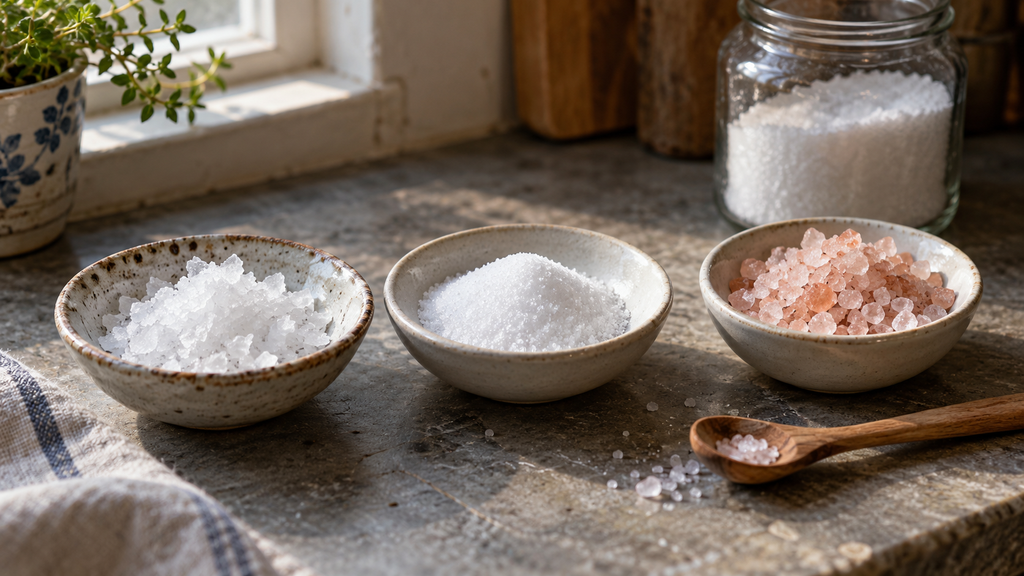
Do not pay extra for sea salt or Himalayan pink salt on the assumption that it contains fewer microplastics. Studies have detected particles in both marine and mined commercial salts, but the samples and methods do not establish a dependable shopping rule based on colour or origin.[1][2] Our recommendation is to choose food-grade salt for its intended use and nutritional labelling, rather than an unverified promise of plastic purity.
There is a better-established health priority: how much sodium you eat. The World Health Organization recommends that adults consume less than 5 g of salt a day in total, including salt already in food, and says consumed salt should be iodised.[3] That is nutritional guidance, not a threshold for microplastic safety.
What researchers have actually found
Two original investigations answer different parts of the salt question. One examined commercial salt products sold in Australia; the other collected seawater and coarse salt at production sites in Vietnam.[1][2] Neither followed people eating those salts or measured an improvement in health after switching products.[1][2]
Kuttykattil and colleagues investigated seven salt types obtained from supermarkets in Newcastle, Australia.[1] They included table, iodised, sea, rock, black and fine and coarse Himalayan pink salts.[1] The researchers dissolved samples, filtered out material, used microscopy and fluorescent staining to locate suspected particles, and used infrared spectroscopy to investigate selected particles' composition.[1]
The study reported contamination in marine and terrestrial salts. Its coarse Himalayan sample had a higher reported particle concentration than its sea-salt sample, while the fine Himalayan sample was much lower than the coarse one.[1] This is evidence against assuming that a mined origin guarantees freedom from particles. It is not a reason to declare every Himalayan salt worse than every sea salt.
The sample set was small, and the authors explicitly acknowledge limitations in sample size and assumptions about which salts consumers buy.[1] The sample table also lists non-food uses for some products, including ice melting for the coarse Himalayan sample.[1] We therefore do not turn its highest result into a ranking of current food-grade salts on a supermarket shelf.
Sea water can be part of the route, but origin is not the whole story
Khuyen and colleagues sampled seawater and coarse salt in three Vietnamese production areas during the dry season in February 2021.[2] They used micro-Raman spectroscopy to investigate polymer identity, rather than treating visual appearance alone as proof of plastic.[2]
The researchers found similarities in particle composition, shapes and colours between the water and salt. They interpreted those similarities as evidence that input seawater contributed to contamination of the coarse salt.[2] That is a useful investigation of a production pathway. It does not trace the journey of every individual particle, compare every salt-making method, or test a packet bought in the UAE.
The Australian team discussed processing, airborne material and packaging as possible additional routes into commercial salt. It did not quantify the contribution from each route, and explicitly said the packaging contribution remained unclear.[1] A mineral deposit's age therefore cannot, on its own, certify the cleanliness of a packaged product. Equally, a plastic package is not proof that all particles detected inside came from that package.
Why a particle-count league table would mislead
Before comparing two published salt counts, ask what each laboratory could identify.
In the Australian study, the infrared analysis quantified selected particles above 20 micrometres; it was not a complete inventory of smaller particles or nanoplastics.[1] The authors also included rayon in their reported category, while describing it as an artificial non-plastic polymer.[1] Their total should not silently become a count exclusively of conventional synthetic plastics.
The Vietnamese study also reported an unidentified group: some fibres or tiny items did not yield a usable Raman identification.[2] An instrument being present in the methods does not mean every recovered speck was chemically confirmed.
Controls are another part of the result. The Australian researchers ran procedural blanks and reported no particles in their negative control; the Vietnamese team used field and laboratory controls and reported no microfibres in those controls.[1][2] These checks help assess contamination introduced during sampling and analysis. They do not make a limited sample representative of an entire country or brand.
The FDA describes the wider difficulty plainly: without standard, validated methods for sampling, preparation, detection and characterisation, studies are hard to compare reliably.[4] A low count from a method that misses smaller particles is not automatically better than a higher count from a method that looks further down the size range.
For a related food example, our guide to microplastics in seafood explains why tissue selection and particle identification matter. The tea-bag evidence review examines a published dispute about what striking counts actually measured.
Detection does not establish the health effect of your salt
These salt investigations provide evidence about material recovered from samples, not clinical evidence that a particular salt causes disease.[1][2] They do not establish how much of that material enters human tissues or a dose at which harm occurs.[1][2]
The FDA's current assessment is that scientific evidence does not demonstrate that the levels of microplastics or nanoplastics detected in foods pose a risk to human health.[4] It also identifies substantial measurement and health-effect gaps.[4] That position is not proof that every exposure is harmless. It means a confident disease-risk number cannot be attached to a salt particle count using these studies.
The salt papers discuss broader toxicology, but their own experiments were not human outcome studies.[1][2] Laboratory concerns about plastic materials should not be presented as demonstrated illness from seasoning a meal.
What to do when buying and using salt
- Do not use colour or origin as a microplastic certificate. Our reading of these studies does not support paying a premium for "Himalayan", "sea" or "natural" as a guarantee of fewer particles.[1][2]
- Check that the product is intended for food. A salt sold for a bath, an industrial use or de-icing is not an alternative seasoning. The ambiguity in the Australian paper's sample table is a reason to check intended use, not to copy its sample ranking.[1]
- Keep sodium and iodine in the decision. WHO recommends less than 5 g of salt a day for adults and says consumed salt should be iodised.[3] That is a total-diet recommendation, not a daily allowance to add at the table. WHO suggests herbs and spices for flavour and limiting salty sauces and processed foods.[3]
- Ask for the test behind a purity claim. We would want the tested batch, sampling date, size range, identification method and blank results. "None detected" needs a stated detection limit before it can be interpreted; it is not an unlimited guarantee of absence.[4]
Our recommendation is to avoid expensive swaps justified only by a salt's origin. The evidence supports asking better questions about testing, while keeping the established nutritional advice in view. It does not identify a universally "microplastic-free" salt or demonstrate a health benefit from switching between sea salt and Himalayan salt.[1][2][4]
This article is educational and does not replace individual dietary or medical advice.