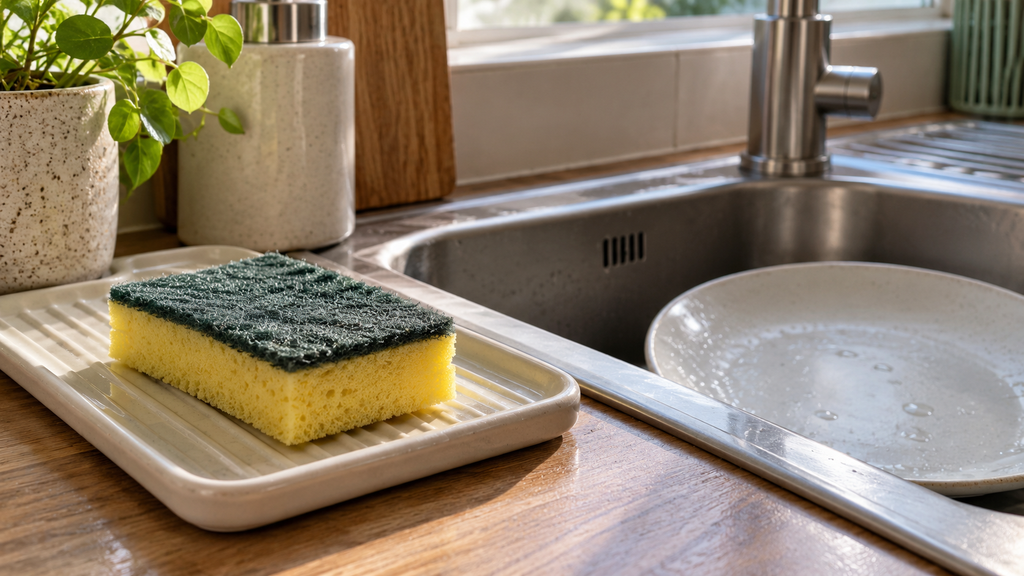
A kitchen sponge can lose small pieces of plastic as it wears during washing-up.[1][2] The useful question is what the whole sponge is made from, including its scrubbing layer, rather than whether the packet looks green.
Our recommendation is to check both layers when buying a replacement, choose a suitable lower-plastic option where you can verify its composition, and avoid wasting water while washing dishes. Keep cleaning effective. The studies discussed here do not establish a personal dose from a washed plate or a health benefit from switching sponges.[1][2]
How a sponge becomes a source of particles
A cleaning sponge may combine several materials with different jobs: an absorbent body, a tougher scouring surface and sometimes an additional cloth layer.[1] Friction and repeated handling wear the material down; where the worn material is plastic, that creates a route for plastic debris into washing water.[1]
Hamann and colleagues investigated three sponge designs in a 2026 study. Their manufacturer-supplied material descriptions included polyurethane foam, synthetic fibres, cellulose and sisal, in different combinations.[1] None of the three products was entirely free of plastic.[1]
That is why the soft part alone cannot settle a shopping decision. One sponge marketed as organic had a cellulose body, but its scrubbing layer combined sisal with recycled PET, or polyethylene terephthalate.[1] Recycled plastic is still plastic. A cellulose body does not make the attached scourer cellulose too.
The work concerns wear from a hand-held cleaning tool. For particles found in an automatic machine's outgoing water, our separate guide to dishwasher microplastics examines appliance components and the plastic items being washed.
What researchers measured in homes
The 2026 investigation combined volunteer households with a laboratory abrasion experiment and an environmental life-cycle assessment.[1] These were different parts of one study, not three independent confirmations of the same quantity.
Participants in Germany and North America used supplied sponges in their normal routines and reported how they used them.[1] The researchers rinsed, dried and weighed the sponges before and after household use.[1] They then estimated plastic release from the material lost and the plastic share assigned to the sponge's layers using manufacturer composition information.[1]
This was an estimate from weight loss and composition, not a count of chemically identified particles collected from every household's drain.[1]
The distinction matters because a used sponge can also retain food and dirt. The researchers excluded sponges that gained weight, alongside other exclusions, because the material lost could not be separated reliably from material gained.[1] They did not microscopically examine the returned sponges to quantify retained dirt.[1] Residues could therefore conceal some loss even in a sponge that ended up lighter.
The final household analysis included 27 conventional European sponges, 13 conventional North American sponges and 28 of the European organic-labelled design.[1] Those are the analysed samples, not every sponge originally distributed or returned.[1] The unequal groups and selected products do not represent all sponges sold in those regions, let alone the UAE market.
The organic-labelled design had the lowest estimated plastic release per person per year in this study, while the conventional European design had the highest.[1] That supports checking actual composition. It does not establish a universal ranking of every product called natural, organic or eco, and the annual estimates are not measurements of what anyone swallowed.
What the laboratory work adds
Hamann's team also built a device called SpongeBot to repeatedly compress sponges under controlled conditions in water.[1] The sponges lost material, but the apparatus lacked several features of a real washing-up session, including food residues and detergent.[1] The authors explicitly caution that the laboratory and household results cannot be compared quantitatively as though they were interchangeable.[1]
A separate 2022 study by Luo and colleagues approached a different problem: identifying the small material released from a selected dish sponge.[2] Its abstract describes Raman imaging combined with statistical analysis to extract chemical information from weak signals.[2] The researchers reported mainly nylon PA6 from the soft layer and PET from the harder layer of the sponge they examined.[2] They also reported imaging material they classified as microplastics and nanoplastics.[2]
We could directly read that study's abstract, but not its full methods; its publisher's open-manuscript link returned a missing-page response. We therefore use it for the reported identification finding, not a precise release rate, a detailed nanoscale size distribution or a claim about all kitchen sponges.
The two studies complement one another without measuring the same endpoint. Chemical identification helps establish what selected debris is; weighing a used product helps estimate how much material has disappeared.[1][2] Neither method, by itself, measures the quantity remaining on a cleaned plate and later eaten.
Less plastic is not the whole environmental calculation
The 2026 study modelled the wider environmental effects of making, using and disposing of the sponges, with a functional unit of 100 hours of manual dishwashing.[1] Its model included water provision, wastewater treatment and assumptions about the fate of released plastic.[1] It was an environmental assessment, not a clinical health-risk calculation.[1]
Water use dominated the modelled overall ecosystem impact.[1] The authors also explain that some North American water and waste-management inputs relied on generic data that did not accurately represent local infrastructure.[1] The result is a reason to consider water use alongside sponge composition, not a precise environmental score for your kitchen or proof that microplastic pollution is unimportant.
Release at the sink is also different from release into a river. The study's later environmental estimates depended on assumptions about wastewater retention and sludge disposal.[1] Our guide to wastewater microplastic removal and particle fate explains why capture in treatment is not the same as destruction. The sponge experiments did not follow each household's debris through its local treatment system.[1]
A sensible routine for washing up
These are precautionary choices, not measures with a demonstrated medical benefit:
- Read the whole material description. Check the absorbent body and the scourer separately. If avoiding plastic is your aim, ask the manufacturer what each layer contains rather than relying on a colour or environmental slogan. The organic-labelled sponge in the study still contained a synthetic scrubbing component.[1]
- Choose a tool suited to the surface. Follow cookware and cleaning-tool instructions. A replacement that damages a coating or does not clean properly is a poor trade-off. The studies do not establish one best sponge or brush for every task.[1][2]
- Avoid unnecessary running water and repeat rinses. Turn the tap off when you do not need it, while still cleaning and rinsing dishes adequately. The environmental model supports paying attention to water use; it does not show that an extra rinse makes a plate microplastic-free.[1]
- Do not extend use at the expense of hygiene. Follow the product's cleaning and replacement guidance. FDA food-safety advice calls for washing dishes and utensils with hot, soapy water between food-preparation tasks; it also advises frequent hot-water laundering if cloth towels are used.[3] A washable cloth is not a maintenance-free substitute.
The sponge studies do not supply a universal replacement interval or a visible-wear threshold that marks a safe personal exposure level.[1][2] Do not turn a product-wear experiment into an instruction to keep a dirty sponge indefinitely or to replace every kitchen tool immediately.
Kitchen sponge microplastics are a credible source-control question: plastic-containing cleaning tools wear, and researchers have identified plastic in released material.[1][2] Check what you buy, keep it suitable and hygienic, and use water thoughtfully. Those are practical choices without pretending the research has calculated a dose from your dinner.