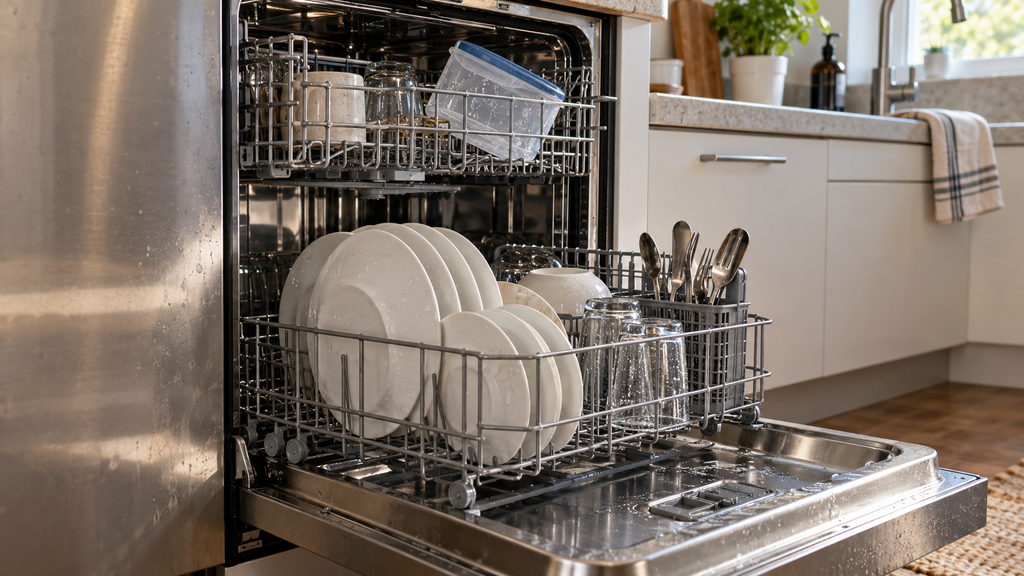
A dishwasher can release microplastics from its own plastic components as well as from plastic items being washed.[1][2] Experiments have found these particles in the outgoing water, including when a machine was run without dishes.[1]
That finding concerns an environmental discharge. It does not tell you how much plastic remains on a clean plate, enters your next meal or causes harm to a person. The dishwasher studies discussed here examined wastewater, not those later steps.[1][2]
Our recommendation is to use containers only as their care instructions allow, avoid putting unsuitable plastic through a dishwasher and consider suitable glass or ceramic when replacing a worn food container. Do not abandon effective cleaning or replace a working appliance on the strength of a dramatic particle headline. The evidence gives us a reason to examine wear, not a personal health-risk calculation.
How can an empty dishwasher release plastic?
In a 2023 experiment, Daniel Sol and colleagues at the University of Oviedo tested a new domestic dishwasher with stainless-steel and reinforced-polypropylene components.[1] They compared an empty machine with washes containing six polypropylene lunch boxes and their lids.[1]
The team collected the drain water, separated material using sieves and filters, counted particles under a microscope and used infrared spectroscopy to check polymer identity in a subset.[1]
They also sampled the incoming tap water.[1] That matters because a particle leaving a dishwasher was not necessarily created inside it: some material was already present in the water entering the machine.[1]
After allowing for that incoming contribution, the researchers attributed most of the particles in the empty-machine effluent to the dishwasher itself.[1] Adding the lunch boxes increased the outgoing count; the researchers estimated their contribution by subtracting the empty-machine result.[1]
This is useful source-separation evidence, but it remains an estimate by difference. It does not mean the investigators watched each fragment detach from a particular spray arm or lunch-box lid. Nor does one appliance and one set of boxes represent every model, material or stage of wear.
What the programme comparison does, and does not, show
The Oviedo team compared a 15-minute pre-wash at room water temperature with a 164-minute intensive programme at 70°C.[1] The intensive programme used more water and produced more particles per cycle.[1]
Those conditions changed together. We cannot use this experiment to assign a separate percentage to temperature, washing time or water volume. More importantly for a household, a brief pre-wash is not a substitute for a full cleaning programme. The experiment investigated particle release; it did not demonstrate equivalent cleaning or hygiene between those two cycles.[1]
Detergent affected the tested materials differently.[1] Under the intensive conditions, adding the selected detergent increased release attributed to the machine's components, while the estimated contribution from the lunch boxes was similar with and without detergent.[1]
That is not a reason to wash without detergent. It also does not support a universal claim that all dishwasher detergents damage all plastic items equally. The researchers examined particular formulations and materials, rather than a representative market-wide comparison.[1]
A sensible practical response is to follow the appliance and container instructions and choose a programme appropriate to the load. These results do not establish a universal low-shedding setting that also cleans every load adequately.
Why a particle count needs its method attached
The 2023 study used a smallest sieve opening of 20 micrometres.[1] Its later fine filtration step did not turn the experiment into a complete survey of nanoplastics.[1]
The chemical checks were also selective. The authors report analysing 30% of visually counted particles by infrared spectroscopy, with approximately 70% of that analysed material identified as plastic, before extrapolating using colour and shape categories.[1]
Their reported totals therefore involve visual counting, subset identification and extrapolation.[1] They are not a chemical identity check on every counted item. The methods also describe testing the plastic effluent-collection containers for background release, rather than assuming that collection introduced nothing.[1]
A second research team, Elvis Okoffo and colleagues, examined mechanical dishwashing of selected articles made from polypropylene, polyethylene, polystyrene, PET and nylon-6.[2] Their 2025 publisher abstract describes wastewater analysis using microscopy, particle sizing and pyrolysis gas chromatography-mass spectrometry for plastic mass.[2]
We could read that abstract and recover the supporting analytical methods from the publisher's Figshare deposit, but not the main paper's full text. We therefore use this study to support the broad finding that washed plastic articles can contribute material to drain water, not to offer a detailed numerical comparison or repeat its household and global extrapolations.[2][4]
The supporting methods explain contamination controls, blank subtraction and checks for substances that can interfere with polymer identification.[4] They also distinguish polymer-mass analysis from imaging and sizing.[4]
That distinction is worth retaining when reading headlines. A mass measurement and a particle count answer different questions; neither should be presented as though every small structure in an image has individually received a chemical identification. These two studies used different analytical approaches, so their headline totals are not interchangeable.[1][2][4]
Drain water is not a measured dose in dinner
The measured stream in these experiments was outgoing dishwasher water.[1][2] Neither study, as used here, establishes how much material stays on crockery, transfers into food or is swallowed by a particular household.[1][2]
The FDA's public assessment says current evidence does not demonstrate that levels of microplastics or nanoplastics detected in food pose a human health risk.[3] It also stresses gaps in standardised methods and health-effect evidence.[3]
That is not a guarantee of zero risk. It is a reason to keep a finding of release separate from a claim of demonstrated illness, and to avoid promising a clinical benefit from changing containers.
Discharge into a drain is also not the same as discharge into the sea. Our guide to wastewater microplastic removal and particle fate explains why treatment and the destination of captured solids need their own evidence. The dishwasher experiments do not trace each released particle through a household's local treatment system.[1][2]
A proportionate routine for plastic containers
These are precautionary recommendations, not changes with a proven medical benefit:
- Check the intended use. Follow the container's dishwasher instructions, including any rack or temperature restrictions. If its suitability is unclear, do not assume that every reusable-looking tub is designed for machine washing.
- Inspect rather than replace indiscriminately. If a container is warped, cracked or otherwise damaged, check its replacement and disposal guidance. The studies do not establish a universal replacement interval or a visible-wear threshold for particle release.[1][2]
- Consider the next purchase. A suitable glass or ceramic container avoids washing a plastic container body. Check lids and other components separately, and follow handling instructions. This material choice does not make the dishwasher's own plastic parts disappear.[1]
- Keep cleaning effective. Do not substitute the experimental pre-wash for a proper cleaning cycle, omit detergent or improvise extra empty rinses in pursuit of an unverified particle reduction.
Heating food in a container is a separate question from washing it. Our article on microwaving food in plastic containers examines those heating experiments and their published follow-up rather than transferring dishwasher results to a meal.
Dishwasher microplastics are a documented release route under tested conditions.[1][2] Pay attention to product suitability and wear, while keeping clean dishes and food hygiene the immediate priority. A drain-water result has not measured your personal dose or shown that replacing an appliance prevents disease.[1][2][3]
Sources
- https://link.springer.com/article/10.1007/s11356-023-25433-7
- https://pubs.acs.org/doi/10.1021/acsestwater.4c00768
- https://www.fda.gov/food/environmental-contaminants-food/microplastics-and-nanoplastics-foods
- https://acs.figshare.com/articles/journal_contribution/Release_of_Micro-_and_Nanosized_Particles_from_Plastic_Articles_during_Mechanical_Dishwashing/29053737