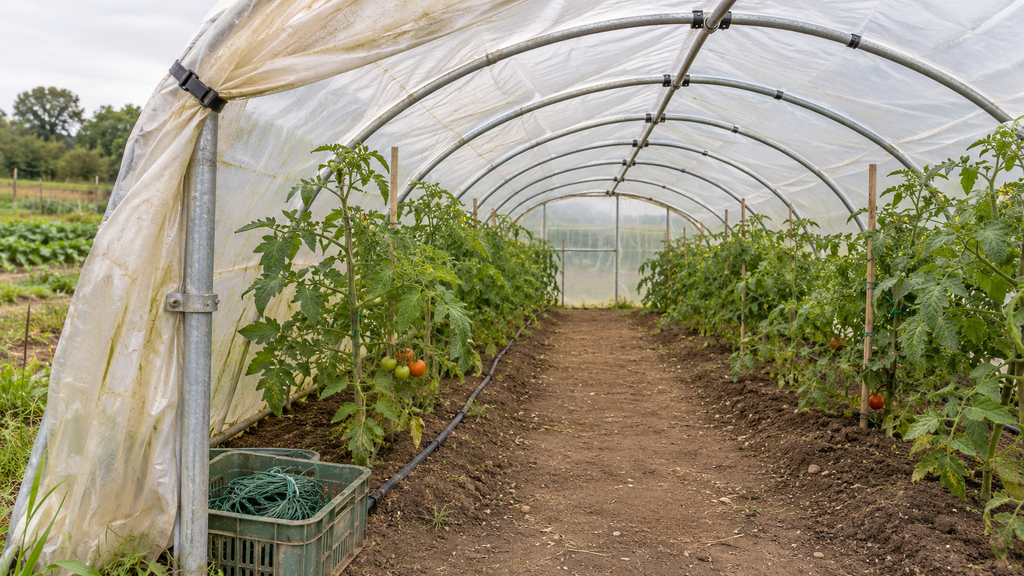
Plastic greenhouse covers can leave fragments on farmland, but finding microplastics in the soil does not tell you that they all came from the roof.[8] An abandoned-greenhouse study in Hungary found a mixture of cover-film remains, pipe fragments and other litter, alongside smaller particles in soil.[8] A separate comparison of farming systems reported more soil microplastics in mulched farmland than in its greenhouse group, a useful warning against treating every agricultural plastic as the same source.[6]
For growers, our recommendation is to manage the cover, irrigation equipment, support strings and incoming materials separately. For someone buying vegetables, these studies are not a reason to assume greenhouse-grown food is unsafe: the Hungarian investigations examined environmental samples and litter, not consumers or the amount in a meal.[8][3]
An overhead cover is not soil-contact mulch
A greenhouse film forms part of the structure above a crop; mulch film lies on the soil around it.[8][7] That difference changes the question you need to ask. Our guide to plastic mulch and soil residues looks at what remains after a soil cover is retrieved. Here the question is how overhead film, fittings and other inputs might contribute, and whether a soil test can distinguish them.
There is a plausible route from a damaged cover to soil: larger plastic materials weather and break into smaller pieces.[3] The Hungarian field papers describe ageing cover films and other equipment among the debris on former greenhouse plots.[8][3] But a plausible pathway is not a measurement of how much each item contributed. The same investigation also found non-agricultural litter and discussed irrigation water, atmospheric deposition and other possible inputs.[8]
This matters when deciding what to replace. Changing the roof alone would not address a broken irrigation pipe or old support string, and a soil result labelled simply "polyethylene" cannot by itself identify a particular cover.
What the Hungarian soil study actually tested
Sa'adu and Farsang sampled an abandoned greenhouse area near Szeged in March 2021 and compared it with nearby conventional farmland.[8] The greenhouse area had previously grown tomatoes and had been abandoned since 2015; the comparison land had a different cropping history.[8] This was a local observational case study, not an experiment assigning otherwise identical plots different roof materials.[8]
The researchers collected visible plastic debris, composite soil samples from two depth ranges, deeper profile samples and shallow groundwater.[8] For the soil work, they digested organic material, used a dense salt solution to separate particles and examined extracts under a microscope.[8] They used heat-and-needle checks on some suspected particles and Raman spectroscopy, a chemical identification technique, on 10% of the suspected microplastics.[8] That last detail matters: the paper did not chemically identify every item in its reported count.[8]
The team reported microplastics in the greenhouse soil and also in the reference soil.[8] The visible debris included material attributed to ruined covers, PVC pipes and plastic strings, as well as items such as wrappers and bottles.[8] These findings support investigating several inputs rather than assuming the cover is the only candidate.
The methods describe cleaning equipment and covering samples to limit contamination, but do not report procedural blank counts alongside the results.[8] A procedural blank goes through the analysis without the environmental sample, helping reveal contamination introduced during handling. Its absence from the reported results limits how confidently very small counts can be interpreted.
The groundwater reporting also contains incompatible totals between its narrative, table and stated average.[8] We therefore do not repeat a groundwater concentration or use it to estimate drinking-water exposure. More importantly for this article, finding particles at different depths does not trace individual pieces from a roof, through soil and into water.[8]
A larger-litter follow-up adds context, not independent confirmation
A 2023 paper by Saadu, Farsang and Kiss examined visible debris on abandoned greenhouse plots at Szeged, Szentes and Szarvas.[3] It shares investigators with the earlier study and refers back to their microplastic work, so it should not be counted as an independent-team replication.[3][8]
Observers collected visible surface litter, classified its shape and likely origin, and used Raman analysis on approximately 10% of the larger pieces.[3] The agricultural items included old greenhouse film, irrigation-pipe fragments, strings and agrochemical packaging; other litter included food wrappers and disposable cups.[3] The authors interpreted the mixture of fragment sizes as evidence consistent with continuing breakdown.[3]
However, this was not a continuous measurement of particle release from an intact working roof.[3] Nor does a survey of larger litter establish the fraction of soil microplastics uniquely produced by cover film.[3] The paper's own source categories include several materials and rely on probable origins.[3]
Why a comparison with mulched fields changes the interpretation
Wang and colleagues' separate study compared greenhouse, mulched and traditional farmland soils.[6] Its abstract reports significantly higher microplastic abundance in the mulched farmland than in the other two groups.[6] That challenges a blanket assumption that a greenhouse roof must be the dominant agricultural-film source everywhere.
There is an access limit here: we could read the publisher and PubMed abstracts, but could not independently inspect the full sampling and analytical methods. We use the result only as a reported comparison within that study, not to rank all farming systems or calculate a difference between countries.[6]
The two findings are compatible. Debris from greenhouse materials can be present, while soil-contact mulch can contribute more particles in another set of fields.[8][6] Neither observation provides a universal percentage attributable to overhead covers.[8][6] Differences in land-use history, inputs and analytical methods still need to be considered before comparing results.
What to ask about a greenhouse soil test
If a supplier or laboratory says it can identify "roof-derived microplastics", our recommendation is to ask what evidence separates that source from the alternatives:
- Does the investigation record the actual cover, pipe and string materials, including old equipment and previous mulch use?
- Does it compare particle chemistry and appearance with those candidate materials, rather than identify only a common polymer?
- Does it consider incoming water, growing media, amendments and nearby litter?
- What particle sizes does the method recover, how many items receive chemical confirmation, and what do the blanks show?
These are questions about the strength of an attribution, not a guarantee that any one testing package can answer it. A matching polymer is useful evidence, but the Hungarian papers show why the surrounding material inventory matters.[8][3] For a separate input route, our guide to microplastics in compost and soil amendments explains what testing the material brought onto land can establish.
A maintenance plan that covers more than the roof
FAO's provisional voluntary code recommends appropriate installation, avoiding use beyond a product's safe and effective service life, and adequate collection and end-of-life management of agricultural plastics.[7] It also recognises their farming benefits and the trade-offs involved in alternatives.[7] This is voluntary guidance, not a statement of the law in every country.[7]
Our practical application is to include the following in a greenhouse maintenance and decommissioning plan:
- Keep a simple inventory of cover film, irrigation equipment and support materials, with supplier instructions and replacement arrangements.
- Inspect accessible materials for damage during normal maintenance. Follow the manufacturer's safe repair or replacement instructions; do not climb an unsupported cover to retrieve a scrap.
- When changing a cover or clearing a site, collect visible loose film, pipe pieces and strings separately from crop waste. Arrange contained storage and ask the receiving collector what it accepts.
- Do not burn or dump the material. FAO's code calls for avoiding open burning and open dumping, alongside proper waste management.[7]
These steps address avoidable material loss; they have not been shown here to deliver a particular percentage reduction in soil particles. A tidy plot is not a certificate that the soil is microplastic-free.
The useful conclusion is narrower than "greenhouses contaminate vegetables". Manage the overhead cover as one potential source, check the rest of the system, and ask a soil test to support only the conclusions its methods can justify. The field evidence gives reasons to improve material handling, not a measured food dose or demonstrated human health outcome.[8][3]
Sources
- https://link.springer.com/article/10.1186/s12302-023-00777-6
- https://pubmed.ncbi.nlm.nih.gov/41205513
- https://doi.org/10.4060/cd3004en
- https://real.mtak.hu/144589/1/%5B15882713%20-%20Agrok%C3%A9mia%20%C3%A9s%20Talajtan%5D%20Greenhouse%20farming%20as%20a%20source%20of%20macroplastic%20and%20microplastics%20contamination%20in%20agricultural%20soils_%20a%20case%20study%20from%20Southeast-Hungary.pdf