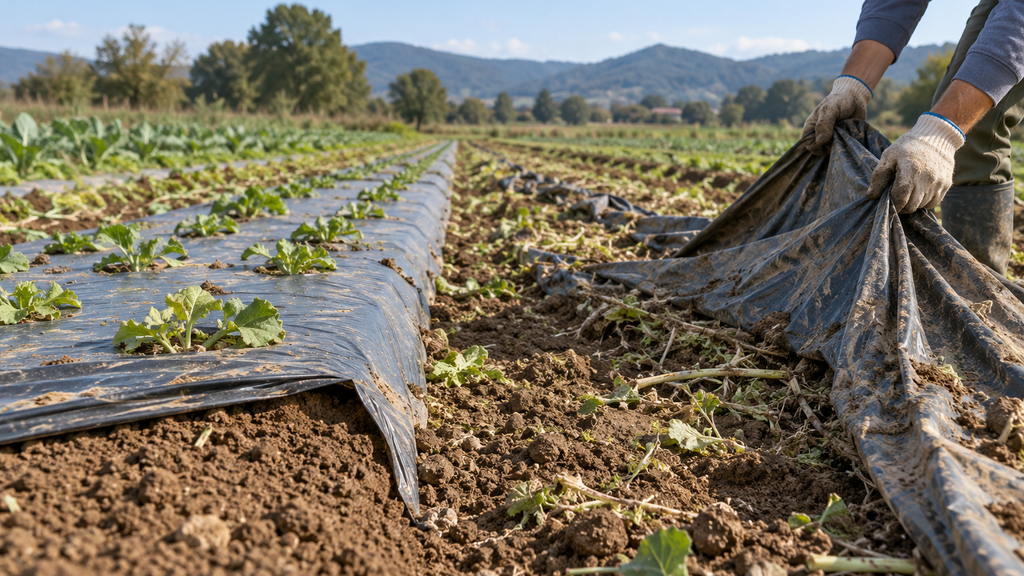
Removing a plastic mulch sheet after harvest does not necessarily remove all the plastic it introduced.[1] A field study in western Germany found film residues and small plastic debris after the covers had been retrieved; a separate Chinese investigation combined soil measurements with modelling to examine how much contamination might come from mulch rather than other inputs.[1][2]
That supports a practical priority: plan how to recover the film before laying it. It does not establish how many particles will reach a vegetable, how much a person will eat, or whether produce from a mulched field causes illness.[1][2] The research discussed here measured agricultural materials and environmental samples, not those human outcomes.[1][2]
Why farmers use plastic covers
Mulch film covers soil around a crop.[3] It can help conserve water and suppress weeds, so replacing it involves agronomic trade-offs rather than a simple choice between caring about pollution and ignoring it.[3] FAO's provisional voluntary code recognises agricultural plastics' benefits alongside the need to prevent waste leakage and improve collection.[3]
The question here is about conventional plastic film intended to be recovered after use. Its end-of-season removal and the fate of fragments left behind deserve separate checks. A field can look tidy after a large sheet has been lifted without every smaller piece having been collected.[1]
What researchers found after retrieval in Germany
Steinmetz and Schröder studied three previously mulched fields and three reference fields without reported plastic use.[1] Two mulched fields grew strawberries under polyethylene film; the third grew courgettes under polypropylene film.[1] The films were 50 micrometres thick and had been used over the preceding three years or growing seasons, depending on the crop.[1]
Sampling took place in autumn 2020 after harvest and retrieval of the covers.[1] The team collected visible surface fragments and sampled soil at 0–10 cm and 10–40 cm depth.[1] None of the six sites had received compost or sewage sludge in recent years, although litter and windblown inputs could not be ruled out.[1]
They used different tests for different size classes.[1] Larger recovered pieces were checked by infrared spectroscopy.[1] For the soil fraction at or below 2 mm, the researchers used a chemical technique called pyrolysis gas chromatography-mass spectrometry to quantify selected polymers by mass.[1] That was not a count of every microscopic particle in the field.[1]
Film residues were found on the previously covered fields, and polyethylene in their topsoil was significantly higher than in the reference group.[1] However, the polyethylene measurements were close to the method's detection limit.[1] Differences for polypropylene and polystyrene were not statistically significant, and the authors cautioned against drawing firm conclusions from the low levels and site variation.[1]
The result is useful because it was measured after removal, not just predicted from the presence of a cover.[1] It remains a small observational comparison: six fields with different crops and histories, not a randomised trial in which mulch was the only difference.[1] Its salt-based separation also systematically excluded denser polymers such as PET and PVC, so it was not a complete inventory of all plastic in soil.[1]
Why not every soil particle can be blamed on mulch
Ren and colleagues investigated long-term mulched agricultural systems in Yunnan, Gansu and Shandong, China.[2] Their study combined environmental sampling, farmer questionnaires and a material-flow model, which follows estimated plastic inputs and their subsequent destinations.[2]
For particle measurements, the team used microscopy and chemically identified a selected subset with infrared spectroscopy, then applied confirmation and blank corrections to the abundance estimates.[2] They did not chemically identify every counted particle.[2] Their model also depended on assumptions about fragmentation, management and the conversion between particle count and mass.[2]
The model attributed only part of the estimated soil microplastic burden to mulch film.[2] Other possible inputs included compost, irrigation water and material deposited from the air.[2] Matching a polymer between an input and soil can suggest a pathway, but it cannot uniquely identify the source of each particle.[2]
There are important geographical limits. The selected systems had intensive, long-term mulch use; they were not a representative survey of every farm in China, let alone the UAE.[2] Atmospheric deposition was represented by a regional estimate rather than long-term measurements at every soil-sampling location.[2] The authors describe the work as a comparative assessment within defined boundaries, not a complete accounting of all inputs.[2]
The two studies therefore support compatible conclusions. Film fragments can remain after recovery, while the total plastic found in soil can have several origins.[1][2] A lower modelled share from mulch does not mean film leaves no residue, and finding polyethylene does not prove that every piece came from the last sheet laid.[1][2]
For that other route onto land, our guide to microplastics in compost and soil amendments examines the quality of material supplied to growers.
What growers and gardeners can do
The following is our practical application of the evidence and FAO's waste-management guidance, not a tested promise of a particular reduction in particles:
- Arrange recovery before purchase. Ask how the exact film will be lifted, stored and accepted by a collector after use. FAO recommends adequate collection, segregation and end-of-life management; a product being theoretically recyclable does not establish that a local collector accepts dirty agricultural film.[3]
- Choose for the intended service life and retrieval method. Ask the supplier about resistance to tearing and the recommended removal point. The German study and the Chinese analysis discuss film durability and incomplete recovery, but neither supplies a universally best thickness for every crop, climate and machine.[1][2]
- Inspect the bed after lifting. Collect accessible visible scraps rather than deliberately incorporating conventional film into the soil. This is source-control advice based on the observed residual-film pathway, not a claim that visual inspection can certify microplastic-free soil.[1]
- Keep collected film contained and follow the receiving facility's instructions. Ask about separation from twine, containers and plant waste, and about acceptable soil contamination. FAO identifies contamination and collection barriers as obstacles to recycling.[3]
- Do not burn or dump used film. FAO's provisional code calls for avoiding open burning and dumping, alongside better waste management.[3] It is voluntary guidance, not a statement of the law in every jurisdiction.[3]
If considering a different cover, compare its crop performance, water requirements, labour and end-of-life route. Do not assume a bio-based feedstock means a material will biodegrade in soil: FAO distinguishes the source of a plastic from its ability to break down under particular conditions.[3] Our guide to biodegradable and compostable labels explains that distinction without treating a packaging label as a farm-film specification.
Soil contamination is not a measurement of food exposure
Neither field investigation sampled edible crop tissue to establish a consumer dose or followed people for health outcomes.[1][2] The German authors also left the ecological implications of the measured levels unresolved; the Chinese study did not directly measure soil-health indicators.[1][2]
These papers therefore do not establish that food grown under mulch is unsafe, or a health benefit from avoiding it.[1][2] The defensible action is narrower: retain mulch's useful farming functions where needed, while making retrieval and waste handling part of the original decision. Removing the sheet is an important step, but the evidence shows why checking what remains belongs in the job too.[1][2][3]