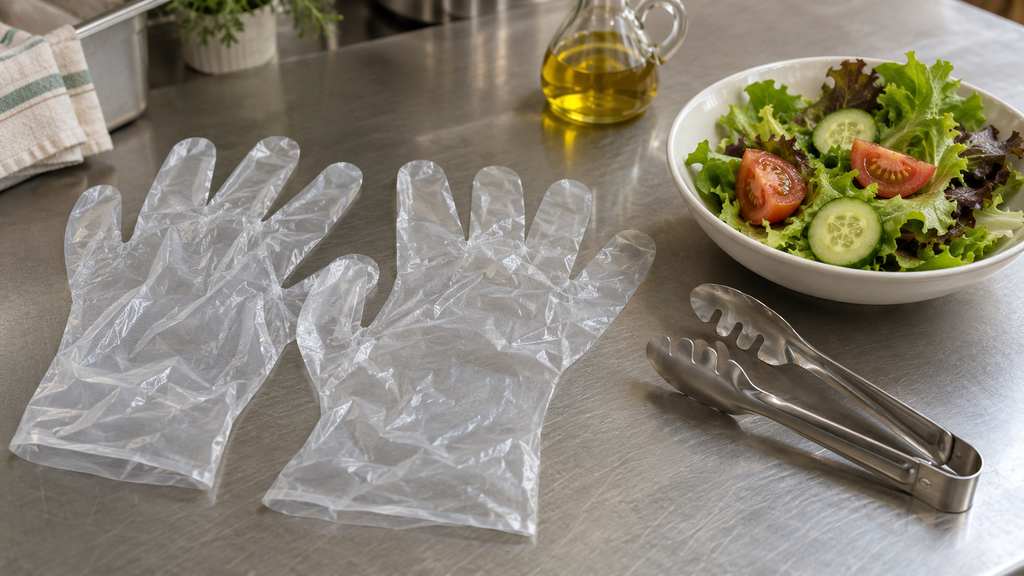
Disposable food-handling gloves may shed material during contact with liquids. A 2026 laboratory study reported more debris from selected gloves in an oil-containing mixture than in water, but it did not measure what reached a meal or what a person swallowed.[1]
There is another complication: some substances released from laboratory gloves can be mistaken for plastic, even by chemical instruments.[2][3] That makes this a question about identification as well as shedding.
Our recommendation is to choose gloves intended for the food and conditions you handle, follow their instructions and keep required hygiene practices in place. The research does not justify abandoning protective gloves, declaring every disposable glove unsafe or buying a replacement on a promise of zero microplastics.
What the food-glove experiment actually tested
Gao and colleagues bought three commercially available food-handling glove products labelled polyethylene (PE), thermoplastic elastomer (TPE) and polylactic acid (PLA). The PLA-labelled product was a blend containing PLA, PBAT and cornstarch, rather than pure PLA.[1]
The researchers cut the gloves into squares, rinsed them and immersed them in either distilled water or a mixture of peanut oil and distilled water. They held the beakers at 40°C for two hours, then filtered the liquids and rinses to collect material for examination.[1]
That is a controlled immersion experiment on prepared pieces. It is not a catering shift, a gloved hand briefly touching a sandwich or a measurement of fragments left in a takeaway meal. Cut pieces expose both faces and cut edges, unlike an intact glove's ordinary food-contact surface.[1]
The team reported higher particle abundances in the oil-containing treatments, with the PE product giving the highest reported abundance in that mixture. Much of the counted material was described as fibrous; electron microscopy also showed surface damage on the examined PE glove pieces.[1]
Those observations make the contact medium worth investigating. They do not establish a universal material ranking: one selected product representing a label cannot stand for every formulation, manufacturer or task. The authors themselves describe material-selection recommendations as preliminary.[1]
Counting debris is not the same as confirming plastic
The study counted material on filters with a stereomicroscope. Its Raman spectra and associated images examined glove surfaces before and after treatment, while electron microscopy examined selected glove surfaces for damage.[1]
The reported methods do not describe chemically identifying every counted filter particle, or a representative filter-particle subset with a stated confirmation rate. A spectrum of the parent glove helps characterise that glove; it does not establish that every fibre collected from the liquid is the same polymer.[1]
The authors included no-glove controls and procedural blanks, described contamination precautions and subtracted procedural-blank counts. Those are useful controls. They do not, by themselves, identify material that appears specifically when a glove is present.[1]
There are further limits. The paper says particles below one micrometre were not characterised by optical counting, despite using a filter with smaller pores. A small filter pore is not proof that the method measured nanoplastics. The authors also report no recovery-efficiency experiments using standard microplastics.[1]
Even the sample accounting needs care: the methods describe eight pieces per group, whereas the results assign four pieces to each filter. The article does not clearly reconcile that allocation with all the reported repetitions. We therefore do not repeat its area-normalised particle counts or calculate a dose per glove, shift or serving.[1]
The qualitative finding is worth discussing, but the confidence attached to a precise number should reflect how the material was collected, counted and identified.
Why gloves can also create false positives
A separate 2020 investigation by Witzig and colleagues examined leachates from ten types of disposable laboratory gloves using Raman microscopy, infrared microscopy and pyrolysis–gas chromatography/mass spectrometry. Its publisher abstract reports that long-chain compounds, including stearates or fatty acids, could be falsely identified as polyethylene.[2]
The full study is also reproduced in the lead author's university-hosted dissertation. Its methods used whole gloves with their outer surfaces immersed in ultrapure water for five hours, with duplicate gloves per type at each of three laboratories. This was a different experiment from the food-glove immersion study, using different glove products and analytical procedures.[3]
On re-examination, much of the apparent polyethylene in certain infrared measurements was assigned to stearates after the reference database was expanded. The study also found that the choice of pyrolysis marker affected apparent polyethylene quantities.[3] Calling an analysis “chemical confirmation” is therefore not enough: the method must distinguish the polymer from plausible lookalikes.
An independent 2026 study by Clough and colleagues extended this problem to dry contact. The researchers pressed selected latex and nitrile laboratory gloves against prepared surfaces, analysed transferred residues and showed how routine spectral-library matching could misclassify stearates as microplastics.[8]
They also described ways to improve identification, including more suitable infrared comparison regions, reference spectra and a statistical approach for Raman data. These were analytical improvements, not a test of food transfer or a clinical trial of alternative gloves.[8]
None of this proves that the food-glove study's debris was entirely stearate, or that gloves never release genuine plastic. It explains why we do not treat a visual particle count as an unquestionable polymer count. The dry-contact paper also stresses that researchers should retain gloves when personal protection requires them.[8]
What this means for your kitchen or food business
Treat the evidence as a reason to ask better purchasing and handling questions, rather than as a reason to weaken food-safety procedures.
- Check the intended use. Ask the supplier whether the particular glove is intended for your foods, contact temperatures and tasks. Keep the actual product specification; a material name alone is not a complete description.
- Do not assume “PLA” means particle-free. The tested PLA-labelled glove was a blend, and the researchers reported debris after treatment.[1] Our guide to biodegradable and compostable plastic labels explains the separate disposal question. A claim about the end of a product's life does not answer what happens during food contact.
- Keep hygiene and protection requirements first. Follow your established handwashing, glove-changing and task-separation procedures. Do not wash or reuse a single-use glove to try to copy a laboratory preparation step, and do not remove a required barrier because of a particle headline.
- Use suitable utensils where the task allows. Clean tongs or a serving spoon may avoid unnecessary direct handling for some tasks. That is a practical option, not a tested percentage reduction in microplastic exposure or a substitute for cleaning the utensil properly.
- Question absolute replacement claims. These studies do not establish a particle-free glove, a universally safest material or a health benefit from switching brands.[1][3][8]
For a different source of kitchen debris, our article on opening plastic packaging examines tearing and cutting film. A damaged wrapper and a glove soaked in a simulant are different experiments; their counts should not be combined into an estimate for dinner.
Does this establish a human health risk?
No. The food-glove experiment did not measure ingestion, human absorption or disease. The two analytical studies investigated contamination and identification problems, not health outcomes in people eating food handled with gloves.[1][3][8]
The US Food and Drug Administration's public assessment says current scientific evidence does not demonstrate that levels of microplastics or nanoplastics detected in foods pose a human health risk. It also highlights the absence of standard, validated measurement methods and says evidence is insufficient to show migration from plastic food packaging into foods and beverages.[4]
That broader assessment does not erase a laboratory observation of debris release. Equally, a beaker experiment does not establish illness from a meal. Neither supplies a personal risk percentage or a clinically proven benefit from buying different gloves.[1][4]
Food-handling gloves deserve the same scrutiny as other food-contact materials: appropriate use, clear product information and reliable testing. The useful next evidence would chemically identify released particles and measure transfer during realistic food handling, while preserving the hygiene function the glove is meant to provide.[1][3][8]
Sources
- https://pmc.ncbi.nlm.nih.gov/articles/PMC13208661
- https://pubs.acs.org/doi/abs/10.1021/acs.est.0c03742
- https://opus.bibliothek.uni-augsburg.de/opus4/files/126474/Witzig_Diss.pdf
- https://www.fda.gov/food/environmental-contaminants-food/microplastics-and-nanoplastics-foods
- https://www.ambujtewari.com/research/clough26avoiding.pdf