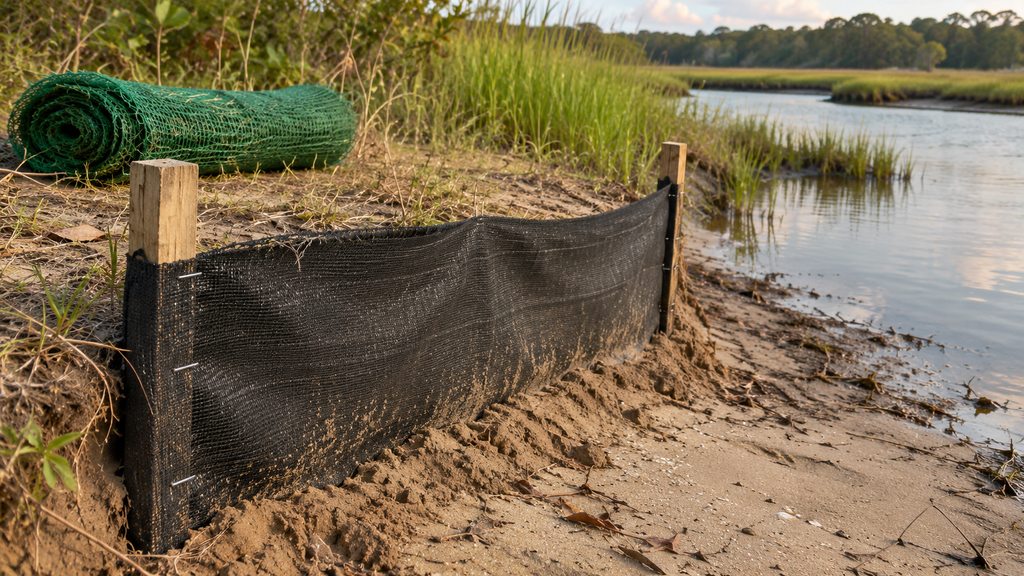
Fabric installed to keep soil in place can become a source of plastic fragments itself.[1] A recent controlled experiment recovered polypropylene particles from water exposed to two erosion-control textiles: black silt fence and green mesh mat.[1] The practical response is better material selection, inspection and planned retrieval, rather than pulling out a working shoreline structure yourself.
The evidence does not tell us how much every coastal installation releases, or whether a particular beach poses a health risk. The newer experiment followed early release in small tanks; an older polyester study's global estimate has been challenged by a geosynthetics society.[1][2][3] Those distinctions matter before turning a photograph of fraying fabric into a pollution total.
What is a coastal geotextile?
Geotextiles are permeable fabrics used in civil engineering for tasks including filtration, separation and erosion control.[1][4] Many are made from synthetic polymers such as polypropylene or polyester.[1][4] They are not all the same product, and a temporary construction-site silt fence is not interchangeable with a permanent reinforcement mat or a sand-filled coastal container.[1][4]
The microplastic connection is physical: cutting, fraying and weathering can detach smaller pieces from the parent material.[1][2] Sunlight and water movement are among the stresses investigated in geotextile research.[1][2] That is a different pathway from the hauling abrasion covered in our guide to fishing-rope microplastics. Here the material is installed as part of an erosion-control system, so the maintenance and end-of-service decisions are different.
What the wave-tank experiment actually measured
Louisa Mai and colleagues compared two commercially purchased polypropylene products with controls containing no geotextile.[1] They used eighteen glass aquaria: six with black silt fence, six with green mesh geomat and six controls with wooden frames alone.[1] The fabrics were attached to frames, partly immersed in seawater and placed on a moving platform in a greenhouse near a South Carolina estuary.[1] The setup combined simulated waves with ambient light and temperature over 48 days.[1]
Water was collected at four sampling points, twelve days apart.[1] After preparation, the team counted suspected particles under a microscope and used laser direct infrared analysis, or LDIR, to identify material chemically in selected samples.[1] This was not chemical identification of every item in the visual count: the microscope work counted a random quarter of each filter, while LDIR examined aliquots from three randomly selected samples per treatment at each sampling date.[1]
The chemical analysis supported release of polypropylene, the polymer used in the fabrics.[1] It also showed an initial release during the first sampling interval, followed by a decrease.[1] However, polypropylene accounted for less than 5% of the total nonnatural particles detected by LDIR.[1] The authors discuss cutting debris and material adhering during manufacturing, packaging and transport as possible contributors to the early particle mixture.[1] Calling every counted particle a newly weathered piece of the installed fabric would therefore go beyond the identification evidence.
Background contamination mattered too. The researchers processed control tanks in the same way and subtracted their mean counts; a laboratory blank contained no polypropylene.[1] Recovery efficiency, the proportion of particles successfully recovered through the method, was not measured.[1]
Why we are not repeating a shedding rate
The paper's abstract and main results do not agree on several reported rates.[1] The initial rates are assigned to different materials, one abstract unit includes an extra "year", and the final sampling rates differ between the abstract and the results and discussion.[1] We therefore leave those numerical rates out rather than choose a convenient version. The qualitative finding of release is useful without presenting an unresolved figure as a reliable emission factor.
There are further limits. The later increases in chemically identified polypropylene release were not statistically significant, and the authors caution about low replication and high variability.[1] LDIR analysed particles above 20 micrometres; it was not a census of smaller microplastics or nanoplastics.[1] The collection sieve and the chemical-analysis size limit were also different parts of the method.[1]
The tanks were repeatedly emptied and refilled during sampling, removing floating debris. That differs from a shoreline where material can remain, settle, become fouled or be moved by storms.[1] The experiment supports an early-release pathway under its test conditions, not a measured annual loss from an actual coastal defence. It cannot supply a Dubai shoreline emission rate simply because both places have sun and salt water.
Older polyester research, and the challenge to its global estimate
Xue Bai and colleagues studied PET, a polyester, in coastal reclamation areas in Yancheng, China, and in laboratory ultraviolet-weathering experiments.[2] Their abstract reports weathered field material and laboratory breakdown associated with photooxidation.[2] That is a separate investigation of a different polymer and setting, not a direct replication of the polypropylene tank experiment.
For this article, we could inspect the publisher's abstract, introduction and section previews, but not the complete methods. An exact-title search did not locate a verified open manuscript. We use the paper for its reported broad pathway, not its detailed particle counts or conversion of laboratory results into worldwide annual emissions.[2]
That global extrapolation is disputed. In a publicly available letter dated August 2022, International Geosynthetics Society representatives Boyd Ramsey and Preston Kendall challenged assumptions about the mass available to fragment and how much geotextile is exposed to ultraviolet light in coastal applications.[3] Their letter is a society-hosted technical objection, not a new release experiment or proof that the journal withdrew the paper. We did not verify a formal author reply or correction resolving the disagreement.
Our reading is narrower than either a global pollution headline or a blanket dismissal: material breakdown warrants attention, but a worldwide tonnage needs defensible mass and exposure assumptions. We do not repeat the disputed total.[2][3]
Long structural life does not mean zero particle release
A separate study by Philipp Scholz and colleagues combined Baltic beach observations with laboratory ageing of a selected polypropylene geotextile.[4] Its accelerated tests examined changes in mechanical properties under elevated temperature and oxygen pressure.[4] A prediction about retained mechanical performance is not a measurement of zero shedding. Conversely, finding released particles does not establish that an entire engineering structure has already lost its load-bearing function.
The field component recorded visible geosynthetic remnants larger than roughly 3–5 centimetres, including material associated with damaged coastal structures and building-material bags.[4] That is evidence of larger litter, not a microscopic sediment survey. The authors emphasised suitable material selection, installation and maintenance.[4] Our beach-sampling guide explains why visible debris observations and chemically identified particle measurements should remain separate.
What owners, contractors and beach visitors can do
These are our practical recommendations, informed by the studies and maintenance guidance. They are not a tested promise of a particular percentage reduction in microplastics.
- Identify the exact product and its job. Ask whether it is temporary sediment control, permanent reinforcement or another engineered component. Check the polymer, intended exposure conditions and retrieval requirements with the designer or supplier.[1][4]
- Give maintenance an owner. Include checks for fraying, tears, exposed edges and loose material alongside checks that the system still controls erosion. The newer study recommends closer monitoring and removal or replacement when substantial degradation occurs.[1]
- Plan the end of temporary use. South Carolina's stormwater field manual calls for replacing ineffective or decomposing silt-fence sections and removing temporary fence when it is no longer needed, with stabilisation of disturbed ground.[5] This is an example of official maintenance guidance, not a statement of UAE law or a universal installation specification.
- Ask about the complete alternative. Coconut fibre, jute and sisal are discussed as possible substitutes, but the newer paper also notes that their strength and suitability need evaluation for different uses.[1] A natural-fibre label alone does not demonstrate that an alternative can safely perform the same engineering function.
If you find damaged fabric on a beach, photograph the location and report it to the landowner or responsible authority. Do not cut or pull fabric out of a bank, seawall or active construction site. Our safety recommendation is to leave structural intervention to the responsible team and keep any volunteer cleanup within an organised programme's instructions.
The useful takeaway
Erosion-control fabrics deserve a pollution-prevention plan as well as an installation plan. Controlled polypropylene research supports early particle release, while field observations show how larger geosynthetic debris can be left behind.[1][4] The amount released over a real installation's lifetime remains uncertain, and neither study measured a beachgoer's dose or demonstrated human illness from that site.[1][4]
For a project owner, the useful questions are concrete: what material is installed, who inspects it, what triggers repair, and who retrieves it when its job ends? For a beach visitor, reporting a failing installation is more appropriate than trying to dismantle it.
Sources
- https://pmc.ncbi.nlm.nih.gov/articles/PMC13653067
- https://www.sciencedirect.com/science/article/abs/pii/S0048969721052451
- https://geosyntheticssociety.org/wp-content/uploads/2022/09/Letter-to-the-editor_Elseiver-re-Bai-paper-1_final.pdf
- https://pmc.ncbi.nlm.nih.gov/articles/PMC7866501
- https://des.sc.gov/sites/des/files/Documents/BOW/Stormwater/BMP/BMPFieldManual.pdf