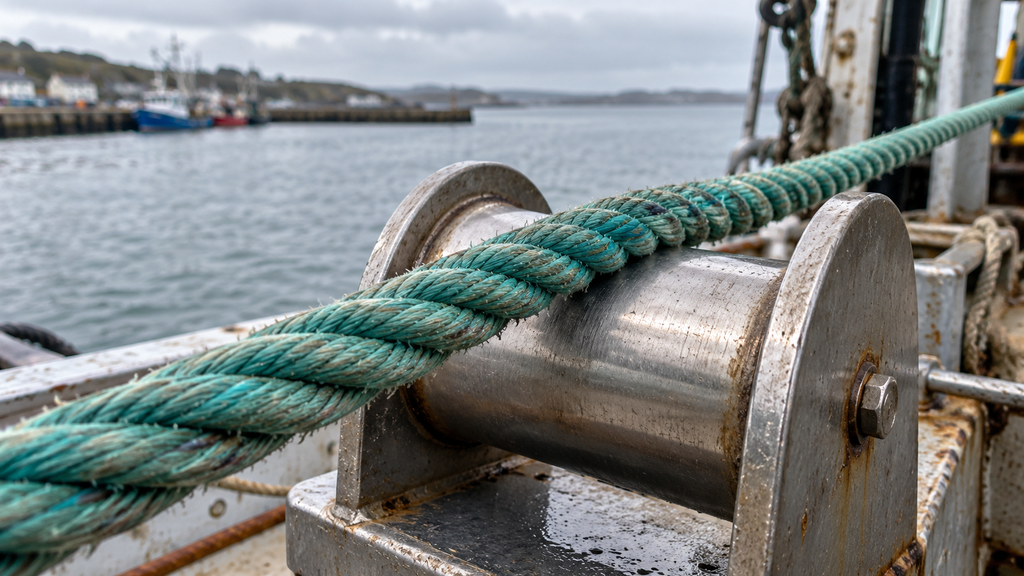
Yes. A fishing rope does not have to break loose and become marine litter before it can release microplastics.[1] Experiments have recovered plastic fragments where working ropes rub against hauling equipment.[1] The useful question for a boat owner or fishing operator is therefore not only how to avoid losing gear, but how to manage wear while that gear is still in use.
That does not mean every haul releases the same amount, or that an old-looking rope tells us how much plastic is in the catch.[1][2] The evidence supports a specific release pathway: mechanical abrasion of synthetic rope.[1][2] It does not supply a universal emission rate, a seafood dose or a human-health finding.[1][2]
What rubs off a working rope?
In a study published in Science of the Total Environment, Imogen Napper and colleagues compared selected maritime ropes with different ages, diameters and materials.[1] These included polypropylene and a polyethylene/polypropylene mixture sold as polysteel.[1]
They first used a research vessel to check whether hauling produced fragments under working conditions.[1] Wet ropes lifted a 15-kilogram weight, with funnels placed at friction points to collect released material and water.[1] Microscopy showed irregular plastic fragments rather than the long fibres a reader might expect from something made of strands.[1]
The distinction matters when interpreting pollution samples. A fragment need not look like a miniature piece of rope. Conversely, an irregular piece found on a beach cannot be assigned to a fishing vessel merely because these experiments produced a similar shape. The experiment establishes a possible source, not a fingerprint unique to that source.[1]
For another maritime pathway, our ship-hull paint guide examines coating releases. Rope abrasion and paint loss deserve separate treatment because the materials and measurement methods differ.
The boat test and the release estimate were different experiments
The vessel work confirmed shedding during hauling, but seawater also carried natural particles that complicated weighing the plastic.[1] The researchers therefore used a dry laboratory rig to quantify releases under more controlled conditions.[1]
In that rig, sections of rope repeatedly hauled a 2.5-kilogram weight through pulleys.[1] The team collected and weighed the released material.[1] Their fragment-number estimates combined that measured mass with rope density and particle-volume estimates derived from laser sizing.[1] They did not simply count every particle in the sea around a working boat.[1]
This is an important limit on the familiar headline of "pieces per metre". The resulting number depends on the test arrangement and the method used to convert mass and size into an estimated fragment count.[1] It is not a measurement that can be attached unchanged to every fishing operation.[1]
The selected two- and ten-year-old polypropylene ropes released more material than the new and one-year-old polypropylene ropes in these tests.[1] However, these were available industry ropes with different service histories, not identical ropes randomly assigned to age outdoors for different lengths of time.[1] The used ropes had already been judged to be at the end of their service by their previous owners.[1]
Our interpretation is that condition and service history deserve attention, not that every rope suddenly becomes unacceptable on its second birthday. The study does not establish a universal two-year replacement rule or prove that age alone explains the observed differences.[1]
What newer hauling research adds
A separate study by Young Kyoung Song and colleagues, published in Marine Pollution Bulletin in 2025, also investigated abrasion using a purpose-built hauler.[2] Its abstract describes tests of polypropylene-based co-polymer rope with different hauling loads and numbers of cycles, again reporting predominantly non-fibrous fragments.[2]
That is useful corroboration of the release mechanism from another research team. It is not a like-for-like replication of every rope, load or counting method in the Plymouth work.[1][2]
For this article, we could read the newer paper's abstract through the authors' institutional record, but that record contained no manuscript file.[2] We therefore use it only to confirm the broad experimental question and reported fragment type. We do not repeat its numerical release rates or global annual estimate without examining the full methods.
The narrower conclusion is already useful: preventing lost gear and reducing abrasion during use address different opportunities for pollution prevention.[1][2]
Not all fishing rope is the same plastic
A separate material-identification study by Raquel Corniuk and colleagues examined recovered derelict fishing gear from around O'ahu, Hawai'i.[3] The researchers dissected gear components and combined infrared spectroscopy with thermal analysis to identify polymers and blends.[3]
Twisted and braided lines proved materially varied, with some lines containing several distinct components.[3] Polyethylene variants and blended materials were prominent in the recovered gear.[3] That is a reason to be cautious about treating "fishing rope" as one uniform material.
This study investigated discarded gear, not fragments collected during a controlled hauling experiment.[3] It informs questions about material identity and sorting for recycling; it does not independently measure how quickly an in-use rope sheds.[3] Nor does a collection of floating gear around Hawai'i represent all rope sold or used in the UAE.
For an operator comparing products, our recommendation is to ask for the actual polymer composition, construction and relevant abrasion-test conditions. A material name alone is not evidence that one rope produces fewer particles throughout its working life. The hauling and gear-identification studies do not establish a universal ranking of rope products.[1][2][3]
Practical questions for boat owners and operators
The Plymouth researchers call for better rope design, maintenance, replacement and recycling arrangements, while noting that further work is needed to establish best practices.[1] The following are our suggested purchasing and maintenance questions, not a tested promise of a particular reduction:
- Check the working system, not just the rope. Ask the supplier or qualified maintenance team whether the rope, rollers and hauling equipment are correctly matched, and what signs of unusual wear require action. Do not improvise changes to load-bearing equipment.
- Keep a service history. Record the rope specification, installation, inspections, demanding uses and retirement decision. A documented condition assessment is more useful than guessing from colour or calendar age alone.
- Follow the manufacturer's care and retirement instructions. Do not keep damaged rope in service to avoid creating waste, and do not discard safe gear early solely because one experiment compared particular rope ages.
- Arrange the end-of-life route before replacement. Ask the harbour, supplier or waste contractor what it actually accepts. Confirm whether different gear materials must be separated rather than assuming every rope belongs in an ordinary plastics collection.
Material complexity can complicate recycling, as the Hawai'i analysis illustrates.[3] None of these papers proves that a named local collection service exists, so check acceptance rather than relying on a recycling symbol or an overseas scheme.
What this does not tell us about fish or people
These hauling studies concern particles released by equipment; the Hawai'i study concerns recovered gear composition.[1][2][3] They do not trace those releases into a particular fish fillet or follow consumers for disease outcomes. It would be a separate, unsupported step to turn rope abrasion into advice to stop eating seafood.
Our guide to microplastics in edible seafood tissue explains why the sampled tissue, particle identification and detection limits matter when the question is food exposure.
The practical takeaway is to include working-rope wear in gear management, alongside preventing loss and arranging responsible disposal. The evidence shows that release can begin before a rope becomes litter.[1][2] It leaves the amount from any particular vessel, the best replacement interval and the resulting human exposure unresolved.[1][2]