A burst party balloon can leave more than the large pieces you pick up from the floor. Researchers have identified small rubber fragments after deliberately bursting balloons in a laboratory.[1] A separate question is what happens when balloon material escapes outdoors: experiments do not support treating a "biodegradable" label as permission to release it.[2][4]
Our recommendation is to skip balloon releases, avoid deliberate popping as a party activity, and collect leftover balloons and attachments. The research supports preventing avoidable debris. It does not establish how many particles a guest inhales or a personal health benefit from changing decorations.
Why balloons belong in the microplastics discussion
The connection is mechanical rupture. Stretching a balloon until it bursts can create small fragments as well as recognisable scraps.[1] In a study published in the Journal of Hazardous Materials, Yunlong Luo and colleagues used Raman imaging to examine debris and compare its chemical signal with the original balloon material.[1] That provides stronger evidence of origin than simply spotting coloured dust.
The material needs careful naming. The tested balloons were identified as rubber, and the researchers described their small fragments as microplastics.[1] Latex balloons can contain plant-derived rubber that is processed with sulphur and other ingredients to make the finished product.[4] Natural latex is therefore not automatically the same material category as conventional synthetic plastics such as polyethylene.[2][4] We refer to rubber or balloon fragments where that is the more precise description.
The burst experiment was not a test of every balloon construction. Its findings should not be transferred unchanged to a metallised film balloon, another rubber formulation or every product sold as biodegradable.[1]
What the burst experiment actually collected
The researchers bought balloons from two brands in Australian shops and burst them using compressed air inside a covered cardboard box in a fume hood.[1] They attached eight cleaned glass slides to the bottom and side walls to collect debris, keeping balloons from touching the slides.[1] A waiting period after each burst allowed floating material to settle.[1]
This was controlled collection after repeated bursts, including an accumulated experiment with 100 balloons.[1] It was not an air monitor worn by a party guest, and the slides did not capture and individually identify everything released into a room.
Raman imaging helped distinguish rubber fragments from mineral particles associated with balloon surfaces.[1] The team also used electron microscopy to examine selected debris.[1] Their main small-fragment analysis focused on material above 10 micrometres; smaller particles were difficult to classify reliably because mineral dust and possible rubber fragments were mixed together.[1] Larger pieces were considered separately.[1]
That distinction matters. Treating every speck as plastic would exaggerate the finding. Conversely, a lower measurement boundary does not prove that nothing smaller was present. This experiment does not provide a complete nanoplastic count.[1]
Why we are not giving a particle count per party
The paper estimates release per balloon by analysing limited sample areas and extrapolating to a larger collection area.[1] Its total is not a census in which every fragment from every balloon was recovered and chemically identified.[1]
The authors acknowledge that results can change with balloon brand, size, material, bursting method and collection position.[1] Image-processing choices also affect counts, and Raman identification of the mixture could not be performed individually on every particle.[1] The box, compressed-air inflation and repeated bursts further separate the experiment from ordinary use.[1]
The supported finding is that bursting the tested balloons generated identifiable small rubber debris. Converting that into a precise dose per child, plate of food or celebration would require measurements the experiment did not make.[1] It also did not measure illness in people or establish a safe exposure threshold.[1]
A useful practical response need not depend on choosing the largest available number. We suggest avoiding unnecessary popping and keeping balloon disposal separate from food preparation. These are handling precautions, not tested percentage reductions in exposure.
Does biodegradable latex disappear after it is littered?
Morgan Gilmour and Jennifer Lavers examined selected latex balloons marketed as biodegradable alongside products without that claim.[4] Their study used outdoor freshwater and saltwater tanks and industrial compost windrows, following treatments for 14 to 16 weeks.[4] We read the full university-hosted journal pre-proof for the methods; it is an accepted, pre-final version rather than the definitive typeset article.[4]
The balloons were inflated and then slowly deflated without bursting before the environmental treatments.[4] This was a weathering investigation, not an independent repeat of Luo's burst experiment.
The researchers assessed appearance, mass, tensile strength and surface chemistry.[4] Balloons remained recognisable after treatment, although colours, textures, strength and some dimensions changed.[4] Some developed holes or broke more easily when handled; changes varied with product and environment.[4] A balloon becoming weaker is not the same as its material disappearing.
The compost experiment also has a relevant limit: its temperature was not measured directly during the study.[4] It should not be presented as proof that every certified product fails every controlled composting standard. The narrower conclusion is useful enough: the selected products did not rapidly vanish under the tested conditions, including those carrying a biodegradable claim.[4]
For help interpreting the terminology, see our guide to biodegradable and compostable plastic labels. The relevant question is what the finished product does in a specified environment, not whether its raw material sounds natural.
What a longer seawater experiment adds
An independent team led by Jan Gerritse placed several household materials, including latex balloons, in a laboratory seawater microcosm.[2] The system used circulating artificial seawater, light including ultraviolet wavelengths, and a microbial inoculum from the coast.[2] It was a controlled tank, not an observation of every condition a balloon might encounter at sea.
After roughly a year, the researchers observed small crumbles around balloon necks.[2] They also found small plastic debris in the shared tank water, which contained many different materials.[2] The water observations must not be reported as a balloon-only particle count.
The study measured weight loss but explicitly did not quantify how much of each item's loss came from small-particle formation versus mineralisation, the conversion of material into simpler substances.[2] Its mass loss cannot therefore be read as a percentage proven to have biodegraded, or used to calculate an exact disappearance date.[2]
The two weathering investigations do not cancel each other out. Recognisable balloons after months and some crumbling after a longer period can both be true.[2][4] Their products, environments, durations and endpoints differ. Neither establishes a universal outdoor lifetime or shows that a biodegradable label makes release harmless.
A cleanup plan that does not depend on the label
Our advice is to prevent balloon material from escaping rather than try to recover invisible fragments afterwards:
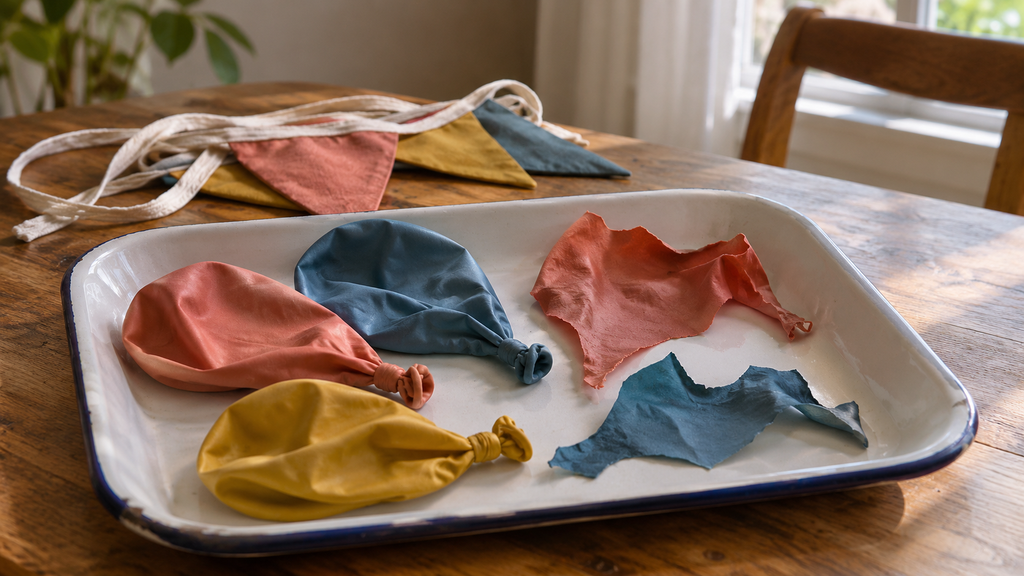
- Choose an activity without a release. Reuse decorations you already own, such as fabric bunting. This is a waste-prevention suggestion, not a measured comparison of every decoration's environmental footprint.
- If using balloons, keep them contained. NOAA's Marine Debris Program recommends ending releases and keeping balloons indoors, with weights to prevent accidental escape.[5] A biodegradable claim is not a substitute for containment.
- Avoid deliberate popping for entertainment. Plan a controlled end to the display and collect the material rather than scattering it. The burst study supports concern about fragment generation, but did not test an optimal household deflation method.[1]
- Collect attachments as well as balloon bodies. Include ribbons, strings and large torn pieces in the cleanup. NOAA documents balloon and ribbon debris in marine habitats and warns about wildlife ingestion.[5]
- Check the actual waste route. Ask your local collector where the finished item belongs. Do not assume that a biodegradable label makes a balloon suitable for your food-waste bin, garden compost or conventional plastic recycling.
Our article on biodegradable glitter and freshwater examines a different celebration material. Glitter starts as small decorative flakes; a balloon can generate fragments through rupture or later weathering. The shared practical lesson is to collect leftovers rather than rely on an environmental claim to finish the cleanup.
The studies here address particle generation and material persistence, not a measured human disease risk from attending a party.[1][2][4] Keep the conclusion proportionate: balloons need a containment and collection plan, including those sold as biodegradable.
Sources
- https://www.sciencedirect.com/science/article/pii/S0304389423023051
- https://www.nature.com/articles/s41598-020-67927-1
- https://figshare.utas.edu.au/articles/journal_contribution/Latex_balloons_do_not_degrade_uniformly_in_freshwater_marine_and_composting_environments/22991270
- https://blog.marinedebris.noaa.gov/scary-truth-about-party-balloons