A biodegradable label does not guarantee that glitter is harmless in a pond or river. Experiments with selected products found effects on freshwater plants from cellulose-based alternatives as well as conventional plastic glitter.[1][2] That is a reason to ask better questions about the finished product, not proof that every biodegradable glitter is worse than plastic.
Our recommendation for crafts and celebrations is to avoid loose glitter when you can, and collect what you do use before washing up. A material swap should not become permission to rinse the leftovers down a drain.
Why glitter is a microplastics question
Conventional glitter made from polyethylene terephthalate, or PET, is manufactured as small plastic flakes.[1][2] Those flakes are primary microplastics: they do not first have to break off a bottle or bag.[1][2] Rinsing glitter from skin or equipment can carry it into wastewater, one route towards aquatic environments.[1][2]
Alternatives need more careful naming. Researchers have tested modified regenerated cellulose, often shortened to MRC, and mineral-based mica products alongside PET glitter.[1][2] Mica is not itself plastic.[1][2] A cellulose core, meanwhile, does not tell you what coats the particle. Some tested cellulose-based products had an acrylic coating; one in the later freshwater study was described as having no acrylic coating and marketed as plastic-free.[1][2]
Calling every alternative a microplastic would blur those distinctions. For environmental decisions, the relevant questions include both what the particle contains and what happens while it remains in water.
What a 36-day freshwater experiment found
Dannielle Green and colleagues built small freshwater systems containing river sediment, water, duckweed and snails.[1] They compared a no-glitter control with PET, cellulose-based glitter, natural mica and synthetic mica, using seven replicate systems per treatment over 36 days.[1] This was a deliberately dosed experiment, not a measurement of typical glitter exposure in local rivers.[1]
Duckweed roots were shorter in the PET, cellulose and synthetic-mica treatments than in controls, but the study did not find significant differences in duckweed biomass, abundance or chlorophyll content.[1] In the surrounding water, chlorophyll b and c were lower with all four glitter types; chlorophyll a was not significantly different.[1] Those pigment measurements indicate changes in the organisms producing them, rather than directly counting every algal species.[1]
The cellulose treatment also contained more New Zealand mud snails than the control and PET treatments.[1] Yet the overall sediment-animal assemblage and the reported diversity measures did not differ significantly among treatments.[1] A species-specific change matters, but it is not the same finding as a collapse of freshwater biodiversity.
The authors suggested that chemicals released from glitter could help explain some plant responses.[1] They did not measure that leachate in this experiment, so the chemical mechanism remained unresolved.[1]
A follow-up separated fresh glitter, aged particles and leachate
A 2023 study led by Bas Boots, with Green among the authors, investigated common duckweed in 14-day experiments.[2] This was follow-up work with a shared investigator, not replication by an unrelated team.[1][2]
The researchers compared PET, two cellulose-based glitters, synthetic mica and kaolinite, a natural clay-particle comparison.[2] Separate experiments used fresh glitter, water in which glitter had soaked for seven days, or the recovered water-aged particles.[2] The soaked, filtered water is called leachate. Testing it separately helps distinguish effects associated with released chemicals from effects of the larger flakes.[2]
Fresh cellulose-based glitters produced the strongest responses at the higher experimental doses.[2] Both affected root growth, while the product described as having no acrylic coating also reduced biomass and chlorophyll relative to controls in particular treatments.[2] PET and synthetic mica generally had little effect on the measured duckweed variables in this shorter study.[2]
Cellulose-glitter leachate also affected root growth in some conditions, though less strongly than fresh glitter.[2] The water-aged particles generally had little effect relative to controls.[2] That does not establish that the particles had completely biodegraded: the researchers recovered them and used them in another experiment.[2] It is not a recipe for making glitter safe by soaking it at home.
The authors detected metals in acid-digested glitter and discussed possible contributions to the plant responses.[2] That measures the material's elemental content, not the metal concentration released into the duckweed's water, and it does not identify a proven chemical cause.[2]
There is also an unresolved reporting problem. The paper alternates between concentration labels in milligrams per litre and milligrams per millilitre in its methods and results.[2] We therefore do not repeat its numerical doses as exposure estimates or safety thresholds. The inconsistency should stay visible rather than being silently corrected by a reader.
Fading glitter is not proof of biodegradation
An independent team led by Marta Doval-Miñarro examined commercial cellulose-based eco-glitters in purified water and filtered Mediterranean seawater.[3] Their main experiment followed pink and golden products for 96 days, with duplicate flasks and water-only controls.[3] The products included a styrene/acrylate coating; they were selected commercial formulations, not a survey of everything now sold as biodegradable glitter.[3]
The particles lost colour and shine and showed surface changes, but retained their hexagonal shape at the end of the experiment.[3] That is useful evidence against assuming rapid disappearance under those laboratory conditions. It does not establish an exact lifetime in a river.
The researchers explicitly distinguished degradation from biodegradation.[3] They did not measure oxygen consumption or carbon-dioxide production, which would help assess biological conversion of the material.[3] Reported mass loss is therefore not a percentage of glitter proven to have biodegraded.[3]
The same study found no observable acute toxicity from the tested leachates in its bacterial assay using Aliivibrio fischeri.[3] That negative result belongs in the story too. It does not establish safety for duckweed, all aquatic species or long-term exposure: the assay tested a different organism and endpoint.[3]
Why the evidence does not give a simple shopping ranking
The studies asked different questions. A freshwater community experiment, a shorter duckweed experiment and a laboratory weathering study with a bacterial assay cannot be arranged into a universal best-to-worst product list.[1][2][3] Different products, durations and endpoints help explain why a result in one test need not recur in another. The follow-up authors themselves identified exposure duration as one possible explanation for their different PET findings.[2]
The European Environment Agency explains that temperature, time, microorganisms, oxygen and moisture influence whether and how quickly a material breaks down biologically.[4] Certification relates to defined conditions, which real disposal environments may not reproduce.[4] We use that briefing for these principles, not as a current register of every certification scheme.
None of the glitter experiments above measured a person's absorbed dose or demonstrated illness from using craft glitter.[1][2][3] They also do not establish the complete environmental footprint of every alternative decoration. Our advice is about avoiding an unnecessary release, not promising a quantified personal health benefit.
A workable routine for crafts and celebrations
- Consider an activity without loose glitter, or reuse decorations you already own. This is a waste-prevention suggestion, not a measured life-cycle ranking of all craft materials.
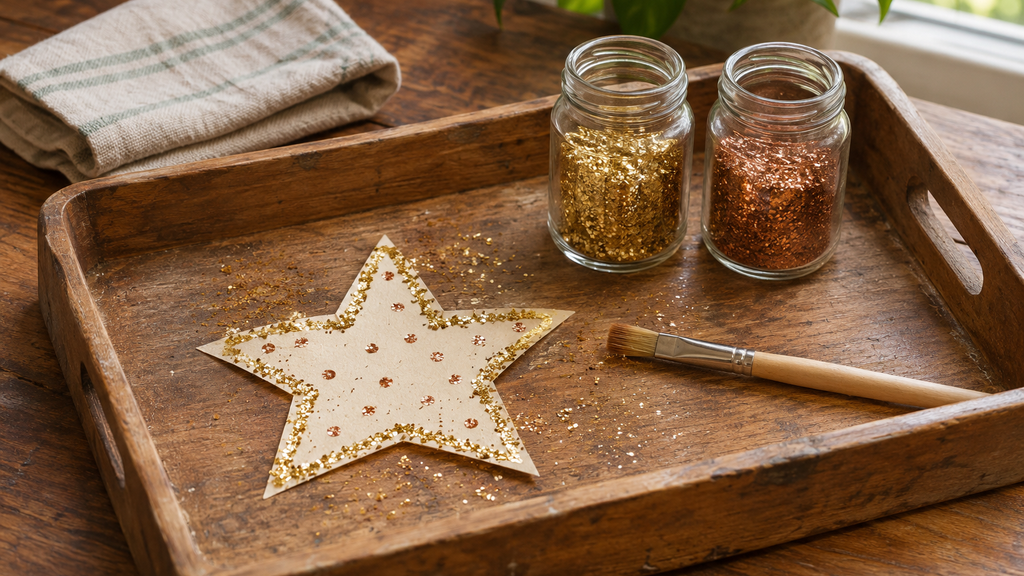
- If using glitter, work over a tray and collect spills before washing the surface. Close the jar between sessions and keep usable leftovers for next time.
- Keep loose glitter out of drains, ponds and outdoor event spaces, including products sold as biodegradable. Do not use an aquarium to test a packet's environmental claim.
- Ask what the finished product contains, including coatings, and which named conditions any certificate covers. A precise biodegradability claim is more informative than "eco" on its own.[4]
- Check your local waste collector's instructions for collected glitter and decorated materials. Do not assume a biodegradability label means the recycling or food-waste collection accepts them; treatment infrastructure matters.[4]
For help reading the terminology, see our guide to biodegradable and compostable plastic labels. For the separate legal question, read the EU microplastics restriction for cosmetics, which distinguishes glitter compositions and uses. It is not a statement of UAE law.
The useful buying question is whether there is evidence for the finished glitter under relevant conditions. Whatever the answer, collecting the leftovers remains part of the job.
Sources
- https://aru.figshare.com/articles/journal_contribution/All_that_glitters_is_litter_Ecological_impacts_of_conventional_versus_biodegradable_glitter_in_a_freshwater_habitat/23765487
- https://www.sciencedirect.com/science/article/pii/S0147651323007959
- https://pubs.rsc.org/en/content/articlehtml/2025/em/d5em00105f
- https://www.eea.europa.eu/en/analysis/publications/biodegradable-and-compostable-plastics-challenges-and-opportunities