Polypropylene baby bottles can release particles during hot-water use, but the widely repeated claim that a baby routinely swallows millions of plastic particles needs an update: later research found that plastic additives can be mistaken for microplastics, and the original team reported much lower bottle counts after improving its method.[1][8]
The practical priority is clearer than the exposure estimate. Do not lower the temperature used to prepare powdered formula, skip sterilisation or improvise extra cleaning steps because of a microplastics headline. NHS guidance requires washed and sterilised equipment and water at least 70°C when mixed with formula powder, followed by cooling before feeding.[2] This article explains the evidence behind the bottle question; it does not replace infant-feeding advice.
What the original bottle experiment measured
In 2020, Dunzhu Li and colleagues published an experiment on polypropylene infant-feeding products in Nature Food. They reported releases reaching about 16.2 million particles per litre under their test conditions.[1] The accepted manuscript is also available through Trinity College Dublin's repository.[4]
The laboratory procedure matters. New bottle bodies were cleaned, exposed to 95°C water for five minutes, dried, filled with 70°C deionised water and mechanically shaken for a minute to simulate mixing.[4][6] Researchers then cooled and filtered the water.[6] Polypropylene accessories were tested separately.[6]
This was principally a water-based simulation of formula preparation, not a survey of finished feeds collected from families. Formula itself interfered with particle counting, so the researchers used additional experiments to examine whether a formula coating affected subsequent release into water.[4][6] That is more informative than testing heat alone, but it is not the same as measuring every particle in a baby's meal.
The team used Raman spectroscopy to identify material and microscopy to examine particles.[4] The main counting procedure used filters with 0.8-micrometre pores and analysed selected areas rather than every part of the filter, then extrapolated to a concentration.[6] It included blank controls and recovery tests.[6] These are useful safeguards; they did not eliminate the identification problem exposed by later work.[8]
The paper's daily infant-intake figures were estimates combining laboratory release, bottle-market data, feeding patterns and assumed milk volumes. They were not measurements inside infants or observations of disease.[4][6] A regional estimate from that model cannot tell an individual family what their child swallowed yesterday.
Why the headline count needs updating
Gerhard and colleagues subsequently investigated seven infant-feeding bottles and challenged the interpretation of released particles.[7] Their PubMed abstract reports that only one bottle had microplastics above their detection limit, and that the detected polymer did not match the bottle material.[7] They also found results depended on whether water was filtered hot or after cooling, and identified migrating additives as a possible source of false positives.[7]
That study does not prove that all bottles release nothing. It raises a narrower, important question: are particles being correctly identified as the bottle's polymer? We could read its abstract directly, but not its full publisher text, so we do not use it here for a detailed numerical comparison beyond the abstract's findings.
There was also a substantial methodological follow-up from Li and colleagues in 2022, with several authors from the original bottle study.[8] They showed that small particles of common additives can have Raman spectra similar enough to plastic polymers to be misassigned.[8] Their revised laboratory protocol used alcohol treatment to separate interfering additive particles from microplastics.[8]
Most importantly for parents reading the old headlines, that paper explicitly reports a reassessment of baby-bottle results: counts fell from over a million per litre to roughly 100–100,000 per litre using the new protocol, depending on factors including brand and duration of use.[8] This is a research finding, not a reliable intake range for your own baby, and not a threshold separating safe from unsafe feeding.
Nor is the alcohol step a home-cleaning tip. It was an analytical treatment applied to captured laboratory samples.[8] Do not rinse feeding equipment with laboratory solvents or add alcohol to a feed. The paper describes improving measurement, not a validated infant-feeding routine.[8]
A systematic review by Price and colleagues, published in September 2026, reinforces the need to check identification and contamination controls.[5] Its authors found the studies too heterogeneous for a meta-analysis and highlighted gaps in blanks and compositional analysis.[5] It is a synthesis of existing studies, not another independent bottle experiment.[5] Its cautious conclusion is more useful than treating either the largest or smallest published count as settled fact.
Detection does not establish harm to a baby
Neither the original release experiment nor the later analytical reassessment followed babies to establish that bottle-derived particles caused illness.[4][8] A particle count in water, an estimated swallowed dose, uptake into the body and a demonstrated health outcome are different questions.
The FDA's current public summary says that scientific evidence does not demonstrate that microplastic or nanoplastic levels detected in foods pose a risk to human health.[3] It also stresses the lack of standardised, validated measurement methods and says more research is needed.[3] That is not proof of zero risk, nor a bottle-specific guarantee. It is a reason to avoid turning uncertain exposure measurements into claims that a particular bottle will harm a child or that buying another one will prevent disease.
If you are comparing other kitchen headlines, our guide to microwaving food in plastic containers explains why test conditions and follow-up criticism matter. Bottle feeding has an additional constraint: the microbial safety of the feed must remain central.
What to do without compromising feeding safety
Keep the established preparation routine. The NHS says to wash and sterilise feeding equipment, use water at least 70°C when it meets powdered formula, follow the specified water-to-powder ratio and cool the prepared feed before offering it.[2] It also advises against warming formula in a microwave because uneven heating can burn a baby's mouth.[2]
The distinction between mixing and feeding temperatures is essential. Water hot enough for safe powder preparation must not be confused with a feed that is ready to drink.[2] Do not interpret a laboratory finding of lower particle release at cooler temperatures as permission to mix powder with cooler water than your clinical guidance requires.
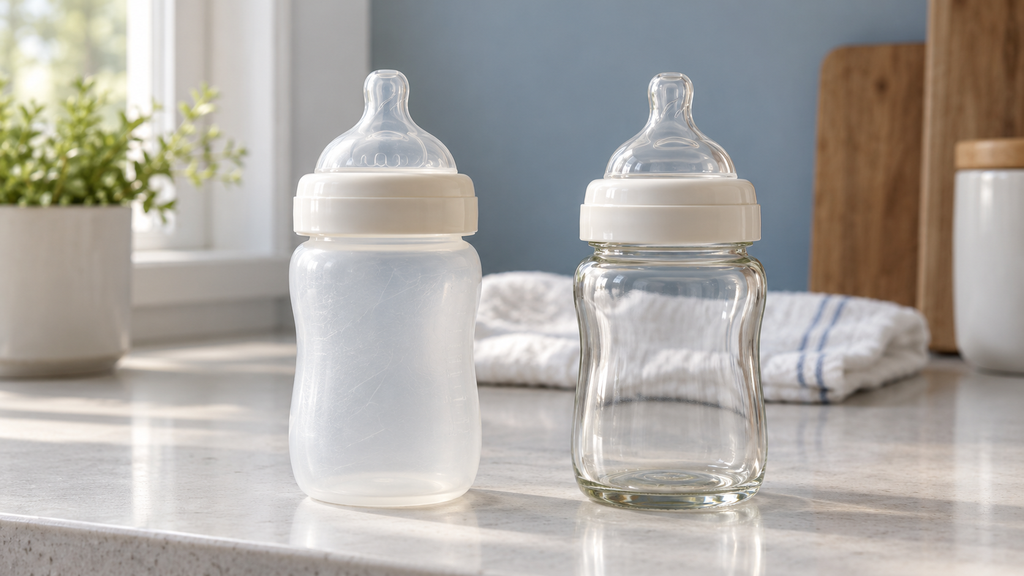
If you are considering a glass bottle to avoid a polypropylene bottle body, discuss a suitable option with your health professional and follow that product's cleaning, sterilisation and handling instructions. Treat this as a material preference, not a proven medical intervention. Neither the bottle-release experiment nor its reassessment demonstrated a health benefit from switching.[4][8] Check the whole feeding system rather than assuming a glass body means every component is plastic-free; the original study also examined polypropylene accessories.[6]
For premature or medically vulnerable babies, or where a specialist formula has different instructions, ask your clinical team before changing preparation. The NHS page cited here is UK general guidance, not a substitute for advice tailored to your baby and local water supply.
Our article on parents' knowledge and willingness to change plastic habits covers the awareness question separately. This article's recommendation is practical: preserve feeding hygiene, question old particle headlines and make any equipment change without a promise of health protection that the research has not demonstrated.[2][8]
Sources
- https://www.nature.com/articles/s43016-020-00171-y
- https://www.nhs.uk/baby/breastfeeding-and-bottle-feeding/bottle-feeding/making-up-baby-formula
- https://www.fda.gov/food/environmental-contaminants-food/microplastics-and-nanoplastics-foods
- https://www.tara.tcd.ie/items/f9ddd024-262c-48bd-8e96-92b75f0ab503
- https://www.nature.com/articles/s41538-026-01153-3
- https://media.springernature.com/original/springer-static/esm/art%3A10.1038%2Fs43016-020-00171-y/MediaObjects/43016_2020_171_MOESM1_ESM.pdf
- https://pubmed.ncbi.nlm.nih.gov/34732109
- https://pmc.ncbi.nlm.nih.gov/articles/PMC9454250