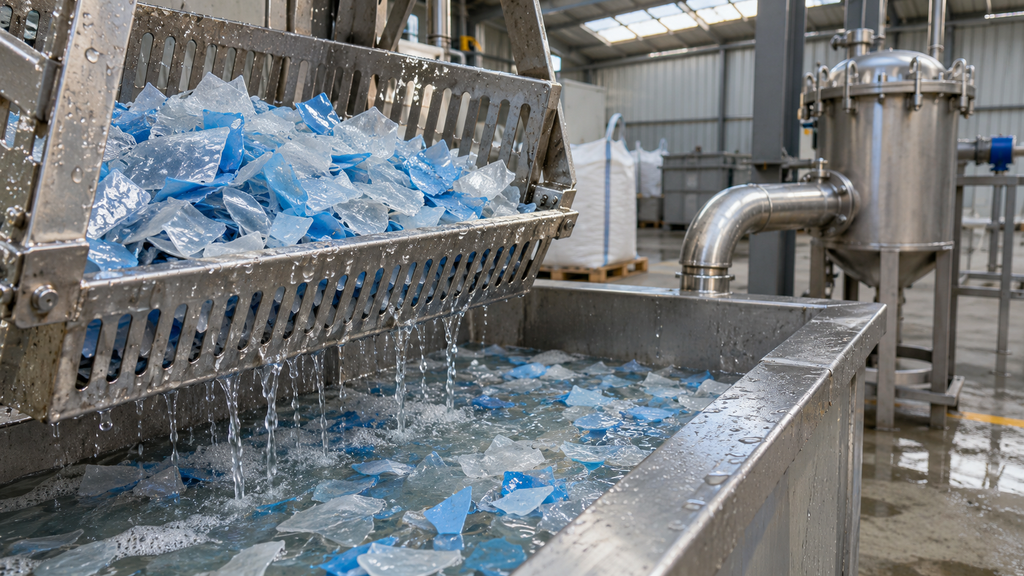
Recycling a plastic bottle does not mean keeping it intact. Mechanical recycling cuts material into smaller pieces, and a laboratory study found that this shredding step also generated microplastic fragments.[1] A separate experiment found microplastics in water from a recycling facility and tested a way to capture them.[2]
The useful takeaway is to ask how a recycler contains its small fragments and treats its water, rather than assume that recycling either prevents all pollution or is pointless. Making particles inside a process and releasing them into a river are different outcomes. Neither study compared the full environmental consequences of recycling with landfill or incineration.[1][2]
For households, our recommendation is to keep following the collector's instructions for accepted recycling while avoiding unnecessary disposable plastic. For businesses choosing a recycler, the questions below go beyond how many tonnes the company accepts.
Where the extra fragments come from
In the mechanical-recycling sequence described by Stapleton and colleagues, waste is sorted, reduced in size and washed before further processing.[1] Rotating blades produce manageable flakes; washing removes unwanted material from them.[1] The same cutting process can create smaller fragments alongside the intended flakes.[1] Washing then provides a possible route for those fragments to enter process water.[1]
That pathway has several stages: fragment generation, transfer into water, capture or retention, and possible discharge. A measurement at the first stage cannot establish the quantity escaping at the last. The shredding researchers explicitly called for further investigation of the proportion that actually reaches the environment.[1]
This is also why a photograph of large recycled flakes tells you little about microplastic emissions. The product being recovered and the unwanted fine material need separate measurements.
What the shredding experiment actually tested
The 2023 University of Wollongong study used purchased PET and high-density polyethylene bottles, polypropylene containers and polycarbonate sheets.[1] These were selected materials, not a representative sample of every mixed recycling load.[1] The team compared unweathered material with plastics kept outdoors at its Australian campus for three or six months.[1]
A laboratory shredder processed 200 grams of each plastic type.[1] All types required two passes through the machine to reach the intended flake size, with the rotational speed held constant.[1] Researchers sieved and weighed the shredded material, then counted particles in selected size fractions using photographs and counting software.[1] The analysis used three 50-gram subsamples; those are subsamples of processed material, not three independently monitored recycling plants.[1]
The experiment found differences between the plastics and higher particle generation after six months of outdoor exposure.[1] The three-month comparison did not show the same statistically significant increase.[1] This supports investigating material condition and storage before shredding. It does not establish an identical weathering timetable for every climate, product or facility.[1]
The chemical analysis also needs its proper role attached. FTIR spectroscopy examined changes in the plastics during weathering; it was not reported as chemical identification of every fragment counted by the photographic method.[1] The paper contains an apparent inconsistency in one written particle-size interval, so we do not reproduce detailed size-bin counts here. Its broader result, that the tested shredding process generated small fragments, does not require silently repairing that interval.[1]
What a recycling plant's wash water revealed
Umar and colleagues studied wastewater from a facility recycling plastics used in fishing and aquaculture, including feed sacks, hoses and cages.[2] They collected water before and after the site's sand filter, then separately tested those waters through laboratory sand-filter columns.[2] These were two different treatment settings, not one filter tested twice under identical conditions.[2]
Polyethylene and polypropylene were the main identified plastics, and fragments predominated.[2] The facility's filtered sample had a lower overall particle concentration, but a different mixture of sizes and polymers.[2] The onsite filter also received surface runoff.[2] The authors suggested that contamination from other streams could help explain the differences; they did not establish a complete source-by-source account of every particle.[2]
The laboratory columns achieved substantial removal within the experiment's measured range.[2] That promising result was not a guarantee that the existing onsite filter performed equally well, or that every full-scale recycling plant could achieve the same result without changes.[2] The authors identified unresolved questions about long-term operation, backwashing and sand replacement.[2]
This study used micro-FTIR analysis on all extracted particles, rather than relying only on their appearance.[2] Its practical lower detection limit was 30 micrometres, despite using a finer filter during sample preparation.[2] The distinction matters: a collection filter's pore size is not the same as the smallest particle the whole analytical method can identify. These results do not measure all smaller particles or establish nanoplastic removal.[2]
Capturing particles leaves another stream to manage
The filtration study also examined water used to backwash a laboratory column.[2] It found plastic fragments there, although backwash water was collected only once and was not investigated comprehensively.[2] Capturing particles from the main water stream therefore creates a further management question: what happens to the water and solids used to clean the filter?
Our guide to wastewater microplastic removal explains the wider distinction between a cleaner outlet and destruction of the polymer. Here, the specific issue starts earlier, with fragments made while recovering waste plastic, and continues through wash-water treatment and filter cleaning.[1][2]
The two studies fit together without supplying a single emissions factor. One investigated generation from selected plastics in a laboratory shredder; the other sampled a particular facility's water and tested laboratory filtration.[1][2] Their methods, materials and size windows differ.[1][2] Combining their results into a universal quantity released per bottle recycled would go beyond either design.[1][2]
Neither study measured a resident's swallowed or inhaled dose, or demonstrated illness caused by a recycling plant.[1][2] Environmental particle measurements should not be turned into a personal health-risk calculation.
Questions to ask before accepting a recycling claim
For a business commissioning waste services, we suggest asking the recycler:
- How is incoming material stored? Ask whether avoidable outdoor weathering and runoff are controlled. The shredding experiment gives a reason to examine storage, not a universal limit on permitted storage time.[1]
- Where are fine fragments contained? Request a description of collection around shredding, washing and material transfer. Ask what evidence supports the controls, rather than accepting a photograph of tidy finished granules.
- What exactly was tested in the water? Look for sampling dates, repeat measurements, flow information, particle-size limits and chemical identification. A laboratory filter demonstration is different from sustained performance at the operating site.[2]
- Where do captured residues and filter-cleaning water go? Ask for the actual handling route. The backwash finding shows why an apparently successful main-water result does not answer that question by itself.[2]
Households cannot audit an industrial water system from a packaging label. Our recommendation is to check the collector's current accepted-material list, keep rejected items out of that stream and avoid buying disposable items you do not need. Do not shred or wash plastic fragments down a domestic drain as a home recycling experiment.
If you are considering a supposedly greener substitute, our guide to biodegradable and compostable labels covers a separate decision: whether a material's claimed disposal conditions match the route actually available to you.
The evidence supports better control of recycling operations. It does not support replacing proper collection with littering, nor does it prove that abandoning recycling would have a lower overall environmental impact. A credible recycling claim should account for unwanted fragments as well as the material successfully recovered.[1][2]