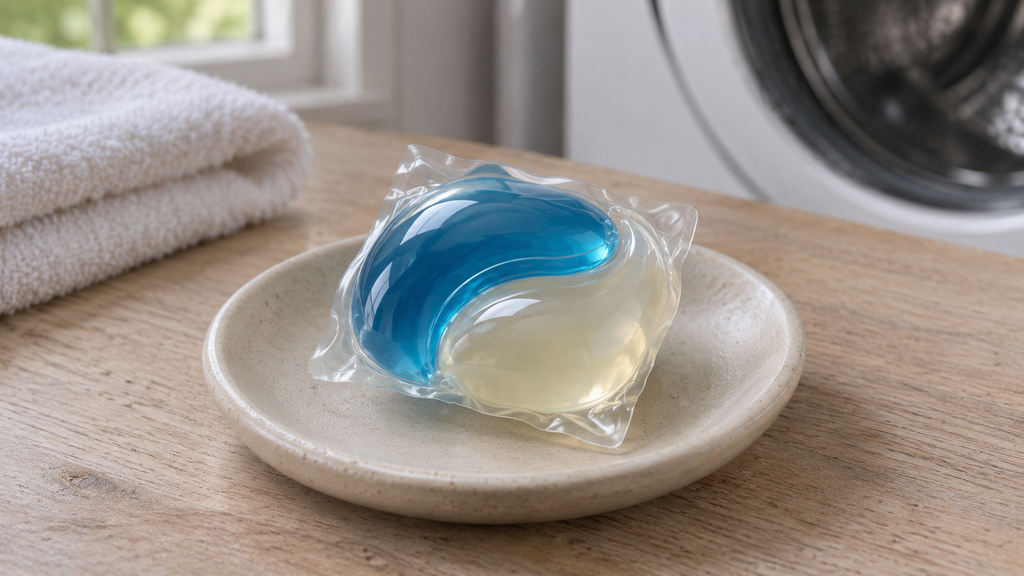
A laundry capsule's wrapper can disappear in the wash without its polymer instantly ceasing to exist. But that does not mean the dissolved material has become a cloud of solid microplastic particles. The water-soluble polyvinyl alcohol used in detergent films, often called PVA or PVOH, needs to be assessed as the particular polymer it is, rather than treated as interchangeable with shed polyester fibres.[2][3]
The useful question is what happens after dissolution. Can microorganisms break down that grade of polymer under the conditions it encounters? A laboratory treatment simulation supports substantial biodegradation of one specified PVOH grade. A much-cited earlier US emissions model reached a less reassuring conclusion, but the US Environmental Protection Agency subsequently challenged important assumptions behind it.[1][2][3]
For shoppers, our recommendation is to ask for evidence about the actual film and its biodegradation test. Neither a disappearing wrapper nor a dramatic national tonnage claim settles the choice between pods, powder and liquid.
Dissolving, fragmenting and biodegrading are different
PVA is a synthetic polymer. Its properties vary with features such as chain length and degree of hydrolysis, a measure of how extensively acetate groups have been converted to alcohol groups during manufacture. These differences affect water solubility and degradation behaviour. A result for one grade cannot automatically describe every material sold under the same abbreviation.[2][3]
Dissolution disperses a soluble polymer into water; it is not, by itself, proof that its carbon has been converted into carbon dioxide or incorporated into microbial biomass. Biodegradation involves biological breakdown. Mineralisation is a more specific endpoint, such as conversion of the polymer's carbon into carbon dioxide under aerobic conditions.[2]
That distinction also matters for the word "microplastics". Solid polymer particles and dissolved polymer chains are different forms of material. In its 2023 response to a PVA petition, EPA specifically distinguished research on microplastics from evidence relevant to the soluble PVA structures used in the products it was assessing.[3]
Calling a substance water-soluble does not establish that it is environmentally harmless. Equally, citing a study of solid plastic particles does not demonstrate the fate or effects of dissolved detergent film.[3] The environmental question remains worth asking, with a method that can actually answer it.
Where the claim that most PVA survives treatment came from
In 2021, Charles Rolsky and Varun Kelkar published a US assessment combining a consumer purchasing survey, measurements of selected emptied pod films, water-use information and a literature-based treatment model. They did not collect nationwide wastewater samples and measure detergent-film PVA entering and leaving those plants.[1]
Their model estimated how material would pass through a conventional treatment system, using assumed degradation and partitioning efficiencies. Its often-repeated estimate that roughly 77% remained intact included both the sludge route and treated water. It was not a measured percentage of every pod reaching a river, nor a national count of microplastic particles.[1]
EPA's subsequent review identified several problems with applying that model to the soluble PVA structures allowed in Safer Choice-certified products. These included degradation assumptions drawn from other PVA applications and blends, assumptions about the availability of degrading microorganisms, and substantial assumed transfer to sludge despite the relevant polymers' water-soluble properties.[3]
Those objections change how the headline should be used. The model raised a question about polymer fate; its national estimate should not be repeated as observed discharge. Nor should the model's findings be transferred to an individual household, a UAE treatment plant or a personal health outcome.[1][3]
The paper reports partial funding from Blueland.[1] That commercial connection belongs alongside the methods, rather than being used as a substitute for examining them.
What the later treatment experiment actually measured
Kathleen McDonough and colleagues published a different kind of evidence in 2024: an original laboratory experiment using a specified PVOH 18-88 material. The supplied grade was 88 mole percent hydrolysed, with a molecular weight of 130,000 daltons. This was a characterised polymer test, not a comparison of every finished laundry capsule on the market.[2]
The team ran a control and a dosed benchtop activated-sludge system for 80 days under an OECD 303A treatment-simulation protocol. They used wastewater and sludge from a plant receiving predominantly domestic wastewater. Water's hydraulic retention time in the reactors was six hours, while the average sludge retention time was 20 days.[2]
Those times describe different things. A treatment system can retain its microorganisms much longer than a parcel of water stays in the tank. Comparing an entire biodegradation test's duration with water's few hours of residence, without considering the retained microbial population, misses part of the process.[2][3]
The experiment initially showed little removal, followed by microbial adaptation and increasing removal. During a later 29-day plateau, the authors reported average removal of 97.4%, with substantial measurement variability. The endpoint was dissolved organic carbon in the dosed reactor's outgoing water relative to the control, not a count of plastic particles.[2]
The separate adsorption experiment found little binding of this grade to sludge under the tested conditions. Together with the time course, that supported the authors' interpretation that biodegradation, rather than simply trapping polymer on solids, drove the later removal.[2]
Still, 97.4% removal is not a direct measurement that 97.4% of every pod film became carbon dioxide during six hours. The treatment simulation measured dissolved organic carbon, and its removal calculation is different from directly measuring mineralisation. The authors also discussed separate carbon-dioxide evolution experiments, but those were different tests.[2]
The dosing concentration was deliberately elevated to make the added carbon measurable, and the reactors operated under controlled conditions. This is stronger evidence for the tested grade's treatment behaviour than a claim based on disappearance alone. It is not continuous monitoring of all operating plants or proof of the same performance in an untreated waterway.[2]
The authors list Procter & Gamble affiliations; the paper states that it received no outside funding.[2] As with the earlier study's sponsorship, readers should see the commercial context while judging the actual design and endpoints.
EPA's decision was narrower than a blanket safety verdict
In 2023, EPA denied a petition seeking additional testing of PVA under the Toxic Substances Control Act and a change to its status on the Safer Chemical Ingredients List. Its response explained why it considered the petition's evidence insufficient to justify the requested testing, and why the relevant PVA structures met the Safer Choice programme's criteria.[3]
Importantly, EPA explicitly said it was not deciding whether the information presented was sufficient to determine that PVA might present an unreasonable risk under that part of the petition. A denied petition is not certification of every capsule, every PVA grade or every wastewater system.[3]
The agency also explained that ready-biodegradability screening tests are not intended as miniature treatment plants. It rejected the assumption that their longer duration automatically makes them unsuitable for predicting treatment behaviour.[3] The right comparison considers the organisms, concentration, endpoint and treatment conditions, rather than only the number of days printed in a test report.
None of the model, treatment simulation or petition decision demonstrates a reduction in human disease from switching laundry format.[1][2][3]
A useful shopping checklist
These are suggested purchasing questions, not a ranking of brands or a quantified health intervention:
- Ask what film was tested. Request evidence for the grade or finished film actually used, including relevant additives, rather than a generic statement that "PVA is biodegradable". Polymer structure matters.[2][3]
- Ask which endpoint supports the claim. A dissolution demonstration, loss of dissolved organic carbon and carbon-dioxide evolution answer different questions. Check whether the evidence is a screening test, a treatment simulation or field sampling.[1][2][3]
- Keep the disposal setting attached. Evidence from an aerated biological treatment system is not a promise of rapid breakdown in seawater, soil or an untreated drain.[2][3]
- Choose a format for the question you want to address. If avoiding soluble pod film is your priority, consider a powder or liquid whose disclosed formulation does not contain it. That choice alone does not establish a lower overall environmental footprint: the evidence examined here is not a complete comparison of ingredients, packaging, transport and cleaning performance.
- Follow the product instructions. Keep capsules in their original closed packaging, away from children and pets. Do not cut one open or dissolve it in a kitchen glass to investigate an environmental claim.
For the broader label question, our guide to biodegradable and compostable plastics explains why the treatment environment belongs in the claim. For solid particles, wastewater microplastic removal and fate examines why capture in sludge is different from destruction. Neither article supplies a missing measurement of your local plant's PVA performance.
The takeaway: a dissolving laundry-pod film is not automatically a measured microplastic-particle release, and dissolution alone does not establish biodegradation. There is experimental support for substantial biodegradation of a specified soluble PVOH grade, while the prominent national persistence estimate is a disputed model. Ask for the product-specific evidence instead of accepting either slogan.[1][2][3]