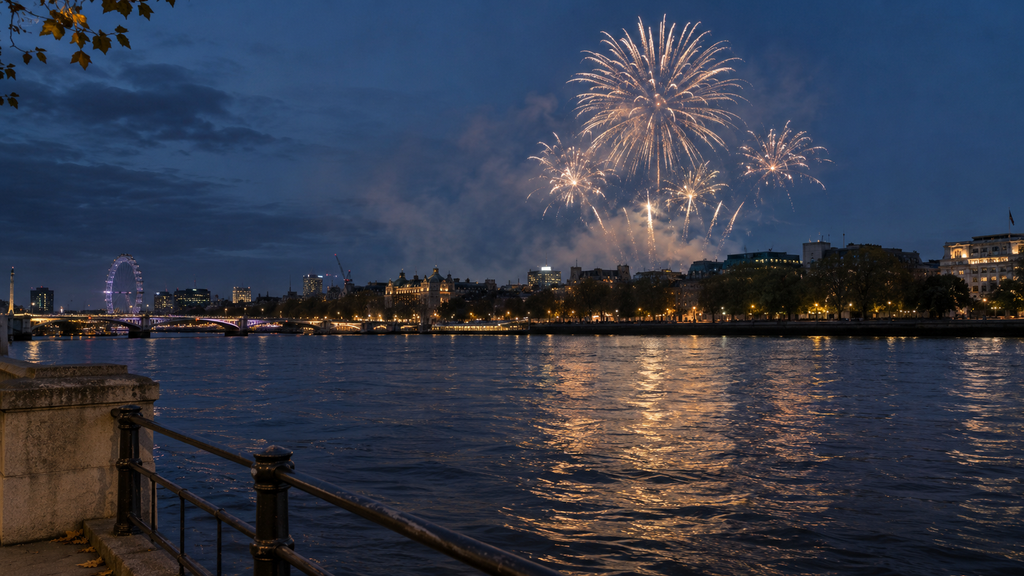
A riverside fireworks display can coincide with a sharp, short-lived rise in suspected microplastics in the water.[1] Researchers observed that pattern beside London's New Year celebrations, but their study could not identify the source of every particle or establish damage to wildlife.[1]
That distinction matters when planning an event near water. The findings support taking debris prevention and monitoring seriously. They do not supply a universal pollution figure for fireworks, a personal exposure estimate or a reason to assume the same result in a Dubai waterway.
Our recommendation is to ask who will prevent and recover event debris, while keeping claims about microscopic pollution tied to what was actually sampled.
Why fireworks are a microplastics question
Fireworks can contain plastic components and polymer binders, although their construction varies.[1] The Thames researchers describe possible pathways through falling debris, airborne deposition and runoff into nearby water.[1]
Those are plausible routes for plastic material to reach a river. They are not proof that all smoke or ash is microplastic, or that every fibre collected after a display came from a firework.
The river already contained suspected microplastics before the event.[1] The authors discuss sewage, road runoff and other urban activities as possible inputs, alongside the fireworks.[1] Their central question was whether the river samples changed around one particular celebration, not whether fireworks were the Thames's only plastic source.[1]
What the New Year study actually measured
Ria Devereux and colleagues sampled surface water at one riverside location near the London Eye around the 2019–2020 New Year display.[1] The detailed table records eight consecutive sampling dates, from 29 December to 5 January, plus a later visit on 23 January.[1] This is more precise than the abstract's description of nine consecutive days.[1]
At each visit, the team collected three one-litre bottles at high tide.[1] The clock time changed with the tide; the New Year's Day collection was almost six hours after the display.[1] Several bottles from the same place help describe that visit, but they do not turn it into a survey of several independent locations or fireworks events.
The researchers filtered the water, inspected the retained material under a microscope and recorded characteristics such as shape and colour.[1] They reported a pronounced peak in the first post-display collection, dominated by fibres, followed by a return towards the earlier range at the next day's visit.[1]
This was not continuous monitoring.[1] It cannot show exactly when the peak began, how high it reached between visits or where the material travelled afterwards. The authors acknowledge that the sampling could have missed the maximum abundance.[1]
Nor does a lower count at the next visit establish that the particles were destroyed. The study did not follow individual particles through the river.[1]
A fibre count is not complete chemical confirmation
Microscopy provided the main screening count.[1] The team then used Fourier-transform infrared spectroscopy, or FTIR, to examine a selected subset of 354 items.[1] This technique helps identify material through its infrared spectrum.[1]
For that chemical analysis, the investigators selected items longer than 200 micrometres because of handling and instrumental constraints.[1] The chemically examined subset therefore does not represent every smaller item in the visual count, and the experiment was not a measurement of nanoplastics.[1]
The FTIR results included synthetic polymers, natural material, anthropogenic fibres such as cotton or regenerated cellulose, and items that could not be identified.[1] It would be misleading to describe the entire microscope count as chemically confirmed synthetic plastic. A human-made cellulose fibre and a conventional synthetic polymer are not interchangeable categories.
The researchers also checked possible contamination from laboratory air, bottles and filtering procedures, and subtracted control counts.[1] They nevertheless acknowledged that some contamination could not be ruled out.[1] Controls improve the interpretation; they do not prove a particular fibre's origin.
Timing supports a hypothesis, not a unique source
The post-display peak is a useful observation. A stronger attribution would also need evidence separating firework material from other inputs arriving or moving through the same stretch of river.
This study had one sampling location and one event, without a simultaneous comparison location unaffected by the display.[1] Its methods did not match the collected particles against samples of the actual fireworks used.[1] Colour and a common polymer name cannot, by themselves, provide that missing match.
There was also a later rise at the January follow-up.[1] The authors considered preceding rainfall as a possible explanation, but noted that the absence of samples closer to those rain events made attribution difficult.[1] We should apply the same caution to both proposed causes rather than treating timing as decisive only when it fits the fireworks story.
The appropriate conclusion is that the event was associated with a brief increase in the sampled material and fireworks are a plausible contributor.[1] The fraction uniquely caused by the display remains unresolved.
Why another Thames study is context, not replication
An independent team led by Katharine Rowley sampled the tidal Thames at Putney and Greenwich between June and October 2017.[5] That original field study examined water from different tides and depths, and found that location and timing affected the reported abundance.[5]
It was not a fireworks experiment.[5] It helps explain why background conditions and sampling design matter, rather than independently confirming the New Year result.
The methods also differed substantially. Rowley's team used a net-based collection and subsequent laboratory separation, and excluded microfibres from its quantities because of contamination concerns.[5] Devereux's event study relied heavily on visually counted fibres.[1] Comparing their headline concentrations as though they measured the same fraction would create a misleading contrast.
For another urban input, our guide to tyre wear in road runoff explains why identifying material and tracing its drainage route are separate tasks.
What this means for an event beside water
Our practical advice is to focus on avoidable releases and a credible cleanup plan, rather than demand an unsupported promise of a microplastic-free display.
- Ask for a named debris plan. Who is responsible for the launch area, shoreline, floating debris and subsequent inspections? Seattle's official event guidance provides one concrete example: it requires organisers of displays near waterways to plan debris recovery, secure equipment and document cleanup.[3] Those are Seattle requirements, not a statement of UAE law.
- Leave pyrotechnic waste to the responsible professionals. Do not collect unidentified firework remains, handle suspected unexploded devices or enter a restricted launch area. Seattle's guidance separates hazardous fireworks waste from ordinary solid waste and requires appropriate handling.[3] Follow the organiser's and local authority's instructions.
- Keep visitor litter contained. Take ordinary packaging and decorations to the appropriate collection point. Do not sweep event waste into drains or the water. Clark County's official advice specifically warns against putting fireworks debris or soaking water down storm drains.[4] Its local disposal procedure should not be copied elsewhere without checking local instructions.
- Ask what environmental monitoring can establish. A useful proposal should explain comparison locations, collection times, tide and weather records, contamination controls and chemical identification. These are our suggested questions for a stronger investigation, not a claim that a particular monitoring package is legally required.
A cleanup log can show what a team recovered. It cannot, on its own, certify that microscopic particles were absent or all removed. Our beach microplastic sampling guide explains the related distinction between collecting litter and making a repeatable environmental measurement.
The New Year study did not measure a person's absorbed dose, test an intervention for health benefits or measure ecological injury from the observed peak.[1] Its findings deserve attention without borrowing those stronger conclusions. For an event organiser, a clear debris-prevention and recovery plan is a useful action even while the precise microscopic contribution remains uncertain.
Sources
- https://oars.uos.ac.uk/2430/1/Microplastic%20abundance%20in%20the%20river%20Thames%20devereux%20et%20al%202022.pdf
- https://seattle.gov/special-events/public-safety/fire-safety
- https://clark.wa.gov/public-works/updated-prevent-fires-injury-and-water-pollution-proper-fireworks-disposal
- https://pure.royalholloway.ac.uk/ws/portalfiles/portal/38217604/Rowley_et_al._accepted_MS.pdf