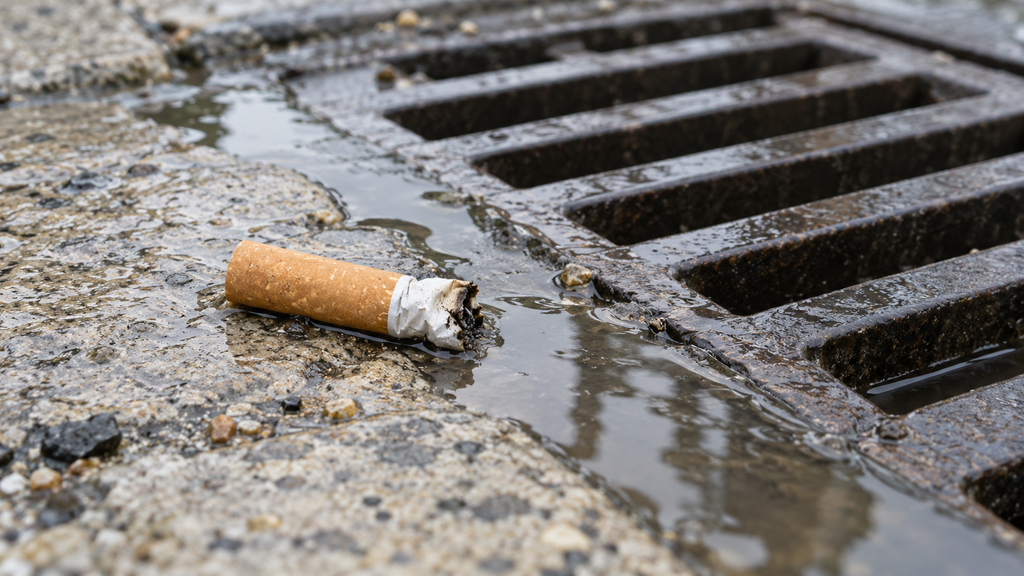
A cigarette butt can look like a scrap of paper, but its filter is usually made from cellulose acetate, a plastic produced by chemically modifying cellulose.[2] When a discarded filter enters water, fibres can detach from it, adding small plastic fibres to the water even while most of the filter remains intact.[1][2] That is the microplastics connection: the visible piece of litter can become a source of much smaller material.
The useful response is to prevent the butt reaching a drain, beach or water body. Fully extinguish cigarettes before disposal and use an appropriate cigarette bin or portable ashtray when needed.[3] The research supports taking this waste seriously; it does not give a personal disease-risk estimate for walking past a butt or swimming near a littered beach.[1][2]
Why cellulose acetate is not just paper
Cellulose acetate starts with cellulose, but chemical processing changes the material into the polymer used in conventional cigarette filters.[2] Its plant-derived starting material does not make a discarded filter equivalent to an untreated paper scrap, nor guarantee rapid biodegradation outdoors.[2] A cigarette butt also includes other components, such as wrapping paper and remaining tobacco, so the whole item and the filter fibres are not interchangeable measurements.[2]
For the broader distinction between a material's origin and its disposal behaviour, see our guide to biodegradable and compostable plastic labels. For filters, the question is concrete: can fibres separate from the material in water, and what did the experiments actually identify?
What an immersion experiment found
In a 2025 Scientific Reports study, Azam Mohammadi and colleagues examined filters from two cigarette brands bought in Bushehr, Iran.[1] They compared distilled water with filtered seawater from the Persian Gulf, under laboratory conditions without sun exposure and outdoor conditions with sun exposure, over periods from one to 60 days.[1] These were prepared filter samples in experimental vessels, not a survey of every butt floating in coastal water.[1]
The team counted suspected fibres under an optical microscope and used micro-Raman spectroscopy to examine the polymer identity of a subset.[1] Cellulose acetate was the predominant polymer reported.[1] Importantly, only 30 suspected particles underwent Raman analysis; 26 were identified as polymers, while four were not recognised as polymers.[1] The visually counted total should therefore not be described as a chemical identification of every fibre.[1]
The researchers also used contamination controls and subtracted fibres found in blanks from the experimental counts.[1] Those checks matter because a fibre introduced during handling can otherwise be mistaken for one released by the filter. The authors identify a further boundary: their visual method covered fibres larger than 20 micrometres and could not characterise the smaller material comprehensively.[1] This was not a nanoplastics measurement.[1]
Seawater samples had higher fibre-release levels than distilled-water samples in this experiment.[1] Although the highest observed levels occurred outdoors in seawater at the longest exposure, the overall comparison between indoor and outdoor conditions was not statistically significant.[1] It would overstate the result to claim that sunlight consistently increased release under every tested condition.
A second experiment tested water movement
Ghazal Vasseghi and John Atkinson asked a related question in an original study in the Journal of Hazardous Materials: Plastics: how does agitation affect fibre shedding?[2] They used unsmoked filters from one cigarette brand, removed the surrounding wrapping papers after wetting, and placed the filters in purified water for controlled experiments lasting ten days.[2] The three settings were still water and two orbital-shaker speeds.[2] These preparations made the experiment easier to control and count; they were not intact, smoked street litter under every possible weather condition.[2]
The experiment found an early release of loose fibres, followed by slower shedding, and greater release under the highest agitation setting.[2] A separate one-day control compared filters with and without wrapping paper and reported comparable release under that particular test.[2] That check is useful, but it does not establish that removing the paper never matters over longer periods or in other environments.
Fibre counts in this study relied on optical microscopy and the material's recognisable structure, rather than spectroscopic confirmation of every counted item.[2] The researchers transferred each filter into fresh water daily, collecting the fibres released during that day's exposure.[2] Consequently, the design did not follow how already-detached fibres might break into additional pieces over subsequent days.[2] Shedding from the filter and later fragmentation of released material are separate processes.
Why there is no universal count per discarded cigarette
These studies support the same broad pathway, but their counts answer different experimental questions.[1][2] They differ in filter preparation, number of brands, water type, movement, exposure duration and identification method.[1][2] A result expressed per gram of filter material is also different from one expressed per filter.[1][2] Quoting one number as the amount every discarded cigarette releases would erase those boundaries.
Both papers go beyond their experiments to estimate wider environmental releases.[1][2] The first scales results using a global estimate of discarded filter mass; the second models New York State using smoking, littering, aquatic-entry and laboratory-release assumptions.[1][2] Those are extrapolations, not direct counts of all fibres entering the world's oceans or New York's waters.[1][2] Neither is a measured UAE pollution inventory.
The 2025 paper also calculates pollution and ecological-risk indices using reference values and model assumptions.[1] These are not observations of illness in people, and the fibre-release experiments do not establish an individual human dose or a clinical benefit from a particular disposal change.[1][2] Keeping that distinction does not weaken the case for preventing litter. It keeps the reason accurate.
Practical disposal without creating another problem
Our recommendation is to deal with the intact waste before it has the opportunity to disperse:
- Fully extinguish the cigarette before putting it in an appropriate bin. Thurrock Council's disposal guidance explicitly makes this fire-safety point.[3]
- If an appropriate bin is unavailable, use a purpose-made portable ashtray or butt pouch and retain the extinguished waste until suitable disposal is available.[3]
- Keep butts out of drains and water. Do not sweep pavement litter into a grille or rinse an ashtray's contents into a sink. These are source-prevention recommendations, not a claim that every drain has the same destination.
- For a workplace or building, identify where cigarette waste actually accumulates, then arrange suitable collection and routine cleaning. Vasseghi and Atkinson discuss disposal infrastructure and litter interception as possible interventions, rather than demonstrating a universal capture percentage.[2]
The council source is UK guidance, not a statement of UAE fines or local bin rules. Follow your actual waste operator's instructions, and do not assume that a product called biodegradable can safely be littered.
If you organise a beach cleanup, record recognisable butts separately from laboratory particle measurements. Our beach microplastic sampling guide explains why counting removed litter and measuring microplastics in sediment need different methods.
A discarded filter does not have to vanish before it becomes a fibre source.[1][2] Keeping it out of water is a practical waste-management decision supported by the release pathway, without pretending that a laboratory count is everyone's exposure.